0
0
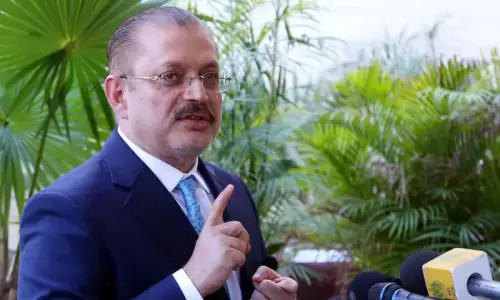
KARACHI, Aug 28: Minister for Commerce Humayun Akhtar Khan on Thursday assured that there would be no major change in tariff on industrial goods except for automobile where the peak tariff rates would be gradually reduced with the start of new round of WTO from 2005.
Addressing press conference in the Export Promotion Bureau’s (EPB) offices about the position being taken by Pakistan in the forthcoming WTO ministerial meeting being held in Cancun, Mexico the minister said primarily there would be a single point agenda from Pakistan regarding free movement of labour across countries.
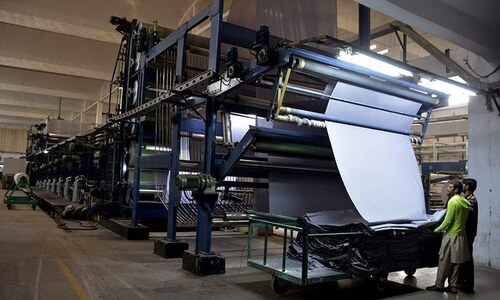
With regard to tariff reduction, the minister pointed out that developed countries were required to bring down their industrial tariffs first but the developing countries would be given some time. Therefore, he stressed there should be no fear whatsoever for the industry.
He further said that the WTO did not lay any condition on tariffs, therefore, once the country came out of the IMF conditionalities the present low tariffs could be fixed higher. Humayun Akhtar said that against the bounded tariffs of up to 95 per cent the applied tariffs are very low at 25 per cent which was only to meet the IMF restrictions.
Humayun Akhtar Khan said that when 146 trade ministers of developed and developing countries will meet at Cancun, Pakistan would seek concession for movement of natural people (natives). “We have already sought some concessions on movement of natural people from the European Union (EU).”
However, the minister said that Pakistan along with other developing countries would vigorously take up issues related to agriculture sector with trade ministers of developed countries. He said presently the developed countries of the West were giving huge subsidies to their farm produces and were also protecting them by fixing high tariffs.
He said this issue of agriculture subsidy and high tariff protection was badly damaging the economies of the under developed and developing countries, including Pakistan as they could not market their farm products in the world market.
The minister said if Pakistan produced surplus agriculture goods it could not compete in the world market because of high cost. Even if we take the inefficiency of growers the huge subsidy given by the West could not allow Pakistan to compete.
Humayun Akhtar Khan disclosed that presently $1 billion a day was being spent by the G-8 countries on farm subsidy which was badly distorting the world market where developing countries could not compete.
Under the negotiations held at Doha Development Round in 2001, the WTO member states would review the progress made in service sector, agriculture, non-agriculture and WTO’s Dispute Settlement Mechanism, he added. Pakistan would seek improvement in such areas like anti-dumping and countervailing duties, the minister maintained.
Another area which Pakistan gives importance and would like to take up in the forthcoming WTO meeting, he said, was the fear of non-tariff barriers. He said that compliance issues such as environment, social and labour, which were not WTO issues but were likely to be widely used by the developed countries to stop flow of goods from developing countries would be taken up bilaterally.
Though there would be no new negotiations at the Cancun ministerial meeting being held on September 10, 2003, but it would review Doha meeting progress, and if, the minister said, no progress was noted, it might even end up in a jeopardy.
Presently, he said, seven negotiating areas connected with WTO were being handled by various committees established in the Ministry of Commerce and in order to create awareness a separate body would be set up in the Export Promotion Bureau (EPB). Printed material and other information would be made available at this forum.
Responding to a question, he said that these committees were also interacting with stakeholders in order to fully protect the interest of the industry and trade. The minister assured that all care would be taken to protect the interest of the country.