



 0
0

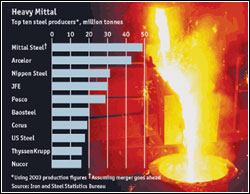 THE way the Americans reacted to the Chinese bid for Unocal’s take-over last year is just how the Europeans are now behaving in the case of Mittal’s attempt to buy Arcelor. The attitudes remain the same: contempt for Third World’s economic advances.
At the heart of this opposition is thinly disguised racism. Europe is finding it difficult to digest the hard fact that some of its former colonies are growing fast enough economically to be able to compete with it, are demanding to be treated at par and want to interact like equals. The colonial ethos, nurtured over the centuries, will take time, if at all, to fade away but till then will remain more powerful than the professed values of free market economy, freedom of trade and investment, fair competition and globalization which it feels proud to claim it practises and which makes it different from the rest of the world.
Hence, Indian commerce minister Kamal Nath was not wrong when he accused the Europeans of being racist in their attempts to block Lakshmi Narayan Mittal’s takeover bid for Arcelor. EU was, however, quick to reject the accusation.
It was on January 27 that Mittal Steel, the world’s biggest steel maker, announced a hostile takeover bid for Luxembourg- based Arcelor, also one of the largest steel companies. Two days later, Arcelor’s board rejected Mittal’s offer in a derisive manner — its CEO calling Mittal’s steel “eau de cologne” and his own steel as “perfume”.
However, it is the governments of France, Luxembourg and Spain which are up in arms, together with the labour unions whose main worry being loss of jobs.
The takeover, if it goes through, will create a new behemoth with a near-10 per cent share of global steel production and a market capitalization close to $40 billion. The new company would have almost 350,000 employees at 61 plants in 27 countries.
Mittal Steel is currently the biggest US supplier of high-grade, high-margin auto steel. Arcelor occupies the same position in Europe.
Mittal Steel — a great success story making the Indians proud of it — employs 150,000 people on four continents — 70,000 alone in France, Germany, Poland, Ukraine, Romania, Macedonia, Bosnia and the Czech Republic. Its owner, Lakshmi Narayan Mittal, the third richest man in the world, has emerged as a symbol of the new India. And he is not the last of his kind.
Indian companies like Tata, Reliance and Indian Oil are waiting to follow in his footsteps.
Mittal lives in London and the headquarters of his company are in Rotterdam. In that sense, he is no less a European than other Europeans. Yet, Thierry Breton, France’s finance minister, fears “a clash of civilizations” if Mittal were to emerge victorious.
In response, Kamal Nath says: “This is an era of globalization, cross-border investment and liberalization, not one in which investors are judged by the colour of their skin.”
Arcelor’s chief, Guy Dolle, refers to Mittal Steel as a “company of Indians” and its shares as “monkey money.”
The fact remains that the steel industry is a very sensitive issue for Europe. At the end of the 18th century, steel laid the foundation of Europe’s industrial revolution and its world dominance for more than 100 years. In the aftermath of the Second World War, it was the project of combining the steel production capacity of six countries that helped Europe heal its wounds and eventually give birth to today’s European Union.
What makes Europe jittery over Mittal’s bid is that it hurts its history. Arcelor came into existence in 2000 from the merger of the leading steel companies from France, Spain and Luxembourg and, as such, carries the legacy of this rich and proud European history.
The French reaction to the takeover bid provides an insight into the fundamental changes that globalization has brought about and tend to make its glorious history irrelevant. France cannot digest the reality that past achievements are not ever-lasting and can also become liabilities under new rules set by globalization. So, it would prefer to reject these new rules.
It is now secretly working on a plan for Arcelor to buy a French mining and metal group called Etamor.
Luxembourg is thinking of rushing through a bill, actually a modified version of an EU takeover directive, that a company board under hostile pressure can take action on its own without having to ask the shareholders – who, in this case, are leaning towards Mittal.
The European Commission has tried to make things clear by saying that it will not go against the takeover bid by reviving “outdated protectionism”. Europe, its spokesman says, now had a “modern industrial strategy” and that it would be inappropriate to revive protectionist or state-aid polices of the past.
“We don’t want to go back to the 20th century, to the 1970s when people believed that European industry could be made more competitive through protectionism, through subsidies to industry,” he said.
Some promoters of free market economy are just perplexed over Mittal Steel phenomenon and think globalization may have gone too far and too fast. For, it is no more bringing the kind of gains that were always expected. The finance community fears the system may have become so volatile that the game may end up with more losers than winners. But Europe will have to get used to such a phenomenon.
Takeovers by Indian and Chinese firms are going to become as common as American ones. The problem is that a profound parochialism grips the European continent at the moment. When Europe called the global tune, it was considered a global trend for it was a global power.
But it is now moving into a world where the West will no longer be able to call the tune as it once did. Now the countries which Europe occupied, humiliated and crushed for centuries and whose people have different skin colour are fast emerging, challenging and competing with it. Unfortunately, few in Europe understand and recognize these trends.

























