



 0
0

Of media hype and media heist
THE Times of India, in what looks like a display of dwindling ethics, censored an important quote from its interview with President Bush last week. Had the White House not put out its own official text of the conversation we may have never known that President Bush actually made any observation on a role for ‘citizens of Kashmir’ in the raging dispute between India and Pakistan.
The world sees the standoff as a potential flashpoint between the nuclear neighbours, and President Bush, who was directly engaged in averting a war between them through much of 2002, had a sound and valid reason to indicate his preferred solution to the issue.
In his brief opening remarks which he made jointly to the Times of India and Dainik Bhaskar at the White House on Wednesday, he made the following ill-fated observations:
“I do want to make something clear in the speech I gave today (to Asia Society). I said that — as to the Kashmir interest — issue, America supports a solution that is acceptable to all sides. As you might recall in my remarks, I said, ‘to both sides’. I would like the record to be so that the world hears me say, ‘all sides’. I fully understand that the deal has to be acceptable to the Indians, Paks (sic), as well as the citizens of Kashmir. Okay?”
The reporter’s answer was yes. But then the entire paragraph disappeared without trace from the story, the summary and the text of the interview published on Friday. In fact had President Bush not volunteered his comments on Kashmir at the start of his meeting with the Indian journalists and on Pakistan in the course of the interview, there is nothing to indicate that a presidential response was going to be sought on any of these burning issues.
This raises a few questions. Was it an act of ill-conceived patriotism that the quotes were deleted, since they were perceived to be an embarrassment to the Indian establishment? Who recommended the Times of India for the interview and was their a quid pro quo involved either with the US embassy in Delhi or at the prime minister’s office, which has been dealing exclusively with the presidential visit?
Also was it planned beforehand that a question on Kashmir or Pakistan would not be raised, because it would imbue the visit with a hyphenated India-Pakistan context? The only question asked on this issue came as a kind of request to Mr Bush to quiz Dr A. Q. Khan on his nuclear wheeling-dealing. And when the comments on Kashmir did come as a bolt from the blue, who decided to delete them?
The Indian establishment works in curious ways and the media is often a willing and handy conduit. This is true of much of the subcontinent barring a very few exceptions. Therefore, it is significant that while the protagonist in the matter did not even publish the remarks on Kashmir, two major Indian dailies chose to hold forth on the ‘unpublished’ comments of President Bush.
The Indian Express claimed the comments should not harm the mature relations between India and the United States. The Telegraph of Calcutta ascribed them to typical ‘Bushism’, the kind that would keep both governments on tenterhooks during the four days the president spends in India.
Bush’s ‘penchant for malapropisms and for putting his foot in his mouth will keep Prime Minister Manmohan Singh and senior members of his cabinet on tenterhooks during the 60 hours or so that Bush will spend on Indian soil next week’, warned The Telegraph on Saturday.
“That nervousness is something the Indian leadership will share with the US President’s aides, if the last three days of preparations here for the Bush trip are any indication,” The Telegraph wrote.
The Indian Express, positioning itself as clued in on American thinking, went a step further and advised President Bush not to open his mouth on Kashmir lest he create a controversy.
Since the president’s comments to The Times were meant to be a correction to his statement made earlier to the Asia Society, a fact he himself admitted, the Express advised him to not speak on the subject if possible.
“For Bush, the lessons from the Kashmir goof-up are quite simple. One (such) is to say as little as possible on Kashmir. The more the president says on Kashmir, the greater will be the number of political errors,” it argued.
So that is what Bush should do. He should keep quiet on Kashmir. What about the Indians, what should they do with the terror of Bushism hanging over their heads? Well, Indians should cultivate a sense of humour, the Express advised.
“Although the strategic essence of Bush’s visit is about taking India out of the South Asian box and engaging it in global terms, for the literalists in India and Pakistan every word from the president on Kashmir and nuclear energy would matter,” the Express said indulgently. “In humour-less South Asia, there is no room for a turn of the phrase.”
The advice did not stop there: “Speeches from the heads of state are important. Those who treat every word in these speeches as sacrosanct, however, are condemned to miss the trees for the wood.
“As Bush prepares to visit the subcontinent, the Pakistanis will raise the rhetorical demand for American mediation on Kashmir. And New Delhi would worry about potential tactless remarks on Kashmir during the Bush visit.”
If he follows the Indian Express prescription, President Bush should ‘learn by rote one sentence on Kashmir that offends no one’ in South Asia. The last is to ‘keep repeating that one sentence in both India and Pakistan’. So what’s the lesson? Keep whistling in the dark.
South Asian journalists would not readily admit to it, but there is an ‘accent’ problem in dealing with Americans and both often find it difficult to follow each other. This exchange between President Bush and the Indian reporters shows how:
Q: Between a cricket match and a Bollywood movie, what would a —
The president: Cricket match and a —
Q: You like watching?
The president: What was the second?
Q: It’s between a Bollywood movie and a cricket match.
The president: I’m a cricket match person. (Laughter) I appreciate it. As I understand it, I may have a little chance to learn something about cricket. It’s a great pastime. (Laughter)
Q: Mr President, what is your earliest memory of India?
White House spokesman: We have got to go to the next one.
Q: What is your earliest memory of India and Indians?
The president: My best memory?
Q: Earliest.
The president: At least memory?
White House spokesman: Earliest.
The president: Earliest. (Laughter)
Q: Earliest.
jawednaqvi@gmail.com
A week of chaos — and some cheer
 IT WAS a truly chaotic week in the city. The anti-cartoon and religious rallies disrupted traffic. Karachi now seems hardly ever to have a day when there isn’t traffic confusion in one area or another. The closing of Chundrigar Road to buses will continue to cause problems till the roadwork is completed.
Last Thursday was really extraordinary. As vehicles burnt fuel and emitted fumes, irritated commuters sweated and swore. Traffic police did what they usually do: add to the mayhem with their incompetence and lethargy. The rest was done by the drivers, who are always in short supply on patience. Wherever they see a gap, they try to sneak in and in the process they further impede the flow of traffic.
Thursday’s situation should be blamed foremost on the administration that permitted three processions to be taken out almost at the same time. Police blocked certain roads to allow passage to the processions by the Pakistan People’s Party, the Jamiat Ulema-i-Islam and the Imamia Students Organization.
But it wasn’t all so bleak. There were cheerful things happening also. The Thar Express steamed off on Feb 17 with 168 passengers from Karachi’s Cantonment railway station and crossed into India from the Sindh side for the first time in 41 years. Decorated with buntings and banners, the train was seen off by provincial luminaries as well as leaders of the MQM and some other political parties.
The occasion was so festive that even the driver of the express became a celebrity, giving interviews to newspapers and TV channels. He said he was proud to have driven the first train across the border after so many years. He was also in the driving cabin when the last train had come back from India before the snapping of the rail link in the 1965 war.
The enthusiasm greeting the reopening eclipsed the controversy created in certain quarters as to whether the route should be opened in view of the fear of more immigrants coming into Sindh. The fear may not be entirely unfounded, but illegal immigrants have been streaming into the province anyway, many from as far away as Bangladesh. The Sindh chief minister pointed out that travellers from India would be coming in with passports and all formalities would have to be followed. It wouldn’t be a free-for-all access. He also said that most of his constituents in Tharparkar had relatives across the border and they had been demanding opening of this route for a long time.
After the reopening came the cricket festival. India’s five-week tour culminated in Karachi on Feb 20 and while there were long faces among Pakistani fans, there was general acknowledgment of the fact that the matches in Karachi had gone off well and people had a rollicking good time, letting their hair down and watching good cricket. Well-known Indian artist M.F. Hussain was among the enthusiasts at the National Stadium and was caught capturing on canvas the stadium and memorable moments of the last one-dayer. Sitting on the boundary line with his painting paraphernalia, the artist said he not only loved cricket but also wanted it to be used as a means of promoting peace between India and Pakistan.
“Looking at the way people are involved in the game, it is a soul-searching and moving experience for me. I see cricket as a unifying force between the people,” said the 91-year-old artist, also known for his fondness for Indian star Madhuri Dixit.
Another Indian actor, Vidya Balan, came to attend a book launch. She has appeared in only one Hindi film, Parineeta (opposite Saif Ali Khan, scion of a cricketing family) but is already being likened by critics to Shabana Azmi. And Shabana Azmi herself was in town last week for the staging of Tumhari Amrita.
Directed by Feroz Khan, the play was launched in India in 1992, with Shabana Azmi and Farooque Sheikh as the only two characters, and adapted for theatre by Javed Siddiqui. The play’s performances in Karachi were arranged as part of a fund-raising effort for the October 8 earthquake survivors.
Shabana and her husband Javed Akhtar have been in the vanguard of the campaign to promote friendly relations between the two countries. Javed Akhtar is due to come to the city some time in March.
Pedestrian bridges
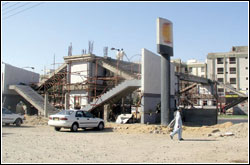 The Defence Housing Authority is building four overhead pedestrian bridges on the span of Korangi Road passing through the DHA. The elaborate structures with pairs of two flights of steps on each side and decorated with glazed tiles will cost millions of rupees. If pedestrians do use these points for crossing, it will be a worthwhile investment as it may help save many lives and limbs. But will they?
Unfortunately, such experiments have nowhere produced the desired results. Most people are too impatient and too out of shape to go and climb up and down stairs. In the mid-70s, iron structures with wooden planks as steps were built at many places in the city. When people ignored the bridges, iron fences were erected on the medians to stop movement across the roads. People having to cross a road frequently cut passages into the fencing. Many of the bridge structures have gone to rust and developed gaping holes and are no longer safely usable.
Alternatives should be discussed to overhead bridges. And in the meantime, pedestrians continue to face problems at the approaches to the Clifton underpass. They stand perched on the dividing berms and wait for a pause in traffic, when they dash across risking life and limbs.
The portion from Teen Talwar to the underpass remains in darkness at night, increasing the risk of accidents involving pedestrians.
When will they get it right? Even the grilles keep on giving trouble — and please don’t ask about the chaos overhead at Schon Circle.
— Karachian
email: karachi_notebook@hotmail.com
A vision of change for Karachi
INITIATED by the former nazim, the process of a change in approach and commitment towards Karachi’s infrastructure development and physical improvement seems to have acquired a positive dynamic of its own. Rather than rejecting the work done by his predecessor, as is the common practice in Pakistan, the present nazim seems to be willing to build on it and take the process of change forward.
But based on the experience of the previous nazim, his successor should remember that good intentions are not good enough, that, unlike his predecessor, he should carry out his vision of change on a strong foundation of professional advice and support. If he wishes to turn Karachi around, then he must start to think outside the box.
There are obviously a large number of areas which require his attention. Ground-breaking and successful work has been done over the years in some of these areas. This work has produced encouraging and instructive results by way of good administration and good governance, but because of the weak political will of the past governments, these interventions have not been consolidated as part of the city’s administrative culture. A few points may be considered:
TRAFFIC: Through a standing order issued by the then IG Sindh a traffic management programme (TMP) was initiated in February 1997. A pilot project was launched from Karachi airport to Hotel Metropole. The objectives of the TMP as stated in the standing order were to bring about traffic discipline on the roads; to train and improve the capability of the traffic police; lay down standards with regard to traffic discipline and prosecution of offenders; and establish the fact that good traffic management is not dependent on large sums of money, but on empowering the police.
The traffic management carried out under the supervision of the TMP allowed traffic police to carry out their duties with full zeal and commitment. No exceptions were made in terms of prosecuting offenders. The support and reassurance given to the traffic police, that they would not be victimized for challaning influential people gave them the authority and the confidence to enforce the writ of the government and carry out their duties without fear or favour.
The approach of the TMP was very different from non-serious practices such as ‘traffic weeks’, ‘awareness campaigns’, ‘spot-checking’, etc. In terms of traffic discipline it brought about at the airport and on Sharea Faisal, it had its impact felt on other roads of Karachi as well. It also generated substantial sums of money for the provincial exchequer and gave respect and authority to traffic police officers. Unfortunately, in October 1999 it was abruptly halted.
Even though the traffic programme was put on the back burner, in March 2000 the then governor of Sindh, Azim Daudpota, was able to persuade the president to sign the Provincial Motor Vehicles (Sindh Amendment) Ordinance 2000, which enabled a new ticketing system to be introduced. Since the promulgation of this ordinance, traffic violators now do not have to go to over-crowded city courts and instead can conveniently pay the fine into any branch of the National Bank.
The traffic of Karachi could be improved significantly and visibly within a matter of months if it is properly managed. In the last three to five years the traffic mess has gone from bad to worse. In a small measure it is because of the phenomenal increase of motor vehicles on Karachi roads, but largely it is because of the apathy of the traffic police and a management culture that is antithetical to modern management. Therefore, it may be useful if the nazim could invite members of the TMP for a presentation on how they had run a successful programme in 1997-99 and what would it take to manage city traffic on a sound footing again.
GOVT SCHOOLS: Despite huge amounts of government and donor money spent on education in the past 30 years or so, there has been very little significant improvement in public sector schools. There has been much rhetoric and many well-intentioned and high-budgeted initiatives for improving the quality of education, and yet the government schools have continued to fair poorly. Regardless of social status and economic ability, parents from all walks of life have endeavoured to provide their children with good education. Hence the mushrooming of low and medium-fee private schools in large cities, in small towns, and even in some katchi abadis across Pakistan.
Over the last 10 years or so, in Karachi the proportion of private schools has risen to over 55 per cent. In Orangi, there are 700 private schools, while there are only 80 or so government schools, which is an unhealthy trend. The government has a responsibility to provide good quality education to all people and it can do so that if the department of education changed its way of policy making and administering government schools.
Last year (August, 2005) a specific proposal was made to the present education minister for the establishment of a Sindh Committee for Educational Reform (SCER). The minister agreed to a few of the recommendations made by the SCER, and agreed (a) to change the academic year in public sector schools to start from August, instead of April, and (b) to do away with final examinations up to Class III. Inter alia, the SCER has also made suggestions to streamline administrative procedures and outlined simple steps to improve the quality of textbooks and of teaching methods.
In 1995, the education department had transferred the management of a government girls’ school in Clifton and (in 1999) of two schools in Mirpur Sakro (Thatta) to a non-governmental research organization. The nazim should look into how these government schools under the management of the NGO have been improved, and whether a similar approach can be employed to improve public sector schools.
There is funding available from the European Union, the World Bank, and other creditor and donor agencies, in case the city government feels that funding may be a problem. What is needed is a vision of change and a commitment to improving the quality of education provided to the children attending government schools on a war footing.
SANITATION: Sanitation and solid waste management is a major function of the city government. And it is one of the key problems of Karachi. The roads and neighbourhoods, even of the affluent neighbourhoods, have not been spared the menace of overflowing sewerage and garbage dumps.
In 1979, the Orangi Pilot Project (OPP) was initiated by the world-renowned social scientist, Dr Akhter Hameed Khan. The OPP addressed problems in several sectors, but the more important ones were low-cost sanitation, improving housing material and, later, micro-credit. Their low-cost, self-help sanitation programme has been so affordable and successful that virtually all of the Orangi houses and lanes now have underground sewerage connected to the main nullahs. In addition to Orangi, the OPP model has been successfully used in 14 towns and 41 katchi abadis of Karachi, as well as in 12 different cities and towns of Pakistan.
When he was the mayor of Karachi in 1992, Dr Farooq Sattar had been helpful in supporting the Orangi project. He is familiar with it and knows that this model can save the cash-strapped city government billions of rupees. The city government relies on the advice and technical assistance of the OPP for many of its projects. It would be extremely useful for the nazim to look at the OPP methodology and how it can assist the city government by way of providing low-cost sanitation on a more comprehensive basis.
MUNICIPAL SERVICES: In January 1999, the Sindh government had notified a task force on municipal services consisting of senior officials of the government, several professionals and relevant stakeholders. It deliberated on the following nine sectors — advertisement and signage byelaws; traffic management project; solid waste management; graveyards; improvement of libraries, parks, playgrounds; the Sindh Disposal of Urban Land Ordinance; establishment of bus terminals; public toilets; and sewerage, drainage and Treatment Plants;
A report of the findings of the task force and its carefully deliberated recommendation has been published. It would be useful if the nazim could look at this document, and perhaps, as a first step, he may be able to implement some of its recommendations. At the same time, he should consider the issues of the various sectors which have been identified by the task force, and initiate dialogue with the various government departments to solicit their comments and input for implementation in other sectors.


























