0
0

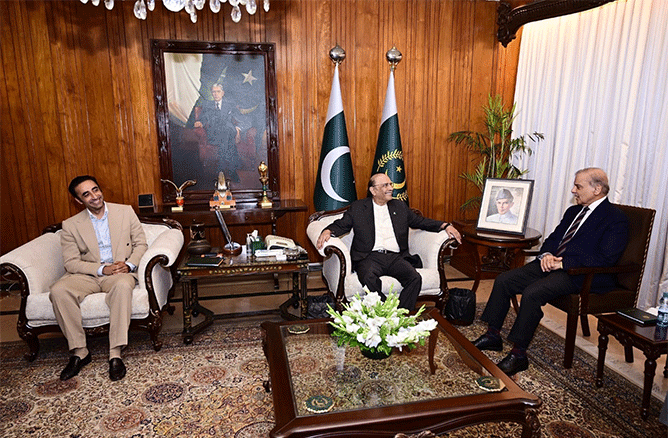
ISLAMABAD, March 4: Pakistan and United States on Saturday affirmed the long-term strategic partnership between the two countries. A joint statement issued following the talks between US President George W. Bush and President Pervez Musharraf held at Aiwan-i-Sadar here highlighted the US acknowledgement of United States for its aspirations for closer bilateral ties with Pakistan.
Following is the text of the joint statement:
“President Bush and President Musharraf have affirmed the long-term, strategic partnership between their two countries. In 2004, the United States acknowledged its aspirations for closer bilateral ties with Pakistan by designating Pakistan as a major Non-Nato ally. The US-Pakistan strategic partnership is based on the shared interests of the United States and Pakistan in building stable and sustainable democracy and in promoting peace and security, stability, prosperity, and democracy in South Asia and across the globe.
The two leaders are determined to strengthen the foundation for a strong, stable, and enduring relationship. This will require a significant expansion of US-Pakistan bilateral economic ties, including mutual trade and investment. As a key step in this direction the United States and Pakistan are making meaningful progress towards concluding a Bilateral Investment Treaty.
Both leaders commit to working together with Afghanistan to make Pakistan and Afghanistan a land bridge linking the economic potentials of South Asia and Central Asia.
The American people feel profound sympathy for the victims of the tragic earthquake that struck on Oct 8, 2005. President Bush reaffirmed the United States’ determination to stand by the Pakistani people as they recover and rebuild.
President Bush and President Musharraf reaffirm their condemnation of terrorism in all its forms and manifestations. Following the September 11 attacks, the United States and Pakistan joined international effortsto fight the scourge of terrorism. President Bush is grateful for President Musharraf’s strong and vital support in the war on terror. The two leaders underscored the need for a comprehensive strategy for addressing the threat of terrorism and extremism.
President Bush and President Musharraf will continue to work together to address political injustice, poverty, corruption, ignorance, and hopelessness. They resolve to maintain their close counter-terrorism cooperation and to increase their efforts to reduce the threat of terrorism regionally and internationally.
The two leaders recognize the need to promote tolerance, respect and mutual understanding, and inter-faith harmony to strengthen appreciation of the values and norms common to the world’s religions and cultures.
The two leaders acknowledge with appreciation the various international initiatives in this regard including President Musharraf’s concept of ‘Enlightened Moderation’. The two leaders agreed that acts that disturb inter-faith harmony should be avoided.
President Bush and President Musharraf support the peace process and composite dialogue between Pakistan and India for improvement of relations and resolution of disputes and building a better future in South Asia.
Both leaders share concern about the threat to global stability posed by the proliferation of Weapons of Mass Destruction (WMD) and the threat of terrorist groups acquiring such weapons. President Bush and President Musharraf commit to play leading roles ininternational efforts to prevent the proliferation of WMD, their delivery systems, and related technology and expertise.
President Bush and President Musharraf are launching a strategic dialogue under the ‘Strategic Partnership’. The dialogue will be co-chaired by the US Under-Secretary of State for Political Affairs and Pakistan’s Foreign Secretary. They will meet regularly to review issues of mutual interest.
In implementation of the strategic partnership,President Bush and President Musharraf commit both countries to undertake the following steps in the areas of economic growth and prosperity, energy, peace and security, social sector development, science and technology, democracy, and non-proliferation:
ECONOMIC GROWTH AND PROSPERITY: * Establish and implement strong financial sector controls that can defend against illicit finance.
* Facilitate Pakistan’s economic growth through increased trade and investment links with the United States and within the region and the global economy, including through an enhanced economic dialogue encompassing bilateral cooperation for Pakistan’s economic development, regional economic cooperation, and the global economy.
* The United States will provide financial support for the establishment of a Centre for Entrepreneurship in Pakistan under the Broader Middle East and North Africa (BMENA) Initiative. The Centre will promote entrepreneurial training and skills development to young women and men to launch business initiatives that would generate employment opportunities.
ENERGY COOPERATION: * Hold a high-level energy meeting to inaugurate an energy working group, which will explore ways to meet Pakistan’s growing energy needs and strengthen its energy security.
* Work together to develop public and private collaboration on a broad range of energy sources.
PEACE AND SECURITY: * Build a robust defense relationship that advances shared security goals, promotes regional stability, and ontributes to international security.
* Continue robust U.S. security assistance to meet Pakistan’s legitimate defense needs and bolster its capabilities in the war on terror.
* Deepen bilateral collaboration in the fields of defence training, joint exercises, defence procurement, technology transfers, and international peacekeeping.
* Decide to increase the frequency of defence policy discussions to strengthen collaboration in the identified sectors.
* Work together to ensure the maintenance of peace, security, and stability in the South Asia region and beyond.
* Cooperate closely in international institutions, including bodies of the United Nations, on matters of mutual concern. (Message incomplete) —APP