



 0
0

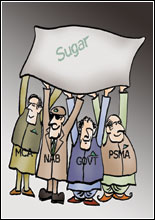 AS the ongoing sugar crisis has brewed and simmered over the past months, it has become amply clear that the inflated prices of sugar are not going to be reversed. The trading of blame between the growers, mill owners and various ministries and the government’s rescue plans of imports have all now become irrelevant.
Over the past few weeks, the dominance of the exploitative trading community and the manipulative body of sugar mills over the government has been firmly established. And the only question that now remains is how much further prices are going to rise as we enter the second half and especially the last quarter of calendar 2006.
By February, it had become clear that the sugar crisis was engineered by politicians vying for powerful positions such as head of the Finance Ministry. Prices had shot up rapidly in the absence of any form of price control and the hoarding of sugar and mass profiteering was taking place out in the open.
Traders and mill owners were towering over helpless consumers and an even more helpless government. It is true that a shortage of sugarcane was an issue. Annual domestic demand for sugar is 3.5 million tons, for which about 50 million tons of cane is needed.
Sugarcane production has declined over the past three years from 53 million tons in 2003-04 to 47 million tons in 2004-05 and 44 million tons in 2005-06. This was largely on account of persistently delayed payments by mill owners to cane growers who preferred to switch to other less political crops.
However, low cane production could have been countered by the import of raw sugar a year ago when it was selling at $200 per ton in the international market and the government had permitted duty-free import to help make up the shortfall in cane and provide an alternative raw material. But most mills preferred to ignore this option since imports involve documentation and that makes tax evasion difficult.
Besides, the greater the shortfall of raw material, the greater the ability of the mills to raise the price of sugar. Of course even those mills that did import raw sugar joined the cartel and sold their sugar at the same inflated prices and the government did nothing to address the issue. So even the benefit of duty-free imports went into the pockets of the mills and was not passed onto consumers.
For next year, the government has set a cane production target of 50.5 million tons although it is unclear how they hope to achieve that since none of the factors that have led to the decline in production have been reversed or even addressed.
The NAB fiasco: As high sugar prices persisted, the government came under fire by the general public. Early in March, the National Accountability Bureau, NAB, began an investigation and gathered information from the stakeholders involved including the ministry of finance, ministry of food, agriculture and livestock, the Trading Corporation of Pakistan and others.
This process eventually led the team to Lahore where they asked the provincial government for a briefing. Their thorough investigation resulted in an impressive collection of information with details of which sugar mills hoarded, what the extent of hoarding was, where tax evasion had taken place and to what extent and the role various stakeholders played.
This created a major frenzy. Sugar mills became jittery as did certain ministries. In the first week of March, the Pakistan Sugar Mills Association, PSMA, offered the Punjab chief minister 10,000 tons of sugar at the rate of Rs25 per kilogram for distribution his province. In return, they wanted the chief minister, also a mill owner, to get NAB of their backs.
The chief minister put forward the request to Tariq Aziz, the President’s principal secretary asking that the NAB investigation be called off. The chief minister argued that the mill owners had turned nervous at the investigation and the involvement of NAB meant buyers would be reluctant to pick up stocks from the mills, this would cause a new shortage and result in even higher prices.
Aziz put forward this request to the President who asked his chief of staff General Hamid Javed to hold a meeting at the Rawalpindi Camp Office. On March 8, this meeting took place with members of PSMA and as a result NAB was asked to call off the investigation.
When Shaukat Aziz received the message from the Pindi Camp Office, he also spoke to the chairman of NAB and requested that the investigation be called off.
The government took the stance that this is a free market economy and so interference in the setting of prices would not be appropriate and instead sugar should be imported and sold at a lower rate. The government seems to forget that a free market economy does not mean an economy that is unregulated and facilitates mass manipulation by industrial cartels and middlemen. Indeed, an unfettered economy that is free and open is a generous invitation to exploit the consumer and this trend is prevalent in several major industries across the country.
Deep frustration set in within NAB and the investigating team which had collected a dossier of information. NAB then issued a press release stating that the investigation had been called off in fear of that it would lead to higher prices. Nothing could have appeared like a more sorry state of affairs and nothing could have made the government look weaker and more subservient to manipulative traders and industrialists.
The politically powerful lobby of sugar mill owners had succeeded in scaring the government into backing off. They came out of the NAB investigation thrilled, having succeeded at keeping their cartel-style practices of hoarding and profiteering unchecked. And obviously, there was no price decline after that and prices continue to hover at Rs40 per kg.
Moreover, PSMA escalated their manipulation and exploitation to the next level. In a great show of arrogance and fearlessness, they decided not to release their usual fortnightly report that shows the level of stocks held by each mill. The last report was released on February 28 and since the NAB investigation, not a single report has been put out.
NAB had worked out that many mills were paying taxes as if the ex-factory price of sugar was between Rs16 per kg and Rs19 per kg instead of the actual ex-factory price of Rs31 per kg to Rs32 per kg.
The Central Board of Revenue also dragged its feet in customary style, entering the arena only in February to investigate the mass tax evasion that had taken place. Massive unregistered buying had taken place in the Punjab allowing both the growers and mill owners to easily evade taxes.
NAB also estimated that between 40 and 50 per cent of sales tax was being evaded. But since NAB was asked to back off, no penalties for tax evasion were to be imposed. The only measure the weakened government could take was fixing a uniform rate of sales tax in April. However, the damage of evasion was already done and very successfully. That would now be irreversible.
Had NAB been allowed to persist with their investigation, evasion could have been penalized and at the same time, mills who had released low quantities of stocks—some just 10 per cent of production— would have been forced to bring hoarded sugar out into the market.
Greater crisis ahead: So what’s next? Pakistan consumes 300,000 tons of sugar per month. The estimate is that of the 2.5 million tons of sugar produced, less than half has been released into the market. The mills, it seems, hope to release their stocks at a trickle-slow pace, lasting them as long as possible.
Once, by August, the stocks dry out, what will happen? The next crushing season won’t begin till December. The TCP will be unable to provide sugar for the entire country and so bulk imports will be needed.
Once the TCP enters the already expensive international market, global prices will rise even further from the current high levels. That will put local sugar mills exactly where they want to be: in a position to once again raise prices even further, using high international prices as a crutch.
What will the government do then? If they couldn’t stand up to the power of the mills when sugar is selling at Rs40, how will they take action when it sells for Rs50, or Rs60 per kilogram? Where will it all end?
The toothless Monopoly Control Authority, meantime, is making a great show of taking action. Last week, it issued notices to several mills and held some meaningless hearings. Given the limited powers the MCA has and moreover the crushingly weak precedent the government has set by asking NAB to back off, this investigation is simply an exercise in public relations and is sure to amount to nothing.
Meantime, since the NAB investigation was called off, politicians who own sugar mills have moved to the second step of their plan. Now that their industry has got off entirely untouched, they have begun a media campaign to toss the responsibility of high sugar prices on the Ministry of Finance.
Stories have appeared in the media this past week, attributed to anonymous sources, claiming that the government will lose $200 million in the import of sugar since imports were not done earlier when prices were lower. Some press reports exonerate the sugar mills entirely from any blame and place it squarely on the Ministry of Finance. This way, the engineers of this crisis hope to fulfil their original aim of making their way to positions of power within the government.
But let’s face facts. The traders and sugar mills have acted in an unethical way and continue to do so. The government has played an even more repugnant role by cowering down to the mills and allowing—indeed making way for— consumers to be so exploited. That is where the government’s fault lies, not where the engineers of this crisis would have us believe—in slow imports.
After all, commodity markets the world over fluctuate rapidly and no government globally is expected to hoard all manner of commodities to avoid a possible crisis. If that were the case, oil would have been stored in mass by governments all over the world.
Many questions now abound. Where are those who called off the NAB investigation at the behest of the politically powerful sugar mills? Since they clearly did not barter the end of the investigation with lower prices, what exactly did they achieve by calling it off?
All the government seems to have achieved is a perception among the public that they are in collusion with the mill owners. This will do little help to endear the government to a people no longer able to cope with uncontrolled, unreachable commodity prices.






























