0
0

 OF late, the PM has claimed a reduction in both poverty and unemployment, but neither ground reality nor independent experts substantiate this view. Though the prices of real estate have soared, fuelled mainly by speculation and lack of avenues of productive investment, income levels, especially of small business, have substantially declined, and income disparity has increased, flow of aid and ‘loan re-scheduling’ after 9/11 notwithstanding.
The policy of privatization and ceaseless reiteration of the free market and foreign investment mantra have not helped. They have benefited a privileged certain class only.
PM’s frequent exultation over Pakistan’s performance as certified by the IFIs notwithstanding, the lot of the common man has continued to worsen.
Most of what ‘foreign investment’ has come in, is either in service sector or in low-skill technologies. Things like KFC, Macdonald’s and Pizza Hut have only introduced Pakistanis to junk food—of a highly expensive kind. Other ‘foreign investment’ has consisted in handing over lucrative, captive local markets, such as in the fields of power and communications, to foreign interests rather than in new fields in industry and technology.
This dream of our economic managers alone cannot take us far unless foreign investment comes into fields where transfer of new technology occurs. We have not even succeeded in taking significant advantage from outsourcing of services.
Lack of interest by foreign capital has sometimes been blamed on the law and order situation. The fact is that terrorist threat emanating from ‘Islamic fundamentalist’ elements has been exaggerated under foreign influence. While this policy may have been of benefit politically to the regime, productive ‘foreign investment’ has been driven away precisely because of this policy. The ‘threat of terrorism’ in any case stands accentuated due to involvement in the US ‘war on terror’ in a big way.
Economic growth has been driven mostly by workers remittances and grants and loans obtained after 9/11 at great political cost but has failed to translate into benefits for the common man.
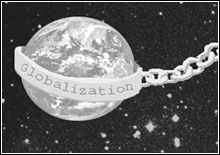
No concerted policy to face the challenges of globalisation is in evidence, except that the ministers and officials repeat in a stereotyped manner the line orchestrated by the IFIs and the industrialized world. Being an elitist government, most of its policies have served privileged class. Globalisation, in its current form, is in the interest of the industrialized West’s elite.
Our elite apparently have a tacit alliance with them. Consequently, they do not view it as a threat. Prior to January 2005, government departments had been placing big advertisements in the newspapers at state expense about the ‘opportunities’ offered by globalisation after WTO provisions take effect.
While they do pay lip service to people’s welfare and talk of transferring “benefits of macroeconomic stability and growth” to the common man, their main objective is to ‘stay on course of reform.’
Globalisation is like a tidal wave. The prime minister said in an interview with a foreign magazine: If you ride it, you will go far. If you try to stop it, you will be blown away. We decided to ride it.” In the same interview, he outlined the fundamentals of reform as “deregulation, liberalization and privatization.” About privatization, he said: “It is not the business of government to be in business. We decided to open everything up. We just sold 26 percent of Pakistan Telecom—which was overstaffed and inefficient—for $2.6 billion. We eventually want nothing in the public sector.”
Similarly, claiming to alleviate poverty while opposing government intervention and favouring privatization of health and education sectors, are contradictory in nature. Government must seriously consider its role in development of education and health facilities. Without this, no economy could take off. There are costs associated not only with action but also inaction. Inaction in the realms of health and education leads to deterioration of these two sectors with associated costs.
Expenditure on public health projects is not an ‘unproductive expense,’ as some unimaginative planners believe. It improves productivity by reducing wastage of man-hours due to poor health and sickness, and leads to a more healthy and enthusiastic workforce.
Misguided imported ‘experts’ fail to realize the tangible and intangible benefits of providing education and health facilities to the populace through the state system.
Current trends of indirect, regressive taxation, downsizing government organizations, and establishment of ‘elite institutions’ of learning while ignoring public sector universities, all ultimately increase poverty.
The notion that ‘poverty alleviation,’ and even development of underdeveloped regions within the country, is some sort of a ‘charitable obligation,’ is itself uncharitable. Charity can at best provide emergency relief in cases of dire necessity. The failure of ‘compulsory Zakat deduction’ instituted during the tenure of another military ruler, General Ziaul Haque to make a dent in poverty is proof, if one were needed. In fact, economic development requires not merely administrative measures but social change.
Economic stability, that they worry so much about, is negated by the policy of frequent change in the prices of inputs like petroleum and power. The OCAC, a cartel of oil companies, is authorized to fix oil prices fortnightly, based on “international market prices.”
After hue and cry by the press and public and some opposition politicians, the government has now changed this policy and from April 2006, OGRA (Oil and Gas Regulatory Authority) is to oversee the OCAC price fixing. Still it cannot fix oil prices. Perhaps to placate public sentiments, or to give a smooth finish to the farce, NAB has been designated the task of finding the ‘methodology’ behind the oil prices fixed by OCAC in the past.
A strange but interesting thing had come to light in the debate on oil pricing mechanism in the Senate in February, 2005 when Opposition Senator Farhatullah Babar disclosed that the petroleum development levy which was Rs9.5 per litre in May, 2004, had been reduced to 0.92 per litre in December, 2005, while the inland freight charges, which are paid back to marketing companies by the OCAC, were increased from Rs1.64 to Rs9.70 per litre. Under this juggling, the government stands deprived of the petroleum development levy, which is used by it for oil exploration.
The real question is why the government authorized the OCAC, a group of oil marketing companies and refineries, which had vested interest, to fix oil prices. The policy of increasing price of utilities in deference to the wishes of the IFIs has also had an adverse effect on industrial development as well as commerce.
The poor in general lose out under the kind of elitist authoritarian rule that has prevailed in Pakistan. The maladies of elitism and VIPism are becoming stronger by the day.
If we go by tall claims, we have a dynamic economy and soon will join the ranks of the Asian tigers. In reality, we are heading towards de-industrialisation. The globalizers, however, seem to be content with carving out a role for Pakistan as a supplier of raw materials and semi-finished goods, or at most, of textiles! The policy of reduction in the rate of interest under the belief that this would bring down the cost of capital and thus spur economic activity has, in this milieu, translated into benefits for the speculator and the influential.
Domestic policies are one side of the picture. The ‘unequal exchange’ between the rich and poor nations, which the West is trying to sustain through corporate globalisation is another cause of endemic poverty in developing countries.
The impact is accentuated in those developing countries, such as Pakistan, where the elite is more fully in league with the developed world’s elite. The neo-imperialist policies being pursued by the United States further complicate and exacerbate this situation, but the contribution of the developing countries’ governments in the process cannot be discounted. Beggars may not be choosers but they can at least develop the will not to beg! It remains to be seen whether we ride the tidal wave or the tidal wave rides us.