0
0

 KARACHI, April 14: A complete and peaceful strike was observed across the city on Friday in response to Jamat Ahle Sunnat’s call, which was endorsed by the Muttahida Majlis-i-Amal, to condemn the massive blast at Nishtar Park on Tuesday last that left 47 people dead and another 103 injured.
The strike call was also supported by various political and religious parties, as well as several trade and commercial associations, demanding a thorough investigation into the bombing and exemplary punishment to its perpetrators.
The bomb ripped through the stage of the main Eid Miladun Nabi event in the city. Among those killed in the blast were Sunni Tehrik leaders Maulana Abbas Qadri, Maulana Iftekhar Bhatti, Maulana Akram Qadri, a former JUP legislator Hafiz Mohammad Taqi, chief of the Tehrik Awam Ahle Sunnat Haji Hanif Billo and others.
Police investigators believe that it was a case of suicide bombing but have so far failed to make headway in the investigation in this direction.
The strike remained by and large peaceful. However, a bus was set on fire in Surjani Town early in the morning.
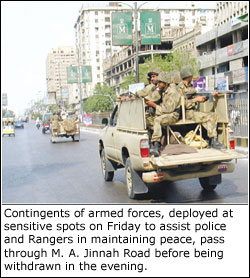
The army, deployed on Thursday at a few sensitive places to assist the law-enforcement agencies in maintaining peace during the funeral and burial process of the ST leaders, was formally withdrawn on Friday.
Although all business, commercial and educational activities had come to a halt soon after the blast and did not resume in the next two days, people markedly responded to the strike call positively.
All markets, bazaars and commercial/business centres remained closed. Most people working in public, private or autonomous establishments preferred to stay away from work.
Roads and streets in otherwise busy areas, like Baulton Market, Saddar, Jodia Bazaar, Hyderi Market, Liaquatabad, Nazimabad, Korangi, Lyari, Tariq Road, Clifton, etc wore a deserted look.
Most of the government and private offices did open in the morning but with a thin attendance, but banks and fuel stations remained closed. Many fuel stations were, however, reopened in the afternoon after remaining closed for three consecutive days.
Public transport continued to remain off the road but a few buses and minibuses were seen plying in the afternoon. Some people who tried to reach their workplaces faced hardship due to the non-availability of public transport.
The Karachi Transport Ittehad had already announced that its members would not bring their vehicles on the road on Friday as the government had failed to provide them with adequate security. They had suffered monetary losses as several buses and minibuses had been set on fire over the past three days, it maintained.
The government and civil administration had deployed heavy contingents of police and Rangers at various places in the city to meet any eventuality. Police had beefed up security measures and intensified patrolling, especially in the sensitive parts of the city.
The operation of the intercity bus services was completely suspended on Friday. “We stopped the advance booking after the call for strike was given. Those who had bought tickets for Friday, would be compensated,” a representative of the Intercity Bus Welfare Association, Haji Iqbal, said.
An official of the Pakistan Railways said that surprisingly, passengers of various trains arrived at the respective stations before the scheduled time of their trains’ departure. He said despite the fact that an effective strike was observed, an unusual number of passengers made it on time and not complain having missed a train.
Absence of public transport, rickshaws and taxis, with few exceptions, badly affected service delivery at hospitals and clinics as doctors and paramedics could not reach their workplace. The number of OPD patients turning up at various hospitals and clinics was very low.
Medical stores and pharmacies across the city remained closed creating problems for the patients seeking drugs. A man at a major private hospital said he could not find any pharmacy open in his locality and had to drive up to this hospital. Fortunately, the hospital’s pharmacy was open. He wondered if every person desperately seeking essentially required medicine could be able to undertake such a hectic search.
Trading at the Fruit and Vegetable Market (Sabzi Mandi) on Super Highway was also affected badly due to the strike. A large number of wholesalers and retailers routinely visiting Sabzi Mandi to buy stocks could not turn up owing to the non-availability of transport means.