0
0

 Illiteracy and ignorance in the use of conventional pesticides on edibles is leaving disastrous effects in the developing countries where mono-cropping system is common.
The vegetable growing belts around cities as well as rice, cotton and maize farming areas of Pakistan come under this category. Many wild animals and bird species face extinction in the cultivated landscapes where high potency pesticides, fertilizers and even banned chemical products are still in use.
Curtailing the use of toxic pesticides in the agro-ecosystem and meeting the World Trade Organization’s restrictions will be possible if non-chemical and biological/mechanical methods of pest management are introduced.
The light equipped power insect sucker (LEPIS) is one such device which can attract and kill the insects mechanically. During field research the equipment was proved environment-friendly and safe for human beings. This will help in the conservation management of wildlife and its related habitats.
The Power Insect Killer (PIK) a ‘solo sprayer machine’ was converted into a ‘Power Insect Killer’ by re-designing its fan and the air suction mechanism. The machine was tested on cotton and different vegetables for its efficacy in reducing insect burden on crop foliage. The results were encouraging.
However, if operated carelessly it can damage the leaves. To overcome this defect, five different adopters were fabricated to modify the sucking mechanism. These were tested at successive growth stages of crops and vegetables with promising results.
The hypothesis derived from it proved that the Power Insect Sucker can be highly effective device though time-consuming and laborious. During the second phase of research, attention was diverted towards improving efficacy of the machine.
It is a researched fact that during the night winged insects get attracted to light, which decades back led to the development of “Still Light Traps” for insect control in croplands. But soon this technique was discarded since it killed only few insects while the rest thronged about the light traps increasing the crop losses in the vicinity.
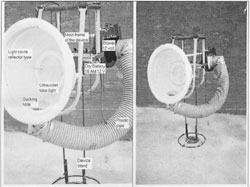
The Light Equipped Power Insect Killer (LEPIS) machine is a movable light trap in which special lights are installed to attract the insects. A battery- driven sucking unit is placed instead of the gasoline engine which is fixed on a mainframe at the rear side of the operator. (See Fig. 1).
A big reflector type light cover (hole in the base) fitted with a round shaped ultraviolet tube light is attached to the frame in front of the operator. The hole at the base of light cover and the blower/sucking unit are connected by a flexible rubber pipe.
During operation at night the powerful ultraviolet light attracts the insects within the light cover. From here, these insects slip into the hole of the light cover or sucked in to be conveyed to the sucking unit through rubber pipe where these are crushed while passing through a high-speed blower. All insect material can be collected for further research by attaching a net bag to the outlet of the blower.
During field operation, flushing of insects slightly ahead the machine has given more promising results. This knapsack type device is easy to handle and cheap to operate. Initial results have indicated that it is highly effective against flies, moths, beetles, bugs, aphids and white flies, including many other chewing and sucking insects.
A fully charged dry battery (12 V, 17 AH) runs the machine for almost six hours and can cover two to three acres of cotton crop. The tractor-operated model of the machine has already been designed which will be fabricated (if funds are made available) for testing in the forthcoming cotton crop in the University of Agriculture, Faisalabad.
An experiment was carried out on the ‘insect response to different wavelengths of light’. The collected insect material was carefully identified for respective insect orders as well as for the proportionate numbers of crop pest and predacious species. The results were encouraging and helpful in selecting the most effective wavelengths of light to be used in the LEPIS device to enhance its efficacy during the field use.
Recently, a mega research project was submitted to the Pakistan Agriculture Research Council under ALP funding pot with a hope to introducing this environment-friendly insect pest control technology.