



 0
0

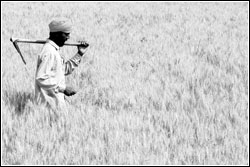 EVERY year as the scorching heat of the summer months takes its toll, thousands of poor farm labourers from some of the poorest districts in three of India’s richest states begin a long trek to the cities.
They reach Mumbai, Bangalore and Hyderabad – the respective capitals of Maharashtra, Karnataka and Andhra Pradesh – squat on public land, railway platforms or on dry riverbeds, and start looking for jobs. Fortunately, the big, bad, though generous, cities provide a lot of opportunities for work, and many of the migrants stay back and settle down permanently.
But many of the unlucky ones who stay put in their villages, trying to extract yields from the cruel, unforgiving farmlands, fail in their miserable task and are reduced to penury. Besides the harsh and dry acres of land that they own, they have no other assets, and are forced to approach moneylenders, who offer them a few hundred rupees at usurious rates.
With the onset of the monsoons, they buy seeds and a few other inputs with the borrowed money, hoping to reap a good harvest. But year after year, it is the same story. The rains fail, the crops wither, the loans multiply, and sadly some of the farmers are forced to resort to drastic actions, like taking their own lives.
Since the start of the new century, nearly 10,000 farmers have killed themselves in these three states – especially in their border districts in the harsh Deccan plateau.
According to India’s agriculture secretary, Radha Singh, nearly 6,000 farmers have taken their lives in Karnataka over the last five years. In neighbouring Andhra Pradesh, about 2,000 farmer suicides were reported, while Maharashtra has seen one suicide every two days over the last five years.
Visiting these hardscrabble districts during the summer months one realises the futility of trying to extract something out of the harsh land. Districts like Beed, Latur, Nanded, and Solapur in Maharashtra, Bidar, Gulbarga Raichur and Bijapur in Karnataka, and Adilabad, Nizamabad, Cuddapah and Anantapur in Andhra Pradesh, suffer from acute scarcity of water round-the-year.
Some other parts of these three states that do not lie in the rain shadow regions have perennially flowing rivers, lush farmlands, and affluent farming households.
Farmers in several fertile districts in these states – Pune, Satara, Sangli and Kolhapur in Maharashtra, Bangalore, Mandya, and Mysore in Karnataka, and Krishna, West Godavari and East Godavari in Andhra Pradesh – raise lucrative crops like sugarcane and tobacco.
Governments in all these states have over the last 60 years invested billions of rupees in massive irrigation projects in these rich districts, pampering the farmers there, at the cost of their lesser fortunate brethren in the poorer districts. And because of their affluence, these farmers enjoy political clout among all the major parties, and dominate the state governments.
While politicians and even many commentators in India talk of the great urban-rural divide – urban residents are citizens of a rapidly developing India, while rural ones are said to be living in underdeveloped and poor Bharat – the fact is that the divide is most acute in rural areas.
A great wall separates denizens of wealthy districts, where farmers have access to abundant water, and are able to squander it on crops like sugarcane, and their poorer cousins in the famished districts.
When politicians in India demand free power and water, subsidised loans and fertilizers for farmers, they refer only to the affluent and well-connected ones, not those living in the impoverished districts.
INDIA’S federal agriculture minister Sharad Pawar – who is also the big boss of the Nationalist Congress Party – is the political representative of the big farmers of western Maharashtra. Last week Pawar called a meeting of chief ministers and top bureaucrats of the three states, and of the southern state of Kerala, to discuss the growing crisis of farmer suicides facing 35-odd districts in these states.
The widely-travelled Pawar – who is also an expert on farm-related subjects – warned that the issue of farmer suicides would not be tackled unless the underlying cause of agrarian problems were sorted out. These include drought, lack of formal credit, growing indebtedness of farmers, and poor prices for their commodities.
Pawar has promised a special financial package to these four states, though he refused to divulge the amounts involved. It is expected to cost the federal government a few billion rupees, and is to be launched in two months. The package would include providing insurance cover to farmers (including their cattle), farm credit, boosting irrigation in the affected regions, and providing marketing infrastructure.
A few days ago, the agriculture minister had to face the ire of onion growers in Nashik, about 200 km north-east of here, when some of them aimed the bulbs at him as he was addressing a farmers’ rally. Onion prices in the region – which is India’s largest producer of onions – have tumbled from about Rs500 a quintal just a few months ago, to Rs200 about a month back, and as low as below Rs50 a quintal earlier this month.
Farmers are demanding a support price of Rs300 to Rs500 a quintal, but the Maharashtra government is in no position to bail them out. The state has run a debt of over Rs1 trillion , and is in no mood to come to the help of farmers. In Nashik district alone, about 1.5 million tons of onions have piled up in the markets, leading to a sharp fall in price.
Worried over the declining prices, sharp increase in input costs, and burgeoning loans, dozens of onion growers have taken their lives in recent weeks.
*****
TRAGICALLY, the bird flu scare in Maharashtra – and the consequent sharp fall in demand for chickens and eggs – has led to some of the poultry farmers killing themselves. According to officials of the National Egg Coordination Committee (NECC), about 10 farmers have committed suicide over the past couple of weeks in states like Maharashtra, Andhra Pradesh, Tamilnadu, and even West Bengal and Assam.
Nearly half a million birds were culled in two districts of Maharashtra last month, following the outbreak of the avian flu. Thousands of birds died in Nandurbar and Jalgaon districts, a victim to the deadly H5N1 strain of the virus.
Hundreds of residents, suspected to be suffering from flu, in the two districts were quarantined, but tests for the virus turned negative. Over 100 persons, mainly in the Far East, have succumbed to the disease internationally, though India has not reported a single death so far.
Authorities in Maharashtra were swift in culling the birds, but the poultry industry is now up in arms against the government. Many in the industry claim that the government over-reacted to the scare; by withdrawing chicken and eggs from the menus of state-owned airlines and Indian Railways (and even the Parliament’s canteen), the government destroyed the industry.
The NECC last week estimated that losses had crossed the $2 billion-mark, and with fears of the avian flu still doing the rounds, most restaurants in Mumbai and other big cities still do not serve poultry products.
About 200,000 poultry farmers have been reduced to penury, and nearly three million people associated with the industry are also suffering. State governments that ordered the culling of birds have promised between Rs20 and Rs40 a bird, though sources in the industry allege there is a lot of favouritism.
Some in the poultry industry smell “an international conspiracy,” to destroy the sector. They question the delay in releasing the test reports from laboratories. The government of course, ridicules these theories, and asserts that the precautions it took were in line with standard international procedures.






























