



 0
0

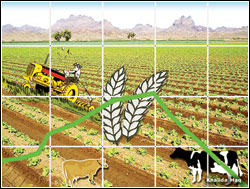 ISLAMABAD: The lower than estimated output of the two major sectors- agriculture and manufacturing - by a wide margin has shattered hopes that Pakistan’s economic growth rate would cross six per cent of the GDP this fiscal against a budgeted target of seven per cent.
While the government had already revised downward its estimate of the GDP growth on February 28, 2006, the latest forecast of wheat production falling 1.5 million tons short of 22 million tons target would have its own sliding impact.
The wheat production estimates have also a political impact. Some officials believe that food ministry had intentionally understated the crop output to support falling prices on the back of massive wheat stockpile ahead of wheat harvest in Punjab. Top political leadership and bureaucrats in food and agriculture ministry come from the wheat growing areas.
“The country may not be able to achieve even six per cent growth rate if the estimates finalised by the Federal Committee on Agriculture (FCA) are correct”, said a senior government official. Early this month, the FCA put the wheat production estimate at 20.5 million tons, even lower than last year’s 21.6 million tons.
Many officials involved in policy making question the wheat output figures at 20.5 million tons on the ground that even two days before the FCA meeting the prime minister was informed of a bumper crop and resultantly price crash in Sindh. Their worry is not only the GDP target but inflation as well that could rise in case of higher wheat and wheat flour prices.
They argue that if the crop was not good, there was no need for the prime minister to announce: “If required, the government will buy the entire wheat crop and export the surplus”. There was no sudden catastrophe that wiped out more than 1.5 million tons of wheat in just 24 hours. The United States Department for Agriculture (USDA) had also predicted more than 21 million tons of wheat in Pakistan based on satellite imagery of crops.
They agree that economic targets would have to be revised on the impact of wheat output but hope that revised wheat estimate in May would be improved.
The wheat prices have already collapsed in Sindh to Rs360-370 per 40-kg against a support price of Rs415 when the provincial authorities estimated wheat output between 2.8-3 million tons. The crop in Punjab, where harvesting is now gearing up, is even better.
The policy makers believe that the ministry of food and agriculture was following a price-centric policy which has met with complete failure. Historically, Pakistan’s wheat output has hovered around 19-20 million tons and if there was a good rain in March, the output increased by one million tons.
Last year, the Minfal had set a target of 10.7 million bales of cotton, which was revised to 11.1 million bales, then 12.2 million bales, followed by 13.2 million bales and finally settled at 14.6 million bales. The cotton output estimates were gradually increased last year to maintain high prices of cotton. This year the same policy is being followed in wheat.
The agriculture ministry officials, on the other hand say, that they were reporting wheat output on actual basis as confirmed by the field staff of the provincial food and revenue departments and could not over-estimate its production to meet ambitious economic targets.
They argue that thousands of growers would fall into the poverty net if Minfal artificially raised the output estimates and that would hurt the national economy badly.
The wheat growers, on the other hand, are unlikely to get support price fixed by the government at Rs415 per 40-kg during the current year owing to a record stocks already available in the country.
Wheat stocks: According to official data, wheat stocks as of March 1, 2006 stood at 2.779 million tons, over 193 per cent higher than last year’s 0.947 million tons of stocks on the same date.
Wheat sowing area and production have fallen short of target despite timely rains and a continuous increase in the support price of wheat over the last few years to encourage growers to bring more area under cultivation and enhance per acre yield.
Wheat stocks in Punjab stood at 1.854 million tons on March 1, 2006, up by about 360 per cent when compared with 0.403 million tons of same period last year. Similarly, stocks in Sindh were reported at 0.322 million tons which were about 91 per cent higher than last year’s 0.169 million tons.
NWFP’s stocks stood at 174,498 tons compared with 115,656 tons of the same period last year, showing an increase of about 51 per cent. Only Balochistan’s stocks were reported lower than last year at 71,435 tons compared with 72,966 tons.
Moreover, the wheat stocks held by Passco on March 1, 2006 stood at 357,958 tons compared with 186,688 tons last year, showing an increase of about 92 per cent.
The private sector has already contracted one millions wheat import from various sources, out of which 816,000 tons wheat has already arrived at Karachi. However, in a recent decision, the government has also removed 15 per cent duty levied on export of wheat flour to ensure better return to wheat growers and stabilise wheat flour.
The public sector wheat procurement this year was 3.939 million tons including 2.438 million tons in Punjab, o.504 tons in Sindh and Passco 0.997 million tons.
On the other hand, the wheat sowing area has reduced by 0.4 per cent on a country-wide basis despite three years of continuous rise in support price. The wheat area in Punjab this year was about one per cent less than the target of 6.4 million hectares.
The crop condition in Punjab is satisfactory and in barani areas the condition improved due to January-February rains.
Sindh increased wheat sowing area by 5.7 per cent to 938,000 hectares against a target of 900,000 hectares and its wheat condition is satisfactory but the prices have crashed much below the support price.
Wheat area sown in the NWFP is 750 thousand hectares, which is 0.3 per cent less than the last year’s sowings. However, the areas sown is 98 per cent of the target. Similarly, wheat sown in Balochistan is 300 thousand hectares, which is 9.6 per cent less than the last year’s sowing and 13 per cent less than the target.
The FCA had announced early this month that the production of three major crops including wheat, cotton, and sugarcane has remained short of target during the current fiscal year.
Cotton production: The cotton production stood at 13 million bales this year against a target of 15 million bales. The sugarcane production has been estimated at 44.23 million ton against the target 48 million tons for the current financial year. Production of some minor crops like potato and gram etc have also performed below expectations.
The National Economic Council (NEC) on February 28, 2006 reduced significantly the estimates mainly because of lower than expected growth in two major sectors of economy including agriculture and manufacturing. As a result, the GDP (gross domestic product) growth rate was estimated at 6.2-6.4 per cent instead of budgetary target of seven per cent.
The services sector is the only major sector of economy that is estimated to meet its budgetary target of 6.8 per cent, owing chiefly to activities related to the earthquake rehabilitation.
The government had targeted the GDP to grow at 7.0 per cent, shared by 4.8 per cent growth in agriculture, 9.5 per cent in industry and 6.8 per cent in services. However, the agriculture sector’s growth estimate was reduced by the NEC to 3.0 per cent and that of growth in industry to 9.0 per cent.
The major crops under the annual plan were projected to grow at 6.6 per cent but this estimate was reduced to 1.9 per cent mainly because of lower than targeted production of cotton and sugarcane.
This revision in agriculture was made due to reduction in cotton output target and factoring all other crops but the government had expected to witness a bumper wheat crop. The wheat has a major share in the GDP as it contributes over 13 per cent to value added and about 3.2 per cent in the GDP.
A shortfall of about 1.5 million tons would have a significant impact on growth rate, said the official but warned that it was just a first estimate and would be updated twice in May and June.
Similarly, the large scale manufacturing (LSM) was originally estimated to grow at 13 per cent but this estimate has now been revised to 12 per cent. “Even this 12 per cent growth in LSM is disputed”, a senior official said adding the growth in cotton yarn needed to be verified further.
Services sector: The services sector, also showing negative signs, would be offset by earthquake related activities, including significant increase in the volume of exports and imports and unprecedented larger inflows of foreign private investment. As a result, “services sector growth rate has been estimated to maintain 6.8 per cent target”.
The 6.2-6.4 per cent GDP growth was estimated on the basis of 12 per cent growth of LSM but there were strong indications that LSM growth may be even smaller and stand at 10 per cent and thus reduce GDP growth rate to below six per cent.
According to the Planning Commission, the GDP growth is running below target and inflation is higher than target rate while export growth is impressive but rate of increase in imports is even larger, leading thereby to huge trade deficit.
The government borrowing for budget financing has already crossed full year target in just six months, which shows a massive widening of gap between revenues and expenditures.
The borrowing for budget financing from July to January 21 stood at Rs109 billion against annual credit plan target of Rs98 billion, showing pressure on fiscal situation which would force the government to revise upward the target for fiscal deficit target of 3.8 per cent.
The rate of inflation for 2005-06 was targeted at 8.0 per cent but the annualised rate of inflation, measured by CPI on the basis of July-January data, stood at 8.5 per cent as against 8.8 per cent during the corresponding period of last year.
The inflation measured by wholesale price indicator (WPI) of 11 per cent during July-January (seven months) is also significantly higher compared to last year. This was mainly due to increase in the prices of fuel group, the planning commission believes.































