0
0

ISLAMABAD, May 5: Economic experts on Friday urged the government to initiate land reforms and said the government should give away 2.7 million acres of state-owned land to alleviate poverty.
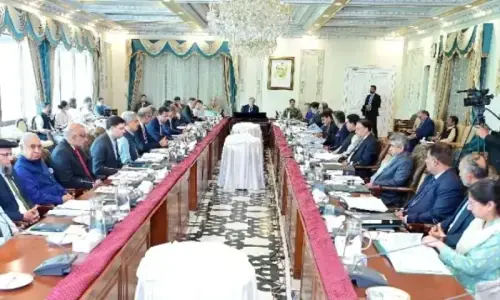
They were speaking at a workshop organised jointly by the ministry of finance and United Nations Development Programme (UNDP) ahead of the launch of the second phase of a poverty-related funding programme. The workshop was also attended by officials of the federal and provincial governments, economic think tanks and NGOs.
Warning against the rising unemployment among literate youths, they said the trend was alarming but could be reversed by focussing on sectors like tourism, agriculture, healthcare, transport and entertainment.
In contrast, secretary-general finance, Nawid Ehsan, who inaugurated the two-day workshop on poverty, claimed that the government had achieved all targets set under the Poverty Reduction Strategy Paper (PRSP-I) for 2003-06.
He said the government would start implementing the second phase of poverty reduction strategy – PRSP-II – during financial years 2007-2010.
Dr A.R. Kemal, special advisor to the planning commission, highlighted the deepening of income inequalities despite the achievement of higher growth rates and said that the government should tackle the problem through implementation of the much-delayed land reforms, adding that it should distribute state-owned land among landless peasants through a transparent mechanism.
Dr Junaid Ahmed, a director of the International Labour Organisation (ILO), proposed prioritisation of certain sectors of labour-intensive areas for tackling unemployment and said the move would help generate about 11.3 million jobs over the next three years.
Dr Ahmed’s paper on employment generation strategy said the government could provide an enabling environment for generating a million jobs in tourism industry, 500,000 in hotel and motel, 300,000 in hospitals and healthcare, 150,000 in entertainment industry, 450,000 in trade (wholesale & trade), 2.32 million in transport, 4.6 million in livestock (dairy), fisheries 150,000, floriculture 100,000, housing and construction 300,000, infrastructure projects 100,000, adding that another million jobs could be generated overseas.
He said that while unemployment was decreasing in absolute term, it was increasing in terms of women employment in urban and rural areas.
Terming the rise in unemployment among literate youths alarming, he said that the trend was rising, especially in urban areas.
Dr Ahmad said no formal studies had been carried out and there was no reliable data available to show any correlation between micro-finance and poverty.
Dr A.R. Kamal said that factors influencing income inequalities were distribution of assets, functional income distribution, and tax and the government’s expenditure sectors.
Highlighting the importance of land distribution, he said it was vital for improving income distribution.
Focussing on the government’s reluctance on land reforms implementation, he said that former prime minister Zafarullah Khan Jamali had recently highlighted it, adding that the government should make a transparent land distribution a part of the second phase of the PRSP strategy.
He said that real estate prices were rising and there was a need to develop a scheme to provide small plots to the poor at affordable rates.
He also stressed the need to regularise Katchi abadis with this strategy and discourage the establishment of new ones.
He said that poor governance affected the poor, who were denied justice and delivery of services, adding that improvement in governance was imperative for poverty alleviation.