0
0
A letter to Washington
“Divine prophets have promised: The day will come when all humans will congregate before the court of the Almighty... I trust both of us believe in such a day, but it will not be easy to calculate the actions of rulers, because we must be answerable to our nations...”
—Ahmadinejad to Bush
IT is inherent in the messianic and eschatological aspects of the Islamic revolution of Iran that its principal ideologues reach out to world leaders and invite them to ponder over a different view of human history. There is an epistolary tradition, stretching back to the last Messenger of God (peace be upon him), of reminding the high and mighty of the world of divine immanence in human affairs.
President Ahmadinejad would doubtless be aware of this tradition when he wrote to George Bush in the midst of an escalating threat to his country and to the political ideology it symbolises. The most recent precedent for him, however, would be the famous letter that Imam Khomeini wrote to Gorbachev in 1989 warning him that failure to align Russia with divine purposes would consign communism to the dustbin of history. We, in Tehran, could feel the electric tension amongst the faithful about a prophecy that was vindicated by events despite Gorbachev’s claims that his perestroika had saved the Soviet state. Our principals in the chancelleries of our capitals wanted a ‘realist’ assessment of the move made by the imam and we obliged by analysing the letter in the cold light of regional politics. It was, however, not easy to convey the afterglow of a vision vouchsafed to a man of God.
Mahmoud Ahmadinejad is no imam; nor was he meant to be. The long letter addressed by him to Bush could have originated, but did not, from the ‘rehber’, the symbol of the continuity of Vilayat-i-Faqih. The author presents himself as a humble ‘teacher’ who faces frequent and intense questioning by students, particularly of universities about the state of the world and, in particular, about the actions of the great powers. The teacher can perhaps read the unexpressed doubts of his pupils and needs to reassure them that God has not abandoned history.
The author also knows too well that the addressee is not a child of Marxism-Leninism as Gorbachev was, a possible non-believer who was making a last ditch effort to save communism, partly through the alchemy of glasnost. Ahmadinejad’s letter is written to a born again Christian who claims that God ordered him to invade Afghanistan and Iraq and whose Christian evangelical mentors continue to plan the destruction of Islam so that an ascendant Israel can set the stage for the second coming. In the unlikely event of George Bush writing back — beyond the Fox News sound bytes — it would be a lively exchange between two politicians driven alike by their respective belief systems.
Can one, asks the humble Iranian teacher, be a follower of Jesus Christ (pbuh), the great messenger of God avowedly working towards the “establishment of a unified international community — one that Christ and the virtuous of the earth will one day govern” and yet attack other countries?
Saddam, Ahmadinejad agrees, was a murderous dictator but the occupation of Iraq by 180,000 foreign troops killed around one hundred thousand people, violated “the sanctity of private homes” and pushed the country back by “perhaps 50 years”. Students ask Ahmadinejad, the teacher (as you, Mr President might know) if these actions could be “reconciled to the tradition of Jesus Christ, the messenger of peace and forgiveness”.
Ahmadinejad’s students, he tells Bush, have another difficulty. They show “old documents and globes and say — try as we have —, we have not been able to find a country named Israel”. Students “are saying that sixty years ago such a country did not exist.” Even if the Holocaust was true, Ahmadinejad asks — now in his own voice, “does that logically translate into the establishment of the state of Israel in the Middle East or support for such a state?” Are we to understand, he asks, that allowing the original inhabitants of these lands — inside and outside Palestine, whether they are Christians, Muslim or Jew, to determine their fate, runs contrary to the principles of democracy, human rights and the teachings of prophets.”
Ahmadinejad does not raise the nuclear question directly, nor does he make any proposals to defuse it other than an implicit invitation to a dialogue of civilisations, particularly those built on the great monotheistic religions. Having invoked the memory of CIA’s anti-Mossadegh coup of 1953, he, however, continues his questioning: why is it that any technological achievement, reached in the Middle East, is translated into and portrayed as a threat to the Zionist regime?
The tone is aggrieved, even sad, but seldom polemical. It is a Qom seminary at its best. The purpose is to hold up a mirror to a rather loud adherent of a kindred monotheistic faith. There is a near certainty that the intended interlocutor — the very religious George Bush — will not look into the mirror and that the deflected mirror will still bring light to countless men and women — particularly students all over the world. Each question is a snapshot: innocent villages in Afghanistan set ablaze on the mere chance of a criminal hiding in them, the Guantanamo Bay that denies the right to trial, the secret prisons in Europe, the coup makers of Latin America used to overturn elected governments, the hardworking, creative and talented people of Africa who are constantly threatened and, above all, the young Americans pushed into a world of fear and depression.
Is the letter only a contest of piety, a dramatic point counter point between a president who seeks peace in religion and another president who exploits it to wage an endless war? Is it an extended rejoinder to the anti-Iran propaganda churned out by a huge publicity machine that Amadinejad cannot otherwise hope to match?
There are at least three considerations that merit a closer look at its purpose. First; it is an attempt to open channels of communication. There are enough people in Iran and the United States urging recourse to direct negotiations rather than through the proxies of the EU 3 — the UK France and Germany. Bush is as yet unwilling to dilute his image of the warrior-king. Ahmadinejad is sending a signal that harsh anti-western and anti-Zionist statements conceal a peaceable interlocutor, should the United States be looking for one. Unable to make such a gesture from a position of weakness, the Iranian president has made it from high moral ground. It protects his missionary image of reinvigorating a 26-year old revolution and yet brings him to the world councils of diplomacy.
Second, at a time when Russia is engaged in reclaiming its superpower status, China in encouraging a slow and steady movement towards strategic and economic multi-polarity, and India in taking rather faltering steps to the high table of global eminence, Iran is reminding the world that the American discourse, beset with unilateral doctrines of intervention and pre-emption, is being challenged at least in three continents. It is time for a dialogue not only on the nuclear question but also on a more equitable world order.
Third, there may well be compelling domestic reasons for writing this letter. The Iranians can be recklessly brave but there is certainly considerable anxiety among them about the outcome of the current stand-off. In a demographically young nation like Iran, the need for a rationale for the present policy of defiance and steadfastness cannot be overstated. Islam, especially Shia Islam, has historically anchored such a rationale in justice which, in any case, is the defining attribute of an Islamic worldview. The letter to George Bush is thus also addressed to millions of young Iranians, and to “students” all over the world.
The neo-conservative political culture of present day United States does not offer much hope that a letter containing a reckoning of George Bush’s presidency by the Christian values that he otherwise espouses would be seen in a positive frame. Reminding Bush of the gap between his Christian faith and the actions of the United States under his watch is the refrain of the letter. No diplomatic demarche has probably ever been constructed in this manner — not even during the Peloponnesian wars. And yet, one hopes that the international community will not miss the little window that Ahmadinejad has opened.
We, in Pakistan, are expected to know better than others that describing Iran as a monolithic theocracy is motivated propaganda. In the absence of a strong academic tradition of our own, our think tanks, university departments and even professional diplomats are often content with repeating western cliches, particularly about Iran and the larger Middle East question. It is true that President Khatami’s reformist programme was not adequately fulfilled and that the last election weakened it. Yet the relative weight of Islam, conservatism, nationalism, globalism, religious reformism and the demand for change made by the younger generation is perpetually rearranged.
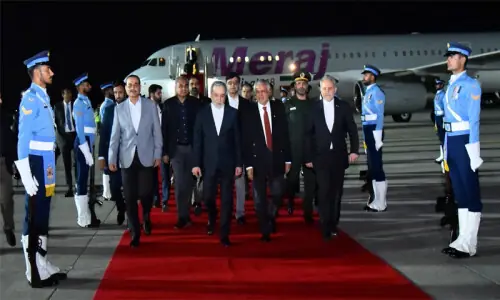
Iran is an excellent partner for a productive dialogue on all issues of concern to the international community. Pakistan can and should help Iran in the institution of such parleys. The visit later this month of Iran’s vice president, Parviz and foreign minister, Manouchehr Mottaki provides an opportunity to ascertain the best way of approaching this task. The visit should be an occasion for a heart-to-heart talk about the present problems as well as a clear agenda for Pakistan-Iran relations in the difficult years ahead.
The writer is a former ambassador.
Email: tanvir.a.khan@gmail.com
Chavez’s achievements
I HAVE spent the past three weeks filming in the hillside barrios of Caracas, in streets and breeze-block houses that defy gravity and torrential rain and emerge at night like fireflies in the fog.
Caracas is said to be one of the world’s toughest cities, yet I have known no fear; the poorest have welcomed my colleagues and me with a warmth characteristic of ordinary Venezuelans but also with the unmistakable confidence of a people who know that change is possible and who, in their everyday lives, are reclaiming noble concepts long emptied of their meaning in the West: “reform”, “popular democracy”, “equity”, “social justice” and, yes, “freedom”.
The other night, in a room bare except for a single fluorescent tube, I heard these words spoken by the likes of Ana Lucia Fernandez, aged 86, Celedonia Oviedo, aged 74, and Mavis Mendez, aged 95. A mere 33-year-old, Sonia Alvarez, had come with her two young children. Until about a year ago, none of them could read and write; now they are studying mathematics. For the first time in its modern era, Venezuela has almost 100 per cent literacy.
This achievement is due to a national programme, called Mision Robinson, designed for adults and teenagers previously denied an education because of poverty. Mision Ribas is giving everyone a secondary school education, called a bachillerato. (The names Robinson and Ribas refer to Venezuelan independence leaders from the 19th century.)
Named, like much else here, after the great liberator Simon Bolivar, “Bolivarian”, or people’s, universities have opened, introducing, as one parent told me, “treasures of the mind, history and music and art, we barely knew existed”. Under Hugo Chavez, Venezuela is the first major oil producer to use its oil revenue to liberate the poor.
Mavis Mendez has seen, in her 95 years, a parade of governments preside over the theft of tens of billions of dollars in oil spoils, much of it flown to Miami, together with the steepest descent into poverty ever known in Latin America; from 18 per cent in 1980 to 65 per cent in 1995, three years before Chavez was elected. “We didn’t matter in a human sense,” she said. “We lived and died without real education and running water, and food we couldn’t afford. When we fell ill, the weakest died. In the east of the city, where the mansions are, we were invisible, or we were feared. Now I can read and write my name, and so much more; and whatever the rich and their media say, we have planted the seeds of true democracy, and I am full of joy that I have lived to witness it.”
Latin American governments often give their regimes a new sense of legitimacy by holding a constituent assembly that drafts a new constitution. When he was elected in 1998, Chavez used this brilliantly to decentralise, to give the impoverished grassroots power they had never known and to begin to dismantle a corrupt political superstructure as a prerequisite to changing the direction of the economy.
His setting-up of misions as a means of bypassing saboteurs in the old, corrupt bureaucracy was typical of the extraordinary political and social imagination that is changing Venezuela peacefully. This is his “Bolivarian revolution”, which, at this stage, is not dissimilar to the post-war European social democracies.
Chavez, a former army major, was anxious to prove he was not yet another military “strongman”. He promised that his every move would be subject to the will of the people. In his first year as president in 1999, he held an unprecedented number of votes: a referendum on whether or not people wanted a new constituent assembly; elections for the assembly; a second referendum ratifying the new constitution — 71 per cent of the people approved each of the 396 articles that gave Mavis and Celedonia and Ana Lucia, and their children and grandchildren, unheard-of freedoms, such as Article 123, which for the first time recognised the human rights of mixed-race and black people, of whom Chavez is one.
“The indigenous peoples,” it says, “have the right to maintain their own economic practices, based on reciprocity, solidarity and exchange ... and to define their priorities ... “ The little red book of the Venezuelan constitution became a bestseller on the streets. Nora Hernandez, a community worker in Petare barrio, took me to her local state-run supermarket, which is funded entirely by oil revenue and where prices are up to half those in the commercial chains. Proudly, she showed me articles of the constitution written on the backs of soap-powder packets. “We can never go back,” she said.
In La Vega barrio, I listened to a nurse, Mariella Machado, a big round black woman of 45 with a wonderfully wicked laugh, stand and speak at an urban land council on subjects ranging from homelessness to the Iraq war. That day, they were launching Mision Madres de Barrio, a programme aimed specifically at poverty among single mothers.
Under the constitution, women have the right to be paid as carers, and can borrow from a special women’s bank. From next month, the poorest housewives will get about 120 pounds a month. It is not surprising that Chavez has now won eight elections and referendums in eight years, each time increasing his majority, a world record. He is the most popular head of state in the western hemisphere, probably in the world. That is why he survived, amazingly, a Washington-backed coup in 2002.
Mariella and Celedonia and Nora and hundreds of thousands of others came down from the barrios and demanded that the army remain loyal. “The people rescued me,” Chavez told me. “They did it with all the media against me, preventing even the basic facts of what had happened. For popular democracy in heroic action, I suggest you need look no further.”
The venomous attacks on Chavez, who is due in London, have begun and resemble uncannily those of the privately owned Venezuelan television and press, which called for the elected government to be overthrown. Fact-deprived attacks on Chavez in “The Times” and the “Financial Times” this week, each with that peculiar malice reserved for true dissenters from Thatcher’s and Blair’s one true way, follow a travesty of journalism on Channel 4 News last month, which effectively accused the Venezuelan president of plotting to make nuclear weapons with Iran, an absurd fantasy.
The reporter sneered at policies to eradicate poverty and presented Chavez as a sinister buffoon, while Donald Rumsfeld was allowed to liken him to Hitler, unchallenged. In contrast, Tony Blair, a patrician with no equivalent democratic record, having been elected by a fifth of those eligible to vote and having caused the violent death of tens of thousands of Iraqis, is allowed to continue spinning his truly absurd political survival tale.
Chavez is, of course, a threat, especially to the United States. Like the Sandinistas in Nicaragua, who based their revolution on the English co-operative moment, and the moderate Allende in Chile, he offers the threat of an alternative way of developing a decent society: in other words, the threat of a good example in a continent where the majority of humanity has long suffered a Washington-designed peonage.
In the US media in the 1980s, the “threat” of tiny Nicaragua was seriously debated until it was crushed. Venezuela is clearly being “softened up” for something similar. A US army publication, Doctrine for Asymmetric War against Venezuela, describes Chavez and the Bolivarian revolution as the “largest threat since the Soviet Union and Communism”.
When I said to Chavez that the US historically had had its way in Latin America, he replied: “Yes, and my assassination would come as no surprise. But the empire is in trouble, and the people of Venezuela will resist an attack. We ask only for the support of all true democrats.” —Dawn/Guardian Service
Going down the memory lane
LAST week in Karachi there were two ceremonies in which a number of people were given awards, presumably for performing meritorious services to the country. This writer did not present himself at either ceremony because he didn’t see the point of attending a function where people were being honoured for doing a job they were being paid to do.
It wasn’t as if they had substantially contributed to the nation’s welfare, or had overnight become rocket scientists. There was, however, one exception, one name that was common to both lists: Akhtar Hameed Khan — the grand old man of Comilla and Orangi. It was a posthumous award and richly deserved. Had this writer been there he would have bowed his head in reverence. They don’t make people like Akhtar Hameed Khan any more.
A number of years ago, The Readers’ Digest used to devote a page or two to ‘The most unforgettable character I ever met.’ They probably still publish the feature. The problem is that one doesn’t get to see the Digest as often as one used to unless, of course, one goes to the dentist; and what with charges being what they are, and petrol prices going up, the visit keeps getting postponed.
The people who surfaced in these columns were not presidents, sportsmen or movie stars. They were ordinary people who could be living down the street or whom one met at the ball game or the soda fountain. Nevertheless, they had some distinguishing characteristic, some small trait or feature that set them apart from the herd.
This writer has often been tempted to write a piece on some of the unforgettable characters he has come across in this country during the last 40 years. There weren’t too many. But they had one thing in common. They led full lives and there was more than one anecdote connected to what they did, what they said — or what is more likely — what people thought and believed they said. Today’s column focuses on the actions or sayings of three such people.
One of the most interesting characters that the city of Karachi has known was the late Squadron Leader Safdar Kureishi, a swarthy, slim airman who stood a little over five feet. He flew for the RAF during the Second World War, repeatedly engaged the Japanese over the mosquito-infested swamplands of Burma and was later decorated by the British. Addressed and referred to by friend and friend alike as Satoo, (it has not as yet been established if he had any foes) he was generous to a fault, helped anybody who needed his help and held open house at his residence in Phase One. Every evening a small band of troubadours with an insatiable thirst, who had more than a nodding acquaintance with Earl Haig, William Teacher and Sons and J. Walker Esq. turned up faithfully at his home to discuss the latest sensational disclosures in the evening papers.
Satoo was a great raconteur. He and his friends swapped anecdotes of the more risqui variety. Their humour was awash with camp and jokes of the dubious kind, often given to outraged facial distortions as though suddenly exposed to a leaking drain. However, the incident that many people remember him for which still produces a chuckle in his old club, was the visit he undertook to the old country many years ago. He landed at Heathrow Airport and joined the immigration queue.
After submitting his passport to the immigration official, passersby later reported that Satoo had suddenly gone hopping mad and had broken into what could best be described as the subcontinental equivalent of an Apache war dance. A supervisor promptly surfaced out of the woodwork and wanted to know what the fuss was all about and why the gentleman in the blazer and regimental tie insisted on performing a one-man cabaret. The squadron leader who had risked his life for King and Country for five long years stroked his moustache and said, ‘This fellow here wants to know how long I intend staying in the United Kingdom.’
“But that’s his job. He’s supposed to ask foreign passengers how long they intend staying in this country.”
Satoo was incensed. ‘Did we ask Clive how long he intended staying in India?’
The supervisor’s face dissolved into a huge smile. He disappeared behind the counter and re-emerged a minute later with Satoo’s passport. ‘We’ve given you a one year visa, Sir — with the compliments of Robert Clive.’
Few politicians evoked such diametrically opposed emotions as Zulfikar Ali Bhutto. My wife and I once had the privilege of dining at his residence before the 1970 election. The dinner was of special importance because it gave those present a glimpse into a fascinating yet inscrutable mind. There were 13 people at the table, 12 guests and the host. It was a long time ago and the only guests this writer can remember being there were the late Anwer Hussain Hidayatullah and the Belgian ambassador.
Suddenly, in between the grilled salmon and the roast veal, Bhutto struck his glass with a spoon and the sound reverberated through the room. After all conversation ceased and the host was sure he had the undivided attention of the guests he said, ‘What is the basic difference between the Holy Prophet, Peace Be Upon Him, and Jesus Christ?’ A few seconds later he repeated the question. One of the guests ventured an answer. The difference was six hundred years. Another guest said they belonged to two different faiths — one was a Jew and the other was a Muslim. A third guest started to say something, and then decided against it. To this day this writer has never understood exactly why Bhutto asked this question and why he chose to repeat this query when he addressed a huge crowd at Bhatti Gate in Lahore.
This writer had the honour of meeting and exchanging views with the great Z.A. Bokhari, the first director-general of Radio Pakistan, who belonged to that prehistoric era when men still believed that principle mattered and that people should act according to their conscience. He reminded me of the school master in Oliver Goldsmith’s poem ‘The Deserted Village’ especially that passage which went: ‘While words of learned length and thundering sound/ Amazed the gazing rustics ranged around,/And still they gazed , and still the wonder grew/ That one small head could carry all he knew.’
There must have been something about the man that persuaded singers of both sexes to want to switch careers so that they could sing. One name that comes to mind is that of Shamim Ejaz, an attractive girl who in 1957 gave up her 500-rupee a month job as an airhostess to sign on in Radio Pakistan for a measly 175 rupees a month. She never regretted her decision.
The story which placed Mr Bokhari among the greats was the one about the car that had been sent to pick up two people who were due to appear at Radio Pakistan. There are many versions of this story, and it might well be apocryphal. But it is such a good one it needs retelling. The version which was narrated to me by the late Dr Salimuzzaman Siddiqui has stood the test of time. One morning Mr Bokhari received a call from Khwaja Nazimuddin the prime minister. The latter sounded terribly upset.
Apparently a car had been sent to collect a very important religious leader who was due to deliver a homily at Radio Pakistan. When the vehicle arrived at his residence the man of the cloth discovered to his horror that he had to share the car with Umrao Bundu Khan — a mere musician. Khwaja Nazimuddin asked Mr Bokhari to immediately make amends by apologising for this “outrageous display of inconsideration.” The next morning the director-general telephoned the prime minister and said that he had apologised to Bundu Khan. While the prime minister was about to have an apoplectic fit, Mr Bokhari said, ‘Religious leaders are born every six months. But it is only once in 50 years that the world produces a man like Khan Sahib Ustad Umrao Bundu Khan.’ I have yet to come across anybody who would disagree with this statement.
The Chagos islanders
DECADES of boneheaded inhumanity and transatlantic subservience on the part of the British government were exposed this week by a high court decision in London. Two judges ruled that the Ilois people have every right to return home, 35 years after they were evicted without warning from the Chagos Islands by British officials.
They were the victims of a deal between London and Washington which allowed the US build a huge and isolated military base on Diego Garcia, the largest island in the Indian Ocean archipelago, still a British overseas territory. The Ilois, who had made their homes and livelihoods on the islands for centuries, were abandoned in a dockside slum in Mauritius: “Unfortunately, along with the birds go some Tarzans or Man Fridays,” wrote a Foreign Office official when the deal was done.
Ever since they have fought for the right to return. A high-court ruling in their favour in 2000 was overturned by the back door with an order in council. Now they have won again.
The US wants to keep the islands free of residents who might cause trouble for a secretive base vital to the invasion of Iraq. Britain offers the lame excuse that their return might upset the “delicate marine life”.
—The Guardian, London