



 0
0

 AGRO-forestry is an ecologically based and natural resource management system that by integration of trees on agricultural farms, diversifies and sustains production for increased social, economic and environmental benefit for land at all levels.
The adoption of agro-forestry technologies is still modest in scale. One of challenges in its adoption relates to the emergence of the new pests and diseases and multiplication of some of the previously known ones.
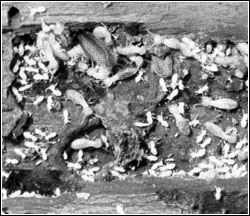
Termites have long been recognized as a serious threat to agricultural and domestic and agro-forestry in the tropics. Some species, however, are able to kill apparently healthy trees and, therefore, have the potential to cause much bigger losses.
Even where termites do not cause death of a tree, they damage the bole, for example, by consuming the heartwood by hollowing the trunk and reducing the value of the tree as a source of timber. The extent to which termites are a problem to trees and the nature of loss they cause, are very much region-specific.
The list of termites attacking trees is apparently not exhaustive since limited studies have been conducted to document pestiferous termites in Pakistan. Termites living and feeding in the soil are almost found on trees.
A survey conducted on termites’ infestation on trees associated with farms in the districts of Jhang and Faisalabad showed that Acacia arabica (kikar) and Dalbergia sissoo (shisham) were the most common trees along the borders of different crops. These trees provide timber to farmers for various needs.
In a follow-up study, it was demonstrated that the presence of crop was not necessary for activity of termites on trees, even when the land was left fallow, same trees were found infested with termites. Though neglected there is a need to treat the trees along with treatment of termites in cropland.
Control of termites has largely relied on broad spectrum and persistent organochlorine insecticides. The ban on the use of these chemicals in an agricultural ecosystem emphasizes the need for alternative methods.
Most non-chemical control of termites on farmlands revolves around good silvicultural or agronomic practices, physical destruction of termite mounds, biological control, and use of plant extracts and resistant species.
However, none of these methods has been evaluated rigorously in agro-forestry and their efficacy remains speculative. It would have been better for farmers to evolve indigenous strategies and control methods for termites but this has not been shown by them rather they have relied on persistent organochlorine compounds and when these were not available, farmers just left it to that.
As a precautionary measure, mechanical damage to trees should be avoided during different agricultural operations such as pruning, weed control or thinning, especially where heavy machinery is used. Wounds and scars on tree trunks or branches serve as entry points for termites into the heartwood of the tree. Besides, mechanical injury, it is thought that stress also predisposes trees to attack, therefore, maintaining plant vigour is an important means of minimizing damage by termites.
A study of the mulching trees with different agricultural wastes and other materials was conducted. Household kitchen waste, sewage sludge, neem powder, ash of khar booti (Haloxylon recurvum) mixed with sulfur (10:1), jojoba meal + lime (10:1), taramira meal + lime (10:1), castor meal + copper sulphate (10:1), dried castor root powder, chlorpyrifos 40EC (20 per cent of the formulated material) were used in the form of 15cm deep and 30cm band around the bole of shisham trees. Age of these trees was 3-5 years. There was no re-infestation of any of the treated trees, when latter were treated twice, in July 2005 and March 2006.
Amongst the above mentioned materials household kitchen waste and sewage sludge are worth employing, as an application around trees would reduce the load on environment which is a growing menace. There would be no cost addition in the application of these materials. The possible risks to human health associated with the agricultural use of sewage sludge are not an easy issue to address because of the complicated variables.
Keeping in view the amount of sludge applied, it may not pose any threat to public health since it is applied to trees which are not directly in use by humans for household purposes. Mulching trees with these compounds do not benefit the mature trees in terms of growth. Thus these are recommended for application to nurseries or new transplanted trees.
Kitchen waste can be the best choice in this manner as there is no need to cover the pile of the kitchen waste with soil since chicken can feed on these wastes.
Chickens are natural predator of termites and they feed by breaking the mud tubes of the termites on soil or along the tree trunk. The presence of chicken would be an additional benefit in the control of termites.
Kitchen waste should not include any dry materials, such as wood, which can attract the termites. It should comprise vegetables or fruit peel and branches of the coriander or mint etc. It would be better to add a small portion of previously composted materials, because the latter contains nitrogen and a huge number of microbes.
The principle underlying the use of kitchen waste is fermentation of the materials releasing the nutrients and other materials which hinder foraging of termites up on trees.
To avoid the stinging foul smell at a latter stage of fermentation or breeding of flies in waste, a thin layer of the surrounding soil mixed with lime or red clay should be spread over the waste. Homeowner, especially from urban areas can be contacted for the collection of this waste.





























