0
0

ISLAMABAD, Oct 5: The World Bank on Thursday forecast a minimum increase of five per cent per annum in the fee structure of higher education institutions to implement Medium-Term Development Framework (MTDF) of the Higher Education Commission (HEC).
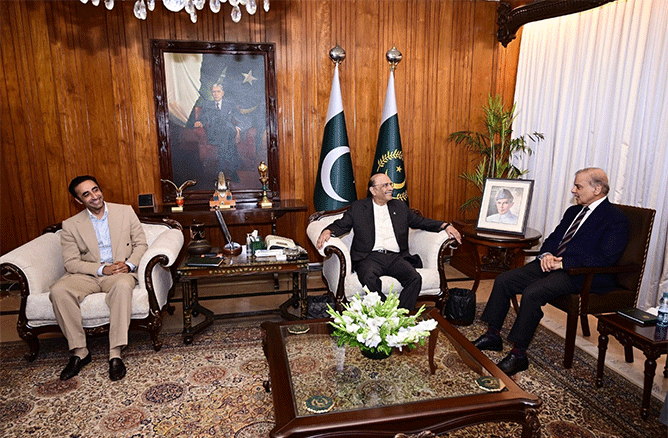
An assessment of the MTDF done by the World Bank was unveiled here by Country Director John W. Wall in the presence of HEC Chairman Dr Attaur Rehman and Adviser to the Prime Minister on Finance Dr Salman Shah.
In early 2005, the HEC developed an MTDF for the higher education for the 2005-2010 period which called for a rapid expansion of the sector along with a number of important reforms aimed at improving quality, efficiency and relevance of the sector.
Assuming past trend will be sustained, enrolments in universities are projected to double by 2010 and triple by 2015, reaching one and 1.9 million by these dates, respectively, the report said.
The projection of costs in the base case is built around an estimate of all measures contained in the MTDF to increase access and improve quality in the degree-awarding institutions.
“If all these measures were to be implemented as planned in the MTDF, it would cost a total of about Rs1,120 billion over the entire 2005-2015 period,” the report said.
In annual terms, the costs would be multiplied by six between 2006 and 2015. In relevant terms, they would rise from 0.5 per cent to 1.4 per cent of the GDP, and would absorb close to 70 per cent of the entire education budget by the end of the period, it said.
However, under the conservative assumption that the budget available for universities during the said time period would not exceed Rs570 billion, of which 22 per cent would be generated from resources, would also result in a cumulative financing gap for the 10-year period of about Rs550 billion.
“This is clearly an unmanageable gap, with no reasonable prospect of being bridged under foreseeable fiscal condition. Therefore, if the MTDF is to be implemented, alternatives must be found to bring costs and resources within a closer range,” the assessment underlined.
It says that even taking government contributions into account, funds must therefore be mobilised from other resources.
The legacy of past neglect is that less than four per cent of the post secondary age group enrolled in universities.
Furthermore, it says, teaching staff is under qualified, curricula outdated and static, and research capacity in the higher education system is week.
Speaking on the occasion, Mr Wall said: “Reforming Pakistan’s higher education system will have a tremendous pay-off and we are already seeing some positive developments, thanks to the creation of HEC.”
At present, Pakistan spends less than 0.4 per cent of GDP on higher education. In comparison, India’s spending on higher education stands at 0.7 per cent, and Malaysia spends 2.7 per cent. The report says that for the needed higher education reforms to be implemented, Pakistan will have to more than double its spending as percentage of GDP in the sub-sector over the next 10 years.
The government’s current spending on higher education through the HEC has increased by more than 344 per cent in real terms from 2001-02 to 2005-06.
“But this recent growth in spending is merely the beginning of the rehabilitation campaign,” said Benoit Millot, World Bank Lead Education Specialist and team leader for the report.
The adviser to the prime minister on finance, Dr Salman Shah, said the government was committed to promoting education sector as it was key to development.
In response to a question, Dr Attaur Rehman said the HEC was taking every possible measure to improve upon the higher education sector of the country and had initiated various programmes in this regard.