0
0

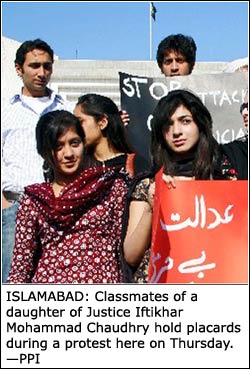 ISLAMABAD, March 15: Amid extraordinary security measures here, the Supreme Judicial Council (SJC) is meeting today to take up preliminary objections of Justice Iftikhar Mohammad Chaudhry to the composition of the council.
The council will also consider a request by one of its members who wants to be excused from proceedings in the presidential reference against the ‘non-functional’ chief justice.
Sources told Dawn that the day the council had met for the first time, Chief Justice of Sindh High Court Justice Sabihuddin Ahmed had expressed desire to be excused from proceedings in the mentioned reference. The Sindh chief justice had repeated his desire when the council met for the second time on Tuesday.
The request, however, had not been made part of the SJC record, said the sources, adding that it was the discretion of the Acting Chief Justice, Justice Javed Iqbal, to take a decision in this regard.
Besides Justice Javed Iqbal and Justice Sabihuddin, the five-member SJC comprises Justice Abdul Hameed Dogar, Justice Sardar Mohammed Raza Khan and Chief Justice of Lahore High Court Justice Iftikhar Hussain Chaudhry.
On his first appearance before the SJC on Tuesday, Justice Chaudhry had submitted a four-page statement, calling for the reconstitution of the SJC with the exclusion of three members.
Made 'non-functional' on March 9, 2007, Justice Chaudhry was accorded a rousing welcome by lawyers and opposition politicians at the time of his appearance before the SJC.
In his statement submitted to the SJC, the ‘non-functional’ chief justice objected that the acting chief justice had been appointed contrary to Article 180 of the Constitution which provided that the acting chief justice could be appointed only when the office of the chief justice fell vacant.
Moreover, under Article 209 of the Constitution, reference against the chief justice could be heard only by the senior-most judge who, in the ongoing situation, is Justice Rana Bhagwandas, he said, adding that there was no urgency to convene the SJC meeting in the absence of Justice Bhagwandas, who is abroad till March 22.
He said that a reference was pending against Justice Abdul Hameed Dogar before the SJC in a case concerning the Shah Latif Bhatai University, Khairpur.
He said the LHC chief justice could also not sit on the council because more than one reference of misconduct was pending against him before the same council. He said the LHC chief justice had also developed strong hostilities against him as he had not accepted his recommendations of advocates and judicial officers for elevation as judge of the high court. Moreover, his elevation as the judge of the apex court was also opposed by him in August 2005 for some reasons which could not be divulged now, he added.
On receipt of a copy of the statement carrying objections raised by Justice Chaudhry, the SJC had served notice on Attorney-General Makhdoom Ali Khan for Friday (today) to respond to the objections.
It is within the competence of the council to decide about its composition. The November 2005 notification concerning procedure of the SJC also empowers it to summon the person who has provided information against a judge or any expert to assist in the inquiry in respect of the incapacity of a judge. In case it decides to proceed against the judge, a show-cause notice is issued along with supporting material calling upon him to explain his conduct within 14 days.The findings of the council could be reported as the proceedings are held in-camera.
On Thursday, the council repeated its earlier direction to the attorney-general to ensure free access to the panel of lawyers with the respondent 'suspended' chief justice; and in case of any problem, the secretary of the council could be contacted.
Meanwhile, Vice-Chairman of Pakistan Bar Council Ali Ahmed Kurd, President of Supreme Court Bar Association Munir A. Malik and Tariq Mehmood held a meeting with Justice Chaudhry for 45 minutes and discussed the case.
Later, Mr Malik told Dawn that no annexure that should be a part of the reference had been provided to Justice Chaudhry who had expressed desire to use the car of his counsel (Mr Malik) to go to the Supreme Court, instead of an official car.
He is reported to have got back his television and his son's car, but the car is without keys. Besides, an Urdu daily is the only newspaper he is getting. He and his family have also been restrained from moving freely inside their home.
A source who had a telephonic conversation with Justice Chaudhry told Dawn that the 'non-functional' chief justice was in high spirits and said that the government was exerting pressure on him to leave the country for a while if he was not willing to resign.
"My hands are clean and I have done nothing wrong," the source quoted Justice Chaudhry as saying.
Former SCBA president Malik Mohammed Qayyum told reporters that there was no provision in the Constitution or any law to suspend the chief justice. He said the suspension was a virtual removal from the office and therefore contrary to Article 209 of the Constitution.
"How can the president suspend the chief justice before the findings of the SJC?” he said.
Citing a Presidential Order of 1970, also validated by Parliament in 1975, he said the president could send a judge, against whom a reference had been filed, on forced leave.
Proceedings before the SJC are neither judicial nor criminal rather administrative in nature, he explained.
According to a BBC Online (Urdu) report, Sharifuddin Pirzada, noted constitutional lawyer and Senior Adviser to Prime Minister Shaukat Aziz, has expressed his inability to represent the government in the Supreme Judicial Council.