WASHINGTON, July 17: Sometimes a military action becomes necessary to fight militancy and if Pakistan decides to take such an action against the militants, the United States will support the move, a senior US official said on Tuesday.
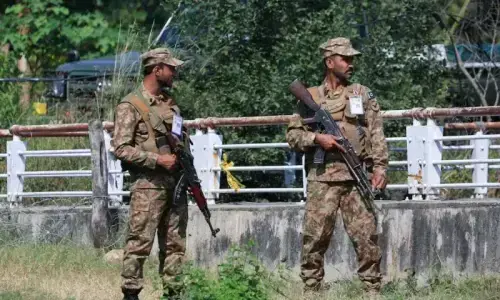
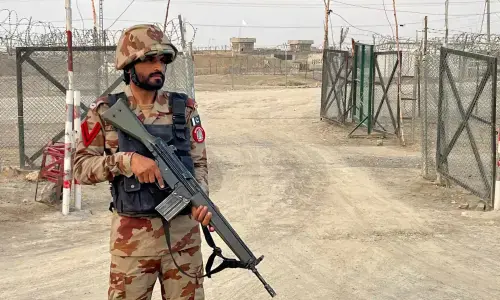
Assistant Secretary of State Richard Boucher also expressed the Bush administration’s intention to provide $300-350 million for training and providing better equipment to the Frontier Corps, including night-vision devices and body armour.
“Some military action is necessary and will have to be taken,” said Mr Boucher while assessing the current situation in the NWFP and the tribal region. “Some elements will have to be dealt with militarily, dealt with weapons.”
He said it was for the government of Pakistan to decide if and when to take a military action, but Washington would back whatever decision Islamabad took.
Asked why President Pervez Musharraf needed US support to fight the militants hiding in the tribal areas, Mr Boucher said although the Pakistani leader was capable of fighting militancy on his own, “he is going to have our support”.
The United States, he said, supported Gen Musharraf, “first of all because he is the president” and also because “he has shown the determination and the ability to lead in a very difficult situation. So we have no problem working with him.”
But he disagreed with the suggestion that Pakistan’s political leadership may not be as willing to fight militancy as the military government.
“If you look across the political spectrum, you see a broad support for working against extremism, and this included politicians like former Prime Minister Benazir Bhutto,” he said.
“The Pakistani people have cast their lot in favour of a modern and moderate Islamic state and there is no going back,” Mr Boucher said. “And we are with them in this.”
When a reporter reminded him that past military actions in the tribal areas have resulted in civilian casualties and raised anti-American feelings, he said: “One makes every attempt to keep civilian casualties at the minimum ... they (the militaries) learn from previous experiences and (become) a lot more sophisticated in the use of force.”
Mr Boucher said that the reason the government of Pakistan took so long to act against the militants holed up in Lal Masjid was that they wanted to minimise civilian casualties.