0
0

Radio, for good or evil
FM radio has a special place in my heart. When I was in college in America, when dinosaurs roamed the earth without let or hindrance, gibbering on radio was one of my favourite pastimes. Other equally or more stimulating pursuits are best forgotten in old age, lest they bring on cardiac arrest or, worse, extreme anxiety vis-à-vis what can never be relived in its original context. No surprises there. What is past is past.
At any rate, those rusty memories have no place in this glossy day and age, involving as they do, by today’s prudish standards, open-ended adventures revolving round concerts by such ‘oldies’ like the Grateful Dead, Bob Dylan and Neil Young. Separately they rocked for the most part but there were occasions, etched on the mental retina as if with acid, when at least two of the three came on stage together to blow away what was left of your mind.
Despite my fondness for American rock and folk music, what I played on radio was reggae, hard and true. None of that ragamuffin or tinkly dancehall stuff. Let’s talk Mutabaruka, Peter Tosh, Toots and the Maytalls, Linton Kwesi Johnson and the occasional Bob Marley. For four years I called it Crucial Reggae and, so I like to think, built up a modest following in a tiny section of upstate New York.
Radio in Karachi doesn’t always offer what I consider choice treats, and that’s perfectly understandable for tastes tend to differ. It would be a boring world indeed if everyone thought the same way — that’s what the mullahs want, don’t they? What FM radio does do is give a voice to the people. As heard in Karachi, it offers a glimmer of hope. More than anything else, it is living proof that we are not all fundos yet, not by a long shot. Most of the people who call in just want to make the most of life, such as it is, and wish their fellow citizens well.
Live and let live is the motto on the airwaves, at least as far as I can tell from the daily dose of my favourite stations, Mustt FM103 and FM107. In particular, 103’s Sunday fare blows the competition away and no questions asked, starting with the Pukhto show in the morning and keeping listeners hooked until Billoo Bhai leaves the building. In between, in Mehranh Rang, Shah sahib’s choice of music is superb (the host insists on the ‘h’ at the end of Mehran, though not in English).
What makes some FM stations so markedly superior to the rest is their commitment to discourse, over and above entertainment. They aim to make the people of the concrete jungle talk, to say what’s on their mind. And there is plenty plaguing people’s grey cells in this year of the lord, from difficulty in paying the bills or seeing your friend blown up by a suicide bomber to electricity outages and failed romances. There is something soothingly egalitarian, democratic if you will, about the accessibility of FM radio. It is interactive, often feeding on itself, and like a Jerry Garcia jam can go almost anywhere.
In our culture, where the little person is stomped on with a viciousness that does not bear contemplation, where else can you hear the voice of the people? While there is nothing revolutionary about it, FM radio at least allows people to vent when they are close to bursting and feel less pent up, even if the succour is fleeting.
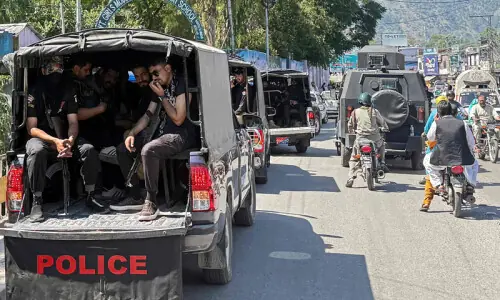
The power of radio is not lost on the truly evil. All over the tribal belt — and most notably these days in Swat — deranged semi-literate clerics with filthy minds are using the medium to spread their message of hate. And succeeding, sadly, by the looks of it. This is surmise of course, but maybe those who are listening to these lunatics wouldn’t have bothered if saner voices were available.
Enough said, for now.
imalik@dawn.com
Pointillism stages a comeback
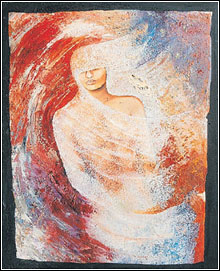 KARACHI: Shaheen Siddqui believes in never say die. She will hound an art writer and make sure that he is there at the exhibition of her paintings. What is, however, praiseworthy is that even in the most crisis-ridden periods in her life, she didn’t give up painting. That was her catharsis. Her paintings have become much brighter and the explanation that she gives is that the crisis in her life is over. Good for her and good for her paintings.
She used to do nudes, but now her females are clothed, some scantily though. Why, she doesn’t offer an explanation. When this writer asks her why green dominates in one of her paintings? “I can’t tell you why because when I pick up my brush, I don’t decide what colour would dominate. It happens all by itself. It’s not like planning your strategies,” she replies.
Ms Siddiqui’s work is not entirely realistic now. Distortion has crept in. There is also some movement. “I started with pointillism and then gave it up. You can see that it has made its appearance once again. Look at this painting, you find paints pasted with a knife all over. The skin is painted with the thumb and the index finger. The dress has points which have been created with the tip of the brush.”
She points out at a painting with two women draped in stripes. The cleavages are more than apparent, so I protest when she tells me that these are Thari women. “How can they be Thari, when for one thing they don’t have bangles and for another I haven’t seen a single Thari woman showing off her cleavage,” she is not convinced with my argument. And I am not with hers. So, we are quits.
You haven’t asked me about this painting, she says. It shows a village-belle riding a bull. “The beast is a symbol of masculinity and the village girl, symbolising feminine beauty, has conquered it. She is clad in red colour. Red, as you know, is a colour that provokes anger in a bull,” she says. My knowledge of bulls is limited so I take her word for it.
Two paintings, which show European children, seem out of place in an exhibition where our own women are shown in every frame. Why? “This is because I have travelled a lot, so the kids have been a part of my memory,” comes the answer.
But full marks to Shaheen Siddiqi for she is, as she claims, a self-taught artist. She has been inspired by Jameel Naqsh, a point she always makes unhesitatingly. “I have examined Jameel Naqsh’s work so minutely that I have at times been influenced by him.”
This is her 21st solo exhibition -- a result of eight months of hard work. “I paint when I am not writing poetry or playing on my sitar,”
“Why do you hold your exhibition at Shakil Ismail’s Gallery, when you have a gallery of your own?” is a question someone asks Shaheen Siddiqui at her exhibition that opened on Monday. “Well, it doesn’t seem nice that you host your own work. When Shakil decides to exhibit his paintings we at Gulmohar offer him our hospitality,” answers the lady.—Asif Noorani
| © DAWN Group of Newspapers, 2007 |