



 0
0

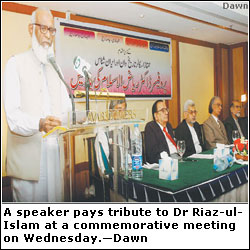 KARACHI, Dec 12: One of the people who have left an indelible mark on scholarship because of their continuous efforts to build a better relationship between Iran and Pakistan is the late Dr Riaz-ul-Islam. An erudite scholar, professor emeritus and a conscientious historian, many have been deeply affected by his death.
These were the sentiments expressed at a commemorative meeting held at a local hotel here on Wednesday to pay tribute to Dr Islam, where a number of educationists and poets from both Pakistan and Iran remembered his contribution to education and research. Author and editor of some excellent books on history and the Indo-Persian relationship, Dr Islam’s scholarly skills were not just confined to Pakistan, but were appreciated in countries like Iran, the former USSR, Europe and Canada as well, speakers said.
“Pakistan, Iran and to an extent the entire Islamic world should be thankful to Dr Islam for his efforts in forging contacts between two Islamic countries”, said Massood Mohammad-Zamani, Consul General of Iran in Karachi. He added that the Persian language and Iranian culture has played a major influence on Pakistan’s traditions, giving the example of the national anthem, which was written more or less in Persian. He further said that books authored and edited by Dr Islam will continue to benefit future generations, and hoped that students would follow in the scholar’s footsteps.
University of Karachi Vice-Chancellor Dr Pirzada Qasim Raza Siddiqui reminisced about his association with Dr Islam and said that the latter was a great inspiration for his students. Dr Islam, he said, had been associated with the KU since its conceptual phase and guided the university with his exceptional vision. “Dr Islam was a great human being and a splendid teacher. No matter where he went, he was selected on the basis of his merit and scholarly background”, he said.
Dr Ghulam Rabbani Aagro also praised Dr Islam’s contributions and requested the vice-chancellor to oversee the conclusion of the literary projects that the late scholar had initiated.
Speakers also highlighted the many facets of Dr Islam’s personality, who, they said, was a beacon for many people.
Other speakers included former dean of the KU’s faculty of arts Dr Arifa Fareed, historian Prof Dr Tafheemi, department of general history chairperson Nargis Rasheed, Dr Rehana Afsar of the Persian department, scholar Dr Affan Seljok and the Director-General of the Khana-i-Farhang, Islamic Republic of Iran, Dr Mehdi Tawassali.






























