0
0

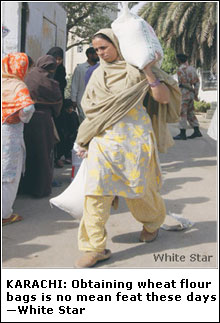 KARACHI, Jan 14: While the drawing rooms of Pakistan’s rich and powerful are abuzz with speculation as to who killed Benazir Bhutto, and whether or not the elections in February are going to be free and fair, the question on the minds of most ordinary people is how to get their daily bread.
With prices of essential commodities skyrocketing, long queues can be seen outside government-subsidised shops as people wait to take home that coveted 10-kilo bag of wheat flour.
“Either I can vote or stand in this queue,” said an irate Sheikh Mohammad Moin, standing since seven in the morning “with just a hurried cup of tea,” waiting for the doors of the ‘Utility Stores’ to open.
By 11.00 am there is still no sight of the truck that brings the flour. The queue is growing longer and patience wearing thin. A 10-kilo bag of flour is sold here at Rs230 compared to the Rs180 mandated by government at regular retail shops.
Over the past one month, there have been endless queues outside these shops all over the country as flour prices shot up from Rs13 a kilo to Rs28 and even Rs30.
To check profiteering, the government moved to fix the maximum price at Rs17.50 a kilo and started fining retail shop owners who were caught selling at higher prices. The result was that flour vanished from the markets.
Moin, working in the telecommunications sector, had to request for a change in his shift timings so that he could stand in the queue. But there is no guarantee that by the time his turn comes there would any flour left for him to carry home. The line is long, almost four dozen men stand patiently, and it is certain that most will come away empty-handed.
Next to Moin, Rafique (jobless since he became too ill to work in a shipping company) standing patiently, says: “It is my third time, this week. I’ve been successful once.”
But Asim Mehdi, who works in a textile factory, has come five times and never once succeeded. “It’s difficult. I’ve either to take the day off, or change shifts and even after that I end up buying a 10-kilo bag for Rs250 from the (open) market.”
“Neither the rulers nor the political parties deserve my vote,” he says angrily. “I don’t want to waste my vote or time on them,” he adds.
Only 13-year-old Mohammad Nadeem looks happy standing in the queue because it means he can skip school. “I’m the eldest and because my father is a railway employee, he cannot take time off and he sends me instead as my mother has to look after my younger siblings and do house work.” Nadeem manages to get a bag home every time.
The men kill time expressing opinions on why the flour crisis persists, and many point to the government colluding with rich mill owners to create artificial shortages and increase demand.
“It’s a government created shortage …because flour is being smuggled out of the country to Afghanistan we are facing this crisis,” said someone. “The mill owners are hoarding stocks and creating artificial shortages.”
Earlier in the month, there were news reports that some politicians were involved in the hoarding, but the government refused to crack down, fearing problems for the Pakistan Muslim League (Q), former ruling party which supports Pakistan President Pervez Musharraf, in the general election.
Frequent and long power cuts, said some, has also affected the working of the flour mills.
Still others pointed to the flawed government policy, saying that a 35 per cent duty imposed on wheat exports came too late as much of the stocks had already been disposed of.
Opposition parties have been slamming the government for its failure to act in time. Maulana Fazlur Rehman of Jamiat Ulema-i-Islam has accused the government of deliberately creating flour, oil and power shortages to divert public attention from the mysterious and spectacular Bhutto assassination.
Explaining the genesis of the wheat crisis, Asad Sayeed, an economist, says: “The main reason is that around last May-June, the government declared that there was a bumper wheat crop of 23 million tonnes. In reality, the crop was only 19-19.5 million tonnes. Such a vast divergence between estimates and actual output has never happened before.”
“With hindsight,” said Sayeed, “the purpose was to depress the price for the growers. Based on this false estimate then, they decided to export wheat (which in any case was insufficient) to Afghanistan. This created the initial shortage. Then in June, there were calls to import wheat to overcome the shortage. At that time the international price of wheat was 200 dollars per tonne. The imports were delayed for a few months, anticipating a shortfall in the international market because of a bad crop in Australia. Eventually, wheat was imported when international prices had gone up to 350 dollars per tonne. The mechanism of import is that the Trading Corporation of Pakistan (TCP) asks for tenders from local groups to import wheat and sell it to them. So, a higher price means a higher commission for them.”
Sayeed blames the government of President Pervez Musharraf for this “because it is run by a small band of regime cronies”. “While all governments in Pakistan have cronies, the difference here is that Musharraf’s cronies are totally unaccountable to the people.”
Sayeed said the various shortages that have racked Pakistan in the last two years were like “another form of speculation” similar to that in “real estate and the stock market”.
Such explanations are of no use to the people standing in the queues. The lines for women are even longer than those for men. Fatima Mansha, a cook, has also taken the day off. “If I come in the afternoon there would be no flour bags left, so today I decided to try my luck in the morning.” There are 13 people in her household and a 10-kilo bag will last three days “if we use it frugally”.
The day goes by and the queue grows longer. The women lose their patience as their young accompanying children pester them. There is no place to rest, no toilets to relieve themselves. Still no one leaves her place in the queue since that could mean coming back again for another fruitless wait.
“I don’t mind standing here the whole day, but to tell me that they are out of stock, when my turn comes, is going to break my heart,” says Shamim. The 16 members of her family consume five kilos in a day. “And even then most of us never sleep on a full stomach.”
“There is no shortage of flour,” says Ruby Ibrahim. “I see so much of it in shops close to my home... what’s in short supply is the money on us.” She says she has heard Musharraf say in his speeches to stop buying things if they are expensive. “If we cannot even buy flour, what is left to eat... we’ve already cut down on most kitchen items…vegetables, milk, lentils and ghee (clarified butter) are expensive too. What is a poor person to eat, just dust?”—Dawn/IPS News Service