



 0
0

 PEHSHAWAR: Saeed Ahmad Khan, one of the hundreds of political workers who had rendered sacrifices for democracy, finds himself misfit in today’s electoral politics.
Even though he spent seven years of his life in jail for the cause of democracy, he believes contesting elections in Pakistan is no more the job of a poor political worker like him because “it is money which makes the difference.”
“We spent hardly Rs27,000 on election campaign of the late Hayat Ahmad Khan Sherpao when he contested election from NA-1 and PF-4 (Peshawar) in 70s,” recalls Mr Khan. Electioneering was so simple and cheap in those days that workers from the middle class could contest, he added.
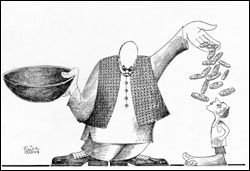
The use of money, in his view in electioneering has become the norm of the current political culture, where a candidate for National Assembly seat has to spend at least Rs20 million to Rs25 million -- a cost only a billionaire can afford.
As per the Representation of People Act, 1976, the limit of spending for a NA constituency is Rs1.5 million and Rs1 million for Provincial Assembly. But who cares.
The blunt comments of Mr Khan truly depict the current electoral culture, where genuine political workers with meagre finances could not survive.
Apart from showing generosity in donating funds for obtaining party tickets, a candidate has to spend big money on election-related activities that have been diversified over the period.
Local leaders of all the mainstream political parties concede that their parties have a fee structure for party tickets. The parties’ official fee for tickets in the current elections ranges from Rs15,000 to Rs35,000, whereas unofficially candidates paid Rs100,000 to Rs300,000.
Spending money on organising corner meetings, usually followed by lavish lunches or dinners and transportation of voters and polling staff, have traditionally been the two main heads.
But technological advancement, say observers, in the advertising sector and growing demands by voters of execution of uplift projects even before the elections had played instrumental role in making electioneering a multi-million game.
Cost estimates for electoral campaign vary from area to area. For example, in rural areas a candidate focuses on door-to-door campaign or corner meetings, whereas in urban areas candidates have to spend major portion of money on advertising campaign. According to political analysts, NA-II (Peshawar-II) has become one of the most expensive constituencies, where the candidates are pouring maximum resources into advertisement since the area offers the best sites for displaying gigantic billboards in the provincial capital.
A small billboard costs Rs10,000 per month, whereas now when election campaign remained for more than two months spending on this particular area by the candidates has surged drastically.
One of the candidates from the same constituency conceded in private discussions that the election campaign had cost him Rs20 million so far.
Apart from spending on publicity campaign, the analysts say the candidates are also paying sufficient amount for uplift projects identified by the communities.
Reports received from different constituencies suggest that candidates in Peshawar are currently paying for paving of streets, water supply pipelines and power transmission lines and installation of power transformers.
Constituents – the ultimate beneficiaries of this money game -- don’t consider such demands as unethical. Rather they have their own justification.
”This is a good time to get community-related work done through the poll aspirants because the politicians usually don’t look back to their constituencies once they reach to the power corridors,” Ziarat Gul, a disgruntled voter from NA-one, explains.
The money factor, besides making electioneering a game for multi-millionaires, has also some ‘positives’, especially when it comes to the economic cycle generated as a result of electoral activities.
Advertisers, printers and transporters act as the driving engines for these economic activities.
The current electioneering, analysts say, has enabled outdoor advertisers to benefit from the technological advancement made in this sector, thanks to low-cost raw material and machinery imported from China.
An executive of a local advertising company says that in the NWFP there are around 100 outdoor advertising firms, which have upgraded their technical capacity by adding on more machinery, mainly to meet the highest ever demand from their clients in the current elections.
Delaying the elections from Jan 8 to Feb 18, according to him, has proved to be a boon for advertising companies, whose billboards occupied by the candidates, will double their bills.
Same is the situation with printers having their printing units at Mohallah Jehangi, the hub of printing industry in Peshawar. Printing presses are working to their capacity, as according to information, most of the printing units were working round-the-clock to meet their orders.
Local printers say they were dependent on Punjab’s industry for printing of multi-colour posters, leaflets and stickers, but now everything could be done locally, as keeping an eye over current elections, they had already brought required machinery and material in advance.
Growing demand from candidates is evident from the fact that the prices of paper and other related material have witnessed a major surge. People associated with this industry say electioneering has given a boost to business.
As poll day approaches, candidates are also making efforts to hire maximum vehicles for carrying the voters on election-day although by law it is not allowed.
Even though a major portion of election-related expenses are borne by the Election Commission of Pakistan, the provincial government is also set to spend a handsome amount, mostly on maintenance of law and order.




























