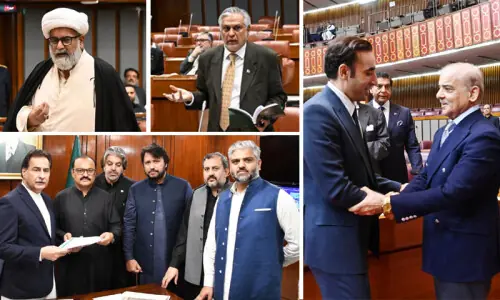
ISLAMABAD / LAHORE, Feb 23: Controversy lies in store for the opening session of the new National Assembly as the interim government’s legal experts have decided to get printed a fresh edition of the Constitution, incorporating all amendments introduced by President Pervez Musharraf during the emergency rule.
The question haunting the PML-N and PPP’s legislators-elect alike is: will they take oath under the amended Constitution, which has been ‘validated’ by the Supreme Court?
Both parties have already rejected these amendments and termed them “unconstitutional and invalid”. They contend that the amendments have been made by an individual instead of the parliament.
The government insists the imposition of emergency (on Nov 3), the enforcement of the Provisional Constitution Order, sacking of judges and other steps taken by the president during emergency had been validated by the apex court and made part of the Constitution.
It also asserts that the legislators-elect taking oath under the amended Constitution would, by implication, be endorsing all these steps.
The PPP has said that it would not give a blanket cover to all steps taken by President Musharraf during emergency.
A PML-N leader said on Saturday that the matter was under consideration and some solution would be found by the time the National Assembly holds its inaugural session.
“Obviously (the new version of) the Constitution would contain Article 270AAA under which amendments made before and during the … emergency rule were given perpetual legal cover,” said a senior government official.
He said if the printing was delayed “we will have to manually affix the corrections in the constitution”.
Normally, the law ministry and the National Assembly secretariat are authorised to print the Constitution.
Attorney General Malik Muhammad Qayyum is on record as having said that no constitutional provision required validation by parliament, adding that changes like the Eighth and the 17th amendments were ‘ceremonial’.
A similar situation had cropped up after the 2002 elections as the Legal Framework Order (LFO) was made a part of the Constitution. A large number of legislators-elect had refused to take oath under the amended Constitution, prompting the then speaker, Illahi Bux Soomro, to show the protesting members his copy of the Constitution and declare that LFO was not part of it.
However, Article 270AAA is a major bone of contention between the president and his legal experts, on one side, and the opposition and the lawyers’ community, on the other.
The lawyers contend that the Constitution cannot be amended without a two-thirds majority in both houses of parliament.