0
0

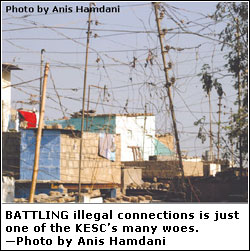 KARACHI, Feb 26: One of the major challenges the newly-elected government will face is the impending power crisis this summer due to the dwindling generation of Wapda and the Karachi Electric Supply Corporation and the failure of the KESC to improve its outdated distribution system to meet the increasing demand.
However, sources said some spadework has already been initiated to impress upon the utilities concerned to take immediate measures and draw up contingency plans.
According to KESC sources, the utility will be resorting to more than six hours of staggered load-shedding, most probably from sometime in March/April, because there would be a gap of about 600 megawatts, causing massive disturbances in industrial production and civic life.
On Monday, 1,644 MW was available to the KESC, whereas demand had surged to 1,805 MW, leaving a shortfall of 154 megawatts, causing more than one hour long load-shedding across the city.
On paper, the installed generation capacity of the KESC is 1,300 MW, but actually, Bin Qasim plant can hardly generate 850 MW, KTPS 65 MW, Korangi gas turbine 34 MW and Site gas turbine 32 MW, which comes to 981 megawatts.
The KESC can muster an additional 678 MW from outside sources, including 80 MW from Kanupp, 113 from Tapal, 112 from Gul Ahmad, 500 from Wapda, (which may fluctuate), 46 from small independent power producers and a few megawatts from the Defence Housing Authority sources.There is no indication that four gas turbines of the Korangi plant, producing 170 MW power and a combined cycle turbine of 30 MW, would be operational by April this year, as was promised by the privatized KESC management last year. It is likely to be available sometime in July-August.
As the city faced unprecedented load-shedding last year, the demand had surged to 2,400 MW. If the standard 10 per cent increase in demand is factored in, it could be something in the vicinity of more than 2,700 megawatts, leaving a big gap in demand and supply.
The KESC is facing problems because it had not addressed the generation capacity, which is dwindling each year instead of increasing, to meet the growing demand.
Notwithstanding the element of alleged corruption and incompetence of the utility’s management and workforce, the ban imposed on setting up thermal power plants by Wapda and the KESC by General Ziaul Haq in 1987 complicated the problem. But this ban was not applicable to the KESC after its privatization on Nov 25, 2005, and it was allowed to set up 100 MW power plants.
But the KESC management, which at that time was looked after by Siemens, could not capitalize on this. Instead, a 19-year-old 850 megawatt power plant from Italy was attempted to be imported. But in the face of strong criticism, the plan was shelved.
Promises unfulfilled
In view of the unprecedented power crisis last year, the KESC management had informed the Sindh governor in October that by December 2007, additional power would be added to the grid. But that was not done. Similarly, the proposal to acquire a barge-mounted power plant to meet the contingency until additional generation capacity was added to the utility was also scuttled without any consideration of the rising demand graph for electricity.
Although traders and the general public have acquired generators to meet the situation, the rising price of fuel might force people to remain without electricity for some time to cut expenses.
The power crisis had aggravated because the utility never considered measures to cope with the additional load of uninterrupted power supplies (UPS), which consume a considerable amount of power for charging the attached batteries. The widespread use of UPS is in addition to the proliferation of other electrical appliances.
Another reason behind this crisis was that while the load had constantly been increasing, no upgrading of the distribution and transmission network has been undertaken in over a decade and the system had started falling apart.
There has always been an urgent need for new generation plants, especially in the public sector, to meet the future demand in Karachi as the existing transmission lines, grid stations and distribution network have been carrying much more load than their capacity, and simply could not carry more.
Lost in transmission
Surprisingly, the privatization agreement with the new KESC owners does not bind them to make any investments in the transmission and distribution network over a specified period. No investment has been made in the system since privatization, probably because of this exemption. Thus, the crisis will continue to deepen if the upgrading of the network is not undertaken on a war-footing.
Almost half of the available electricity being lost in transmission and distribution could be saved and tariffs could be brought down significantly by strengthening the system. Sources say that the crisis is not one of shortage of electricity; rather, it is one of poor management over a very long period of time.
The proposal to set up power plants on a public-private partnership basis for industries has been discussed while experts had advised the government to speed up work on a coal-based power project to meet the shortfall.
It may be pointed out that the government had doled out Rs12 billion to the utility under the financial improvement plan in 2004 to bail out the KESC management and help it overcome the crisis.
According to sources, the previous KESC management had spent about Rs3 billion over a period of two years prior to the utility’s privatization, but no tangible development work was seen on the ground and the crisis persisted. Had the money invested by the government been spent on grid stations and other projects, the crisis would not have become so intense.
Stakeholders and others also see ‘foul play’ in the process of KESC’s privatization, arguing that it was given away for Rs22bn against the estimated value of its assets and receivables of around Rs200bn.
Keeping in view the growing demand of electricity in the city, a consortium of the CDGK, Port Qasim Authority and a foreign firm had on April 4, 2007, announced they would set up a power plant in the metropolis to generate 350 megawatts power.
The plant was supposed to be established at Port Qasim, for which the consortium had reportedly acquired 20 acres of land. But replying to Dawn’s query on Tuesday, the CDGK maintained that it has submitted a formal request for allotment of 200 acres of land for the establishment of the proposed plant adjacent to KESC’s Bin Qasim power plant.
The plant would have five gas turbines, each producing 16 MW with a total capacity of 80 MW, whereas eight gas turbines of 30 MW each would produce 240 MW.
City Nazim Mustafa Kamal had told a press conference on April 4 last year that the plant would produce 320 megawatts electricity, which would be sold to the KESC for onward distribution in the metropolis. “In future, the generation from this power plant would be increased to 1,800 MW,” he had added. But there are no signs of progress in this regard.
The CDGK also signed an MOU with a California-based firm to set up a plant for generating 2,000 MW for the city, for which the Alternative Energy Board has already issued a letter of intent to the company. This would add 4,000 MW capacity for the whole country, including 2,000 MW for Karachi.