0
0

The second verdict
THE thumping majority with which the National Assembly has elected Dr Fehmida Mirza and Barrister Faisal Karim Kundi of the PPP as the Speaker and Deputy Speaker, respectively, comes as the second anti-establishment verdict in just over a month. Dr Mirza’s election as the first-ever Muslim woman speaker of a legislature anywhere is particularly welcome. The PPP-led coalition has shown that it commands the confidence of the House by an over two-third majority despite the delaying tactics applied in summoning the NA: over a month has passed since the election but new governments have yet to take office at the Centre and in the provinces. Provincial legislatures are yet to be convened, even though the same winning forces are poised to form governments in all the four federating units.
As the Constitution stands since 1990, it is not for the president to invite the person who he thinks commands the confidence of the NA to form a government. The PPP’s not naming its candidate for the premiership cannot be made an excuse for delaying the calling of the NA to elect a prime minister. The session should be called for the purpose without further ado. If the reason for delay is the unfolding reality that President Musharraf is rather isolated now and that the Senate is the only elected forum, where he does not fear a majority of his rivals, it is ill-advised. The speakers’ election should help the president see for himself the writing on the wall. If he still wishes to tarry with the summoning of the NA to elect a PM or delay calling to session the provincial assemblies, then heavens alone help him. Any sound counsel going out to President Musharraf in the wee hours of what has been his absolute grip on power for the last eight years must entail that he take serious stock of the situation. Delaying transfer of power on whatever pretext can cast further aspersions on his role and distract from the credit for holding free and fair elections.
These are critical times; but, certainly, there is life beyond the Musharraf presidency. Internal and external security concerns and the unfinished business of the judiciary beckon the next government. The economy, too, is crying out for help, as the power crisis deepens and inflation takes a crushing toll on people’s budget. These are no small challenges. The sooner the process of transfer of power to the elected representatives is completed the better. Let it not be said that procrastination on the part of a slighted president, as indeed his advisers who have brought him no good counsel all these years, is aimed at creating more mischief. The people have spoken; now their will must prevail without any further delay.
Five years later
FIVE years after it invaded Iraq, the US finds itself hopelessly bogged down in that country. Statistically speaking, Washington can come up with the right figures to show that it is winning. Last year’s ‘surge’ has led to a 60 per cent drop in violence, and the daily average death toll has fallen from 65 last June to 26 now. Baghdad is relatively quiet, and some refugees have started returning. But these figures should not serve to overshadow the bigger picture, which is grim. Vice President Dick Cheney called the Iraqi invasion a “successful endeavour”, but his presence in Iraq’s capital coincided with a devastating blast at Kerbala, when a female suicide bomber blew herself up, killing a minimum of 41 people. The reason for Baghdad’s ‘relative calm’, as claimed by Mr Cheney, is that ethnic cleansing had already taken place before America sent another 30,000 troops to Iraq. He may find it difficult to explain the increase in the frequency of suicide bombings, which averaged seven a month towards the end of last year, has gone up to 18.
The cost to America itself has been heavy in terms of human lives, and not merely money, which the Bush administration can afford, despite the rejection of its Iraq policies by American voters in mid-term elections in 2006. There are 4,000 American dead, and if we include the injured and the psychiatric cases then the casualty toll, according to the Pentagon itself, has surpassed 50,000. The financial cost ranges between a minimum of $500bn and $3tn dollars. To the neocons, who have exercised absolute control over the policies of the Bush administration, this cost may be “worth it” — like Madeleine Albright’s infamous statement that the death of half a million Iraqi children from the US-led sanctions was “worth it”.
The truth is that in the process of destroying the Saddam regime, the Bush administration has destroyed the country itself, and that has not served American interests. Rhetoric notwithstanding, it is doubtful if the next US administration will find it easy to withdraw from Iraq. But whenever it decides to pull the US troops out they will leave behind them a country in total chaos, with Kurdistan already all but independent. In fact, there is every possibility that Iraq could head towards dismemberment, with its inevitable consequences on the neighbouring countries. This anarchy in an oil-rich country is likely to help extremist groups and will constitute anything but the “successful endeavour” Mr Cheney talked about.
Another school bombed
A SCHOOL for girls has once again been blown up by militants in Darra Adamkhel which, along with other places in the tribal belt and the NWFP, has witnessed similar attacks over the past couple of years. Threats are routine, and have resulted in schools being closed, parents not sending their daughters or students conforming to militant demands by donning burqas. This is a worrisome trend and one shudders to think of the consequences of such violence as it spreads to other parts of the country. Already the adult female literacy rate in Pakistan is a mere 35 per cent, about half the male literacy rate. Girls’ enrolment in primary and secondary school is also far less than it is for boys, while the primary dropout rate among them is higher. This implies an inferior social status for them. With this level of general apathy towards girls’ education, it is not surprising that when militants threaten to blow up their schools or actually do so, there is very little protest and the state is not concerned about providing security. Admittedly, the NWFP and its environs are among the most conservative parts of the country. But it is sad that even the more liberal political forces in the area do not realise the importance of education for women, and refrain from moving against those who deliberately put hurdles in their path.
The truth is that while militancy is destroying whatever little progress women and girls may have made over the years, be it in education, politics or in some other field, tribal beliefs and general conservatism have proved almost as much of a setback. Perhaps it is a positive sign that this time the government in the Frontier, which has strong links to the tribal areas, is a secular one unlike its predecessor. One hopes that it will be progressive in other ways too. It has a moral and legal responsibility to ensure that girls and women are not restricted. For this, the provision of a decent education at all costs is a necessary first step.
Fear, power & people’s voice
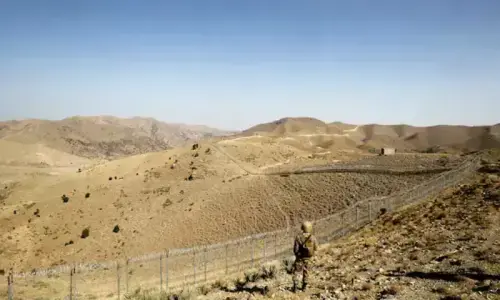
THE trail of events in the Pashtun belt from tribal Waziristan in the south to the Swat valley in northern NWFP has brought a cloud of fear and despair to the region. This has changed the entire sociocultural and ethno-tribal dynamics of society.
In Swat and Waziristan, power has been transferred from the local elite to the Taliban and from the civilian administration to the military establishment. The writ of the state was probably the first casualty in the process. Most observers therefore believe that this marginalisation in the Pashtun belt is mainly responsible for strengthening militancy and militarism, which instil fear in the people and help the militants in their bid to fill the void left by the collapse of socio-economic and political institutions.
The extremist movements in Swat since the 1990s have been strong in the area where the landed aristocracy has traditionally retained a firm hold. The people who joined the extremist movements of both Sufi Mohammad and Fazlullah were mostly those who belonged to landless families. The religious groups had always been considered inferior and were not allowed any say in the socio-political affairs of the area. Both movements gave the marginalised power and prestige and pushed the erstwhile Khans and traditional elders to the side, besides making the majority of the common population voiceless and powerless.
Chomsky argues that “the resort to fear by systems of power to discipline the domestic population has left a long and terrible trail of bloodshed and suffering.” In his essay ‘A Resort to Fear’ he elaborates using the examples of Nazism in Germany. “The ‘ordinary’ folk were driven to fear of a Jewish-Bolshevik conspiracy to take over the world, placing the very survival of the people of Germany at risk. Extreme measures were therefore necessary in ‘self-defence’.”
We clearly find the same theories doing the rounds through the ideological drama being played in the Pashtun belt. George W. Bush declares war on those who are going to snatch ‘freedom, liberty and democracy’ from the American people while bin Laden and Mullah Umar (besides Fazlullah, Baitullah Mehsud and Faqir Mohammad) claim that the US is hatching a conspiracy with the rest of the ‘Christian world’ to annihilate Islam. In this case, militarism and militancy reinforce each other in a dialectical manner.
The perpetuation of fear both by the systems of power and by militancy marginalise a whole community and culture, turning the majority of the population into ‘subalterns’, a term coined by the Italian intellectual Gramsci. Rob Burton, a professor at California State University, says: “Gramsci used the term both literally and metaphorically to describe those who had been marginalised, forgotten, overlooked or ‘othered’.” Burton further says that “The voices of resistance (of the subalterns) might be expressed through songs, films, murals, oral and written stories, letters, even community-based traditions such as dances or village gatherings.” Is this true in the case of those trapped in the fear created by militancy and militarism? Can the common people trapped in fear have the strength to express themselves?
There has been a substantial collapse of the power of expression among the common people of Swat and Waziristan in recent months. Sociocultural gatherings in Swat since July 2007 have come to a halt. Even marriage ceremonies are held in a quiet manner. Music and other types of artistic expression have become a story of the past. It seems the people have become mute and are unable to express even an innocuous opinion. Those who could create space for such expression, like political parties and social organisations, have either closed down or abandoned their liberal and democratic stance. The individuals who used to give a voice to the people have been eliminated or forced to leave the area.
The Pashtun intelligentsia is divided in deciphering the major causes of the trauma. One group of opinion-makers focuses only on a larger picture making the people believe that the war has been imposed by the US and other western powers, and thus cannot be reversed. The other group believes that the militants have appeared out of the blue and that the rebellion must be quelled with force. In both cases, the common people are left with no option and have to live in a dungeon of limitless fear.
It has been observed that focusing on the larger picture of conflict has not been helpful in dissolving the immediate state of fear. The people must be able to assign themselves a role. Focusing on the larger picture only deprives them of this role. Instead of giving conspiracy theories more space to grow and engulf the whole population, a better option is to support the people to work for their collective survival by overcoming their fear of the unfamiliar. This can happen only when there are spaces for expression and communication. The intelligentsia must help the people rediscover their voice to play a decisive role in ending their suffering.
Poets and writers represent another stratum of society that could give a voice to the people. We have yet to see any novel or short story in Pashto that gives expression to people’s feelings, though some very excellent poetry has been created by some very promising Pushto poets on the subject. English writers like Khaled Hosseni in his A Thousand Splendid Suns and Feryal Ali Gauhar in her No Space for Further Burials have given expression to the fear sown and grown in the minds of a whole generation trapped between militancy and militarism.
Feryal Gauhar’s expression is more incisive and revealing in discovering the language of fear. “There are many languages here, and the only one I have managed to understand is the one which speaks of fear” as she put it. And what does this language look like? “As if the tongues of all the people here had been pulled out and chopped into pieces and scattered to the wind”. That is the way the language of fear works.
The political parties, especially the secular, progressive and nationalist organisations, can and must play a very important role in creating spaces for the expression of the masses in areas like Swat and Waziristan. In the first place they can develop collective leadership to include those who have remained marginalised all these years. Secondly, the political parties can and must develop an agenda of the common people with their consultation. Thirdly, the political parities must help people gain access to spaces in which different interest groups from within and without can engage in a meaningful dialogue. Perhaps only this can bring an end to the era of fear and terror in the Pashtun belt.
The writer is a political analyst based in Islamabad.
khadim.2005@gmail.com
OTHER VOICES - Middle East Press
American intervention now
Haaretz
A SENIOR American official [has] predicted that … President George W. Bush will increase the pressure on both Israel and the Palestinian Authority to achieve significant diplomatic progress. The American intervention will be evident already at the end of the week, with the arrival of Vice-President Dick Cheney for talks in the region. Immediately after him, US Secretary of State Condoleezza Rice is expected to arrive here. Recently, Rice has not concealed the US administration’s dissatisfaction with the progress of the negotiations … She has once again expressed her disappointment with the policy of expanding settlements and with Israel’s evasion of its commitment to evacuate outposts and dismantle roadblocks.
The American source said that Bush expects genuine steps from Israel to advance the implementation of his two-state vision. He emphasised that the US would not force anything on Israel, but that it expects the Olmert government to decide where it is heading. Between the lines one could detect an implied threat that in the absence of progress, the administration will hold Israel responsible for the failure …
If Olmert is truly interested in promoting the two-state solution, he must encourage his friend in the White House to use his remaining months in office to bridge the gaps between the sides.
… We can hope that [Bush] will follow in the footsteps of the three presidents who preceded him: Ronald Reagan, George H. W. Bush and Bill Clinton, who did not end their involvement with the Israeli-Palestinian conflict even after the American people had elected their successors … — (March 17)
A problem not unique to UAE
Gulf News
THE problem of inflation is not unique to the UAE. It is a global phenomenon that has consequential effects upon industry and individuals alike, from the richest to the poorest.
Inflation permeates every aspect of our lives as basic raw materials, manufacturing costs and incomes are adjusted to take account of increases in prices and/or reductions in supply. Inevitably, it is the man in the street who suffers most as he tries to earn his salary, often not adjusted for inflation, and meet … expenditures.
The present inflationary spiral has been in existence for a while now and is likely to stay around for some time. Its … domino-like effect will drift across the globe and may take several years to settle, ultimately and most likely, to a much higher level of prices than now experienced.
Although the UAE has experienced inflation and moderate recession before, the present inflation period has never been so prolonged. It is for this reason the UAE government is now determining ways to peg prices for the benefit of the economy in general and consumers in particular.
Yet with retailers acceding to requests to hold prices to last year’s level it will mainly bring about loss of profit to [the] … retailers, maybe even driving them out of business.… [D]ramatic increases in prices of raw materials, as is anticipated later this year … [will create] a public perception that nothing has changed for the better.
So it will not solve the problem, merely delay its resolution. Sadly, what the government is doing is like plugging a hole in a dam with a finger.
— (March 15)
| © DAWN Media Group , 2008 |