



 0
0

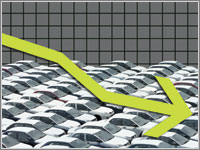 A temporary two- month relief by way of withdrawal of 2.5 per cent withholding tax on auto business, announced on February 21, just three days after elections, is unlikely to stimulate the car-making industry.
Big auto makers with almost 60 per cent market share reported a 7.5 per cent drop in their profitability, from Rs2.3 billion in six months of last fiscal year to Rs2.1 billion, during July-December 2007. Auto sales fell to Rs47.8 billion from Rs49.6 billion, impacting on production. Growing lawlessness, deepening political crisis triggered by promulgation of emergency on November 3, rising international oil and domestic steel prices, stronger yen and other international currencies were attributed by the industry as having “ combined adverse effect on their business.”
‘’Like all industries, the auto industry too is increasingly coming under impact of a regressive tax structure, weakening rupee, domestic inflation and a host of other political, social and economic factors’’ a top auto tycoon observed. He attributed much of the problems of the industry to the foreign trade liberalisation that has been practiced with religious zeal in last eight years. ‘’We need to make investment, production and export the guiding principles of economy’’ he strongly pleaded.
Realising that auto industry is hard pressed and needs some relief, the authorities withdrew the 2.5 per cent withholding tax for two months with clear instructions to car assemblers that this benefit be passed on to their customers. Why the revenue authorities picked up only the auto assemblers for this relief and why only for two months and why not till the presentation of next budget.? These questions remained unanswered by the auto assemblers and the officials. But quite a few auto dealers believe that foreign investors in auto business were trying to convince government of withdrawing withholding tax for a much longer period.. ‘’It is merely a coincidence that withdrawal came after three days of elections’’, one of the dealer said. He hoped that auto sector will get full attention with all other businesses by the elected government at the time of framing of next budget and the relief will continue till then.
Auto business has witnessed boom since the year 2000 as interest rates came down to record lows and banks and leasing companies stepped up consumer financing.. ‘’From a little over 30,000 units’ production in 1995-96 car assembling went up to 160,500 units in 2005-06. Just in a matter of a decade, the car making went up by almost 430 per cent.
The boom years for the auto business were 2002-03, 2003-04 and 2004-05, car markers made big money and expanded capacities to meet the increasing demand on the back of consumer loans. In three to four years, industry representatives said more than Rs100 billion was invested in auto business. Of this investment, Rs52 billion was invested in the assembling plants, Rs35 billion in the ancillary industry and remaining in the development of sales outlets. Foreign investors, particularly the Japanese followed by Chinese came in a big way and Pakistan appeared on the global automobile business map.
Automobile tycoons were upbeat of their business till 2005-06 when many of them, it is said, planned Rs225 billion investment to push up annual car production to 500,000 by the year 2010-11. But by then, the consumer financing that had touched about 13 per cent of total lending, started showing signs of strains. The interest rates of banks started going on the back of inflationary pressures and fuel prices too increased. Finally, law and order started getting worse .All these factors led to gradual withdrawal of banks from lending for auto financing, accumulation of debt defaults and a drop in sales of cars.
‘’We have in hand a list of 3,000 vehicles given by six banks to impound as their borrowers have defaulted on payment of loan instalments’’ an official of one of the top recovery companies said. These companies have been mandated to locate all such mortgaged vehicles whose borrowers are defaulting on payment. The official disclosed that defaults on auto loans’ payment is mounting. Not only that the number of defaulters is increasing, there have been cases of cars purchased against banks’ loans that have been taken to Afghanistan. False reports of car snatching have been reported in police stations of remote areas.
There are no firm figures available for ‘’missing cars’’ or debt default amount but a conversation with a few bankers, officials of the recovery companies and car dealers reveal that at least 65,000 to 70,000 cars are being searched throughout the country and the amount of stuck- up auto loans is not less than Rs15 billion.The auto industry is facing hard days ahead.
Two wheelers have a big market in the developing countries but Pakistan is lagging far behind even the tiny country like Viet Nam. No doubt., in last five years--- 2001-02 to 2005-06 --- the production of motor cycles in Pakistan went up from 120,000 to 751,000. But then it still remains low when compared to China, India and Viet Nam.
A study carried out by the Competition Support Fund (CSF) reveals motor cycle production in China at 17 million units out of which 41 per cent or about seven million units are exported. Chinese motor cycles are present virtually in markets of every country .India produces 7.7 million units of which about seven per cent is exported. Thailand produces three million units and exports 28 per cent of its production. Viet Nam produced two million units and exports about five per cent of its production. Pakistan’s production is about 0.751 million units of which not even one per cent is exported.
Now, there is a proposal to expand production capacity to 1.7 million units in next four or five years which can generate almost half a million jobs, with a potential to export. But production costing remains a big challenge for the auto and for all sectors of industry.





























