0
0

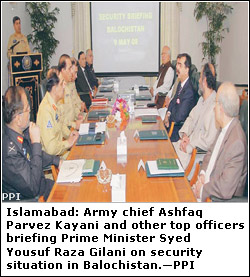 ISLAMABAD, May 9: Chief of the Army Staff General Ashfaq Parvez Kayani briefed Prime Minister Yousuf Raza Gilani on Friday on the security situation in Balochistan.
The briefing was ostensibly held against the backdrop of prime minister’s announcement that the government wanted to end military operation in the province and resolve the issue through dialogue and political means.
Little details of the specifics discussed during the meeting were released either by the PM Secretariat or the ISPR.
According to a press release issued by the PM’s Secretariat, the army chief presented a full spectrum security analysis of the situation, including efforts made to stabilise the situation in Balochistan. Gen Kayani underlined the significance of uplift works undertaken by the government with the assistance of army and Frontier Corps to improve living conditions of the people.
The prime minister stressed the need for combined efforts of all elements of national power for peace and progress in Balochistan. He called for a comprehensive strategy based on political engagement, economic development and use of minimum force, if at all required, to deal with the problem.
ISPR director general Maj-Gen Athar Abbas told Dawn that the army chief briefed the prime minister on the situation that existed in the province before an operation was launched there, with a specific reference to the writ of the state and security of national installations.
The briefing was attended by Balochistan Governor Zulfiqar Ali Magsi, Chief Minister Nawab Aslam Raisani, the chief secretary, interior secretary and IG.
Prime Minister Gilani also held a meeting with Chief of the Air Staff Air Chief Marshal Tanvir Mehmood Ahmed.
The PM said that in order to strengthen the defence of aerial frontiers, the government would continue to focus on improving its indigenous capabilities and entering into joint ventures with other countries for providing advanced equipment to the Pakistan Air Force.
The air chief apprised the prime minister of various initiatives taken by the PAF to optimise its effectiveness and efficiency.