



 0
0

‘Never give in’
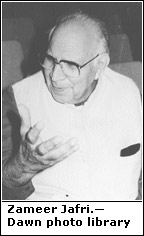
 Back in July 1998, one evening my journalist friend Ajmal Siraj gave me a ring to inform me that veteran poet and humorist Zameer Jafri was coming to their office and asked me if I could make it. I rushed to his office as meeting Zameer Jafri was something nobody could afford to miss.
I reached there in time and Jafri Sahib arrived shortly afterwards. We all rose to our feet in respect as he entered the room. The elevator was out of order and he had to climb the four long flights of stairs. He was out of breath and sweating but smiling with a face fresh as ever.
My friend’s colleagues flocked to the room to see Jafri Sahib and we had to move to a more spacious room. We were asking all kinds of questions and he was replying with his usual smile and ever-present sense of humour. He was so witty that he could find humour in the most unexpected of situations. His talk was punctuated with regular smiles and occasional laughter. Somebody asked about the reason of his coming to Karachi. He said: “My son is in the army. He insists on taking me along wherever he is transferred. So I am posted in Karachi these days.”
I said Karachiites were really happy over his new ‘posting’ and that Mushtaq Ahmed Yousufi was saying the other day that the lady luck had smiled on Karachiites that a prose writer like Jafri Sahib was in the city. Yousufi Sahib believed that Jafri Sahib’s personal diaries were a beautiful example of Urdu prose and they must be published in their entirety. As if I had reminded him of something, he started speaking about his personal diaries. He had been writing them for 50 years without break. One of them had been published, titled ‘Shahi Haj’, describing a ‘royal Haj’ that he had performed. He let us know that his humorist friend Muhammad Khalid Akhtar also kept a diary but was reluctant to get them published.
 Then I asked something about his early life. He very wittily described how he had been a failure in some of his early ventures. He had fought an election and clinched a ‘landslide defeat’. Then he launched a newspaper named ‘Baad-i-Shimaal’ from Rawalpindi, which flopped but its name won accolades even from Faiz Ahmed Faiz. Earlier he had joined the army and was sent to Singapore during the Second World War. Listening about Singapore, I casually referred to ‘Murshid’. His eyes lit up. He used to call Chiragh Hasan Hasrat, his senior in the army at Singapore, ‘Murshid’. He narrated how he had learnt a lot from Hasrat, who was a hard taskmaster but very informal and friendly once they returned to their place in the evening.
Somebody asked about his books. He said: “I have actually lost count but can tell you the names of about 24 or 25 of them and after that I start to blow”. I asked how old he was. “According to the official records, my elder brother is younger than me by two years,” he said laughingly. “No, I actually want to ask another question, just tell me your age.” He said that in those days the fashion of birth certificate was not in practice but he guessed he was about 82. “In these 82 years,” I said “you have seen the world, you have fought wars, have experienced and learnt a lot. Now tell me, sir, how would you sum up the lessons and wisdom of these long and eventful years.”
He said: “I am a serviceman and will talk in the lingo of the forces. Look, son. Life is just like a war. You are at the front. You have to wait it out. You have to dig yourself in. Never lose hope, no matter how bad the odds, keep on fighting. Never give in. There have been some battles in the history where a general surrendered but had he not done so, he would have won the battle because the general on the other side was also considering giving in.”
After that unforgettable meeting, I jotted down some points and met him again in Mudabbir Rizvi’s office at PTV’s Karachi centre, where he had come to record a programme. He said they were planning a re-launch of the humour magazine ‘Urdu Punch’, of which he was one of the editors, and asked me to write something for it. I readily agreed but subsequently backtracked on my word. He telephoned me more than once to remind me about it. Then he wrote me a letter insisting for an article. How I remain ever so repentant for not having kept my promise!
When ‘Urdu Punch’ re-appeared, he was in New York where he had gone for his medical treatment and I was cursing myself for my failure. Then came the news of his death on May 12, 1999, and later arrived his dead body.
But I remember what he taught me. I keep on writing, trying not to give in.
Another park saved from mini-golf’s jaws
 WITH tempers rising in several localities in the twin cities due to loadshedding, dry taps in homes and rising food prices, no wonder there is little public stamina for the proposed building of a mini-golf course in Islamabad and that too in a public park — the difference between golf and mini-golf being somewhat akin to that between test cricket and one-dayer.
After it was reported in this paper last week that the fate of the capital authorities’ second attempt to establish a mini- golf course in a park in the upmarket F-7 sector was lying with the Islamabad High Court, where some residents from nearby streets in the area had moved a petition against the project, the authorities quickly announced uplift plans for the park in question, complete with landscaping and walking and jogging tracks.
The authorities’ first attempt to have a mini-golf course constructed in the same sector in 2005 — in a different undulating park adjacent to Jinnah Super Market — was struck down by the Supreme Court at the turn of 2006, after residents from the French Colony kacha abadi opposite the park staged a protest against the project.
Twice now, public parks in Islamabad have been saved from commercialisation. But has the capital city seen the end of proposals to establish a mini-golf course in one of its many small parks?
Despite the apparent objections by residents belonging to both the upper and lower classes in F-7 sector, mini-golf is becoming a common facility elsewhere in the twin cities, particularly in new private housing schemes.
Among the varied facilities that Rawalpindi’s Bahria Town housing estate adjoining Islamabad has is a mini-golf course, while it also has plans for an 18-hole full golf course.
The Defence Housing Authority Islamabad housing scheme, located near Bahria Town, also has plans for a 10-hole mini-golf course.
Commercial mini-golf courses have also been established in other cities like Lahore and Karachi.
The objection of Islamabad’s F-7 sector residents is apparently not to mini-golf per se but to the conversion of their free-entry public parks into pay-to-enter recreational facilities.
While golf today remains an expensive and elitist game, mini- golf has become a popular recreational activity for middle and even lower class adults and children in US and Europe.
This is not surprising because unlike golf courses, mini-golf courses are often like amusement theme parks or family-oriented entertainment centres complete with unique landscapes, shrewd designs, wicked slopes and obscured obstacles to test the skills and dexterity of the avid mini-golfer, with the distance to the hole from the starting area rarely more than 10 metres as compared to several hundred metres in golf.
It would be easier to justify a mini-golf course in Islamabad if it is a general public recreational facility where admission tickets are reasonably priced, with costs for children and the elderly cheaper than for adults.
The more sensitive question, however, is the location. If the mini-golf course had been proposed for the full-sector sized sprawling Fatima Jinnah Park in Sector F-9, chances of it getting through might have been better.
Despite the apparent rule against commercialisation of public parks, this rule has already been broken twice in the past decade in the case of Fatima Jinnah Park, first by the establishment of a complex housing a restaurant, shopping mall and bowling alley in a section of this park facing F-10 sector, and second by the establishment of Islamabad’s first and only outlet of the international fast-food chain, McDonald’s, in an isolated corner of the park, the latter despite public protests.
Had any of the two proposed mini-golf projects in F-7 sector been given the nod, the decision could well impact the future of small public parks in all residential sectors of the capital city.
These parks, many of which have recently been given facelifts, have for decades served Islamabad’s residents young and old who frequent these parks in the evenings for walking, jogging, playing or simply for a breath of fresh air.
In any case, for a city that continues to face basic pressing problems like the lack of housing, growing electricity and water shortages, dirty and ill-kept markets with open manholes and other sanitation issues, etc., the establishment of what would be considered by the public as capitalistic projects will always be questioned, whether it be a mini-golf course, a cable car on the Margalla Hills, or even the seven-star Centaurus complex.



























