



 0
0

The kebab connection
 WHEN discussing kebabs, especially in the context of international cuisine and its local manifestations, one feels it is a bit of an omnibus term. So many dishes come under the rather large umbrella of the word that one finds it quite difficult to pick a focus.
For instance kebabs in all their varied forms are enjoyed with great relish here in the subcontinent, in Central Asia, across the Arab lands, in Iran, in Turkey as well as other nations that fall within or have once been under the sphere of influence of these countries or where large immigrant populations are settled. For example, who would have thought kebabs would be wolfed down with such delight in places such as far away New Zealand, Australia or the United Kingdom? Strange are the effects of globalization.
Here in Karachi, perhaps one can associate kebabs in the cultural context with mehndi functions and the ensuing trend of serving kebab paratha to guests at such functions. But if you’re a bit of a killjoy (as is this writer) and are not too fond of loud functions, kebab paratha can be had elsewhere in the metropolis without the song and dance.
This writer and a few trusted culinary companions visited a couple of the city’s celebrated kebab haunts to get a better idea about this meaty, guilty pleasure.
Though the North Indian city of Meerut may historically be better known as the place where the clarion call rallying native troops against the British colonizers in 1857 was first sounded, a local eatery in the Gurumandir area named after the city proves that revolution is not Meerut’s only claim to fame.
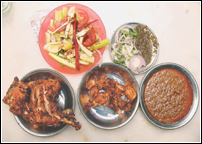 As a colleague and I made the cardinal sin of visiting New Meerut Kebab on a Saturday night, finding space was a bit of a quest as the place was packed with diners gulping down barbequed delights. Perhaps this was a good omen, as if a place enjoys such an influx of customers, the food can’t be half bad.
We dispensed with formalities and immediately got down to business, ordering seekh kebabs, Bihari kebabs, chicken tikka and chicken boti. Of course to help us scoop up this considerable spread, piping hot greasy parathas were also ordered. Now being a bit of a paratha purist, I tend to consider most parathas sold at such establishments as glorified puris, as a paratha should be – in my mind – light on the grease, crisp yet fluffy. The stuff one usually gets at commercial eateries is anything but.
The seekh kebabs, though a little small in size, were absolutely delightful. The plateful of Bihari kebabs was also marvellous, garnished with ginger, with a velvety texture. The chicken tikka was, surprisingly, above average, as a lot of barbeque joints in the city bungle this dish with reckless abandon. However, the chicken boti, though almost as velvety in texture as the Bihari kebabs, was way too spicy for this writer’s taste. The grease-fest was rounded off with salad and power-packed tangy tamarind and mint chutney. Though my friend did not partake of the latter for reasons of hygiene – perhaps rightfully so – I threw caution to the wind and heartily dipped my kebabs and parathas into the condiment, as one feels this is an essential part of the experience. As I have lived to tell the tale, perhaps it is not so bad.
On another occasion, a friend and I visited Waheed restaurant, located in one of the side-lanes off the famed Burnes Road, what some would consider the hub of Karachi’s gastronomic culture. Now I have been to this place before and perhaps it was nostalgia that brought me back, but suffice to say as far as kebab paratha and other barbequed fare is concerned, I was a tad disappointed.
It seems the place’s speciality is nihari, and not being too fond of the stuff, I have never tried it. There are no parathas here: just regular naans and sheermal.
The chicken tikka was way too dry and the marinade was flaking off. I actually felt sorry for consuming that particular bird. The chicken boti, along with being equally dry as the tikka, was way too spicy.
The only saving grace of this place was the kebab fry which, admittedly, is heavenly. It seems to be a liquefied version of Bihari kebab, as it has a similar taste. The stuff, scooped up with hot naans, simply melts in your mouth and has a wonderful texture, not too different from a semi-solid shorba.
A plateful of salad, garnished with lemon and chaat masala, was delivered by a vendor from a push-cart outside the eatery, while the tamarind-mint chutney here needed loads of work, along with the other dishes. Alas, my gastronomic radar seemed to be failing me.
This is just the tip of the kebab paratha/barbeque iceberg. The Bundoo Khan network – one I have not visited in quite some time – merits mention. But as was hopefully made clear above, it takes a little extra oomph to serve up these meaty delights to perfection.
Neither Hair nor there
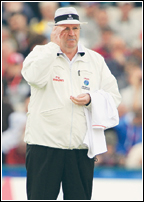 LONDON: Darrell Hair, the disgraced umpire of the ICC Elite Panel, is once again back in business after almost two years of forced exile by his employers.
Having participated in a mentoring and rehabilitation course in Australia to control his abrasive attitude, which cost Pakistan The Oval Test of August 2006, he has come with the promise that he has now ‘learned to communicate better’.
“I have picked up a few things, making sure what you say and what you want is understood by other people,” he said on the eve of the second Test against New Zealand at Old Trafford.
A veteran of 74 Tests, the controversial umpire at this stage of his life is ‘neither Hair nor there’ because he knows that his contract with the ICC runs out next April and till then he remains in a limbo — not knowing what the future holds for him. Another false move or an error of judgement and he will be history.
The England captain Michael Vaughan and the Kiwis have nothing to moan about him but Pakistan certainly has all the cause for concern in case he turns up for the ICC Champions Trophy, to be played in Pakistan later this year. The ICC is, however, unlikely to make that mistake.
At the time of his reinstatement early this year, though, Dave Richardson of the ICC had indicated that Hair is unlikely to be exposed in a match involving Pakistan and one hopes the ICC sticks to that promise.
Pakistan surely has all the reason to vent their anger over Hair who, having confiscated the ball during the crucial Test at The Oval in 2006, had awarded five penalty runs to England while accusing Pakistan of ball tampering at a time when Pakistan had the game well into their grip.
Infuriated over the whole saga, then Pakistan captain Inzamam-ul-Haq later refused to take the field and the match was forfeited, giving England a 3-0 victory in the series. The forfeiture was the first such instance in the 130 years of Test cricket.
In the hearing that followed after Pakistan protested strongly, Hair was criticised and condemned by the chief referee Ranjan Madugalle after Geoff Boycott and Simon Hughes found no signs of ball tampering on the ball in question.
Hair was thrown into the dungeon to sulk and eventually lost his place in the panel while Inzamam was barred for four ODIs, deservedly so for taking the law into his own hand.
At the time of the incident the officials present at The Oval announced to the media that the decision for not taking the field in retaliation to umpire Hair’s allegations was unanimous and not that of the Pakistani captain alone.
But the fact of the matter was that the officials of the PCB there were as naïve as Inzamam himself and had certainly been guilty of being economical with the truth which they finally admitted at the time of Inzamam’s exit from the international scene. At that moment they unanimously blamed the burly skipper of taking the law into his own hands and for arbitrarily choosing to stay off the field which cost Pakistan the Test.
As far as Hair is concerned he is lucky that he has been brought back despite the embarrassment that he has caused the ICC. He was lucky not to be shown the door after he shocked them and the world to ask for $500,000 to quit the panel following The Oval incident.
He later withdrew his demand when the ICC declined to bow to his rather shocking behaviour.
His decision-making in his own case became a lot more questionable when he threatened to sue the ICC for racial discrimination and then, in a surprise move, withdrew the case seven days later.
ICC’s reward in return was his reinstatement which many in Pakistan will take it as diabolical.
Watch out lesser mortals ... here we come!
 THE citizens of Islamabad must fear for their lives after what happened on the Margalla Road last week.
Dawn reported in its Islamabad Metro section that three young motorcyclists narrowly escaped a potentially fatal accident after a recklessly driven security vehicle hit them with some force at a traffic signal.
The hit-and-run folks did not bother to take a lowdown on the injured bikers and sped to their destination.
An annoyed eyewitness then reportedly, gave a chase to them only to discover the vehicle that hit the bikers was part of the security escort of Prime Minister’s Adviser on Interior Rehman Malik.
Malik, as many a political pretender and hacks have discovered, is the real McCoy of this government, a man who must be feared or so the vibes he gives.
While political clout is one thing, it is the brandishing of this sword in the face of hoi polloi, which upsets their sensibilities.
VIP culture in Pakistan is endemic, one whose very mention may have now assumed a cliched proportion but that doesn’t detract from its repulsive existence.
These so-called VIPs forget that they owe even this convoluted aggrandisement to the taxpayer, whose money is used with impunity in the name of security.
Islamabad, more than any other city, epitomises this diseased manifestation of power and pelf. It is almost as if keeping a low profile and down-to-earth demeanour would be beneath their calling.
While these VIPs move around in their enlarged security apparatus — cavalcade for the still ‘mightier’ ones — at a fair cost to the normal traffic movement, spare a thought for the hapless people, who despite paying for the upkeep of this ruling class (not even elected in the case of Rehman Malik) have little muscle to make them fall in line.
A classic case is the ‘No Thoroughfare’ signboard on the Constitution Avenue. One cannot but miss the irony in the sign. Then, there is the blockage in front of the Parliament House. You could be excused for thinking we had some contribution in getting our representatives inside the august House. Only for our movement to be impeded — all for the noble cause of their security, of course.
The siren-wailing security entourages that hold back public movement are a daily reminder of how distanced are the rulers from the ruled.
This is not to deny that there are no security issues involved but, perhaps, these movers-and-shakers could stop for a moment and take stock of the inconvenience they cause to the lesser mortals. Sometimes, it can be a matter of life and death for those locked in an emergency — say for a patient, who needs to be rushed to the hospital after suffering cardiac arrest.
The movement of the president, prime minister, army chief and now even the de facto ruling party chairperson (who is neither an elected representative nor an office-holder in the service of Pakistan) puts an even greater strain on the exchequer and public movement.
Compare this with what the founder of this nation, Muhammad Ali Jinnah, practised. He had only one police van with a single inspector for his security, who was a non-Muslim (can our rulers even emulate those secular credentials?). All this while Jinnah faced as much of a threat to his life as any other leader from any era.
But what have we today? A cavalcade of bullet-proof vehicles, some fitted with high tech jammers, expert security personnel, a group of commandos and sometimes even decoys — none of which, can still be an insurance to protect the rulers.
While we are at it, pertinent also would be to know how Mr Jinnah viewed public order and adherence to the rule of law as revealed by an episode.
Once, the Quaid was held up in his car with Chief of General Staff General Gul Hasan thanks to a closed railway crossing in Malir, Karachi. Gen Hasan got out of the car and manoeuvred to have the gate of the crossing opened.
Making out what had happened, Mr Jinnah was furious and at once, ordered it closed again, countering: “If I don’t follow the rules, who would?”
We have a come a long way ever since.
In his opening speech following the vote of confidence, Prime Minister Yousuf Raza Gilani went down the familiar road of pledging austerity, including cutting costs at the PM House and limiting the ‘power’ drive of official vehicles to 1600cc.
Even before a feeling of deja vu could set in, he himself gifted official Mercs to two of his party rivals for the premiership — Chaudhry Ahmed Mukhtar and Shah Mehmood Qureshi.
The point one is trying to make here is that it is in the nature of the masters of our destiny to look larger-than-life and bandy this opulence — usually, at the expense of the very people who vote them in.
Meanwhile, watch out for VIP security limos in the interest of your limb!
The writer is News Editor at Dawn News. He may be contacted at kaamyabi@gmail.com



























