KARACHI, May 23: The Karachi Stock Exchange index of 100 shares plunged by 615 points or close to the maximum of five per cent on what many investors thought was ‘black Friday’ for the market. It was the biggest single-day decline since the start of the current year.
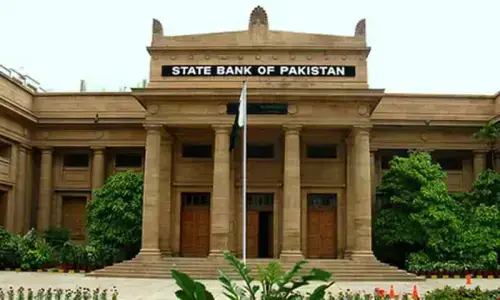
Traders said that everyone had expected equities to drop, following the monetary measures announced by the State Bank of Pakistan on Thursday, which included a massive increase of 1.5 per cent in key discount rate to 12 per cent from 10.5 per cent.
“The central bank’s initiatives aimed at curbing inflation proved to be just an excuse for the already jittery market,” said a stock broker. He lamented that the market had been held hostage to uncertainty on the political front and an increasing bleak economic picture, reconfirmed by the downgrading by international rating agencies -- Standard & Poor’s and Moody’s.
But nervous investors have been moving out of the equities since mid-April. The index has shed 2,664 points or 17 per cent of the value in just 24 sessions since the current meltdown began. From its dizzy height of 15,676 points on April 18, the index dived to 13,012 points on Friday. In the process, a cool sum of Rs1 trillion ($13 billion) have been wiped off the market capitalisation.
The free fall of equities on Friday was exacerbated by the critical statement from PPP co-chairman Asif Ali Zardari regarding President Musharraf, evidencing fissures in the relationship between the presidency and PPP, which otherwise were perceived to be smooth going.
Traders said that there were many ‘margin calls’ at the market which forced weak-holders to unwind their long positions, but luckily no defaults.
Adnan Afridi, KSE managing director, affirmed that risk management systems were in place and that exposures had been collected on time.
Arif Habib, former KSE chairman, said that investors were hoping things to fall in place after the general elections, but none of that happened. He thought that the SBP measures announced on Thursday had proved as the last straw on the camel’s back. “Since returns on risk-free investments have been increased, investors in risk-bearing equities have also raised their expectation for a corresponding higher return,” he said.
Mr Habib estimated that the equities carried risk premium of around six per cent over fixed income investments.
Mohammad Sohail, director equity broking at JS Global, said that the mandatory floor of five per cent return on saving deposits imposed by the SBP was totally unexpected and came as a rude shock to both the local and foreign investors.
Market could see a major hit on the profitability of banks. With 25 per cent weightage in the KSE index, the banking stocks were first to fall on Friday, pulling down the rest of the market.