0
0

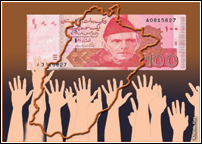 When it comes to poverty, governments and their economic managers and planners prefer to talk about absolute numbers - national averages or national poverty estimates.
Any reference to regional disparities or poverty variations at the sub-national or even at the sub-provincial levels is carefully avoided.
“This reluctance on the part of the governments to avoid the mention of provincial and district poverty variations has everything to do with politics than with anything else”,” says an Islamabad based economist, who does not want to be identified because of his association with a government funded programme.
“Poverty mapping at the provincial or sub-provincial levels has always had political consequences for any sitting government. That is precisely why the government has so far not released the provincial poverty estimates for the last poverty survey for the fiscal year 2004-05 or the previous one done in 2001-02,” he said.
The regional poverty variations are no secret. These have always existed across the provinces as well as within the provinces. But what is more baffling than regional differentials in poverty incidence pertains to exceedingly wide variations in district poverty estimates.
A recent research study by Ali Cheema, an economist who teaches at the Lahore University of Management Sciences, on “The Geography and the Lives of Poor: Evidence from Punjab” brings to surface the widening poverty differential at the regional as well as sub-regional levels.
The study shows that high poverty in Punjab is mostly clustered in the 14 districts of the southern and western regions of the province. These two regions have been dubbed as “crescent of endemic poverty” by Cheema.
The Multiple Indicator Cluster Survey (MICS) of 2003-04, the only effort ever made by the provincial government to map poverty at the district level, illustrates that 52.1 per ent population of the seven western districts - Mianwali, Khushab, Bhakkar, Layyah, Muzaffargarh, Dera Ghazi Khan and Rajanpur - is poor.
The incidence of poverty in the seven districts of the South Punjab - Rahimyar Khan, Bahawalpur, Bahawalnagar, Multan, Lodhran, Khanewal and Vehari, is calculated to be just below 51 per cent.
Compared to these two poor regions, the percentage of the poor living in the four districts - Rawalpindi, Chakwal, Jhelum and Attock, in the Northern Punjab is lowest or just above 21 per cent. In the rest of 17 districts of the central Punjab slightly less than 29 per cent people are poor.
“We always talk about absolute poverty — national averages - but never try to look at the variations at the district or the village level, critical for economic planning and effort to reduce deprivation,” Cheema told Dawn.
“The poverty differentials between the districts are baffling. On the one hand, we have Sialkot in the central Punjab with just below 19 per cent poor. On the other hand, we have Rajanpur in the west with its over 68 per cent population living in abject poverty,” he says.
His work also points out that even within the comparatively richer central Punjab, we have centres of poverty like Kasur and Okara with more than half of their populations being poor.
“There are tremendous variations of opportunity even within the districts. We must take these variations seriously,” argued Cheema.
There are numerous factors responsible for the increasing regional and district poverty variations, economists say.
The regional disparities and poverty differentials in Punjab are partly attributed to certain historical endowments - feudal stranglehold in the poorer regions, low public sector spending and investment in infrastructure, dependence on agrarian economy, etc.
The central Punjab largely owes its prosperity to the establishment of canal colonies and irrigation network laid out by the British colonialists, Cheema said. Moreover, the economies of the central and northern regions also diversified into industry and service sectors.
“The poorer south-west regions lagged behind because they continued to depend on agriculture and failed to diversify into other sectors of the economy,” the Islamabad based economist said.
“The increase in poverty incidence in the south-west regions in the recent years is largely due to declining access of the people to land, both as owners and tenants. This factor is producing a large number of daily wagers with low levels of mobility and falling wages. This labour cannot be absorbed by the local economies and is reluctant to migrate to other job markets,” Cheema says.
He said we find different opportunities for labour mobility in different areas. “Labour markets, occupational structure, and local economies are different in different districts. In the northern and central regions the landless workers find employment in industry, services sector and other areas of the economy. Government jobs also come handy in the central and northern parts of the province.
In south we don’t have a very strong industrial base or services sector to absorb surplus labour in the agrarian economy and hence both the opportunities of the employment and returns on employment are very low, contributing to increasing poverty there,” he said.
This also means that the probability of remaining in poverty trap is quite high for the kind of labour produced in the southern Punjab.
“The state should invest in education, health, etc and help diversify agriculture, farm and non-farm sectors to create job opportunities. The state has to do a lot more than equalisation to address poverty in the lagging regions and districts. The revenue distribution formula under the Provincial Finance Commission needs to be revisited in order to address regional inequalities between districts. It has to give incentives to the private sector to invest in the lagging regions both for improving human resource as well as for job creation,” argues Cheema.
“Massive investment in social sector and infrastructure is needed in the poorer districts. There have to be dedicated programmes for development, which should move away from projects,” he adds.
The lack of poverty mapping at the regional and district levels is one major reason underlined by economists for successive governments’ failure to target poverty in the lagging areas through state interventions.
“This has encouraged bureaucracy and government planners to believe that the greater investment in the better off areas and regions would lead to ‘growth spillover’ in the poorer regions. That represents a skewed, short-sighted thinking and needs to be radically changed. If the lagging areas have to be developed and poverty reduced, the state shall have to create development there. The spillover theory did not work in the past and there is little or no chance of it working in the future either,” he said.