0
0

 BANANA is a nutritious fruit and leads all other fruits in food value. It is rich in carbohydrates, minerals and vitamins. Banana produces 300 to 700 mounds of edible matter per acre, higher than average yield of any food crop.
Extended cultivation of the fruit can help in food security. Economic importance of banana over other fruits is that it is perennial and a regular source of income for growers.
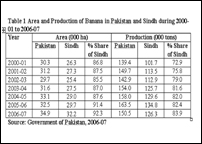
Banana cultivation in the country started after independence, and after its success in Sindh, it emerged as an important fruit crop. Data in table 1 indicates that Sindh is a major banana producing area with about 85 to 92 per cent in banana acreage and about 90 per cent of production. The average area under the fruit in Sindh was 32,200 hectares with a production of 1,26,000 tons during 2006-07. (GOP, 2006-07).
In Sindh, banana is mainly cultivated in Khairpur, Hyderabad, Thatta, Nawabshah, Noshahro Feroz, Sanghar, Mirpurkhas and Badin districts. Further data in figure 1 indicate that Khairpur, Thatta and Hyderabad districts are the leading banana producing districts with production of 35,324, 30,432 and 21,996 tons respectively.
Horticulturists have developed technology for the prevention of disease through cultural practices. To eradicate the disease, the orchard is destroyed after three years of fruiting. It is reported that the disease attacks the plants after three years and the plants cannot survive.
Banana has a lot of potential to earn foreign exchange. During the four months of the peak season about 50 to 60 trucks (250 mds capacity) of banana per day are exported to Afghanistan and about four to five trucks to Iran.
Cost of production: Plantation of banana orchard at the initial stage involves cost of land development, labour utilisation and input application. Land development needs the most attention and time. Total cost per acre for banana production is presented and calculated in table 2. It has been found that average cost per acre is around Rs66,300.
Banana is cultivated by a large number of farmers mainly in Thatta, Hyderabad, Nawabshah and Khairpur districts. A majority of them sell harvesting rights of their orchards to contractors. The contracts are mostly finalised in February which is for one year. The contractor estimates its yield and calculates costs to be incurred for supervision, labour, transportation and marketing, and pre-harvest and post-harvest losses.
Wholesalers buy and sell the fruit with the help of commission agents who bring the sellers and buyers together. The wholesaler deals in the inter-regional markets and supply produce to processing industries, exporters and retailers according their demand.
A wholesaler is a major agency in marketing of agricultural products, having good contacts with commission agents in the wholesale markets and retailers in the local markets/area. Wholesalers mostly purchase the product from commission agents on credit and return the same after selling the product.
Sindh has monopoly in growing banana with the availability of natural resources such as fertile land and suitable weather conditions. There is sufficient production to meet the domestic demand and to earn foreign exchange through export of value-added products such as banana powder etc.
Only one variety Basarai is cultivated since independence, which has reduced its production potential. Some times supply of quality banana is irregular and inconsistent due to attack of BBTV. Short shelf life and inadequate post harvest facilities and non-availability of cold storage facility in the producing area results in loss of the produce. With the help of technology among growers yield of the fruit can be improved. Shortage of irrigation also leads to permanent wilting which results in low yield.
Banana plant is a heavy consumer of nutrients, especially potash and nitrogen. Due to increases in prices of fertiliser, growers reduce intake of nutrients which results in low yield.
Recommendations: Production of plants through tissue culture techniques by establishing tissue culture labs in major banana-producing areas can result in healthy plants and consequently better yield.
Establishment of cold storages in banana producing areas and markets may enhance the life of the fruit and thereby income of the farmers. The prices of inputs such as fertiliser are needed to be kept at reasonable level for its frequent application and improved yield.
There is also need to carry out research for producing high-yield varieties and improving shelf-life of the fruit. Exploring of new banana markets and encouraging local traders for better packing by providing attractive packing material can enhance export of the fruit.