



 0
0

Our Karachi
 For someone born (but not raised) in this city, it hurts when one sees that the popular image of Karachi projected across the world is one associated with violence, muggings, traffic gridlock and other such unsavoury activities. So whenever cultural events take place in the metropolis, it genuinely warms the heart.
A recent initiative supported by the city district government Karachi is the Hamara Karachi project, which oversees a number of recreational and cultural programmes in the city by the sea to give its bamboozled citizens a break from the debilitating routine of price hikes, rampant crime and political uncertainty. Recent activities held under the project included a Mehfil-i-Naat, cricket match and concert, held on different days.
However, it was during the cricket match held recently that this writer noticed something quite ironic that perhaps warranted being shared with others.
The match was held at a cricket stadium in North Nazimabad that belongs to the current provincial minister for sports. It was close to midnight when this writer reached home and upon approaching the house, I saw that the stadium’s familiar floodlights were on, which indicated that a match was in progress. Not being a big sports buff, I wished the organizers well and opted to head on home.
Just as I was about to settle down for a late night snack, predictably, the lights went out. While enjoying my candle-lit dinner, I was forced to rush out to the garden when I heard explosions.
Praise the Lord, as it wasn’t a terrorist attack, but our friends in the stadium were setting of fireworks as part of the celebrations. The sight was all the more profound as the entire surrounding neighbourhood of North Nazimabad was bathed in darkness while the Roman candles, rockets and other pyrotechnics lit up the night sky.
But who needed electricity? A fine breeze was a blowin’ while the moon peeked out from behind heavy cloud cover from time to time. Plus, the kids seemed to tremendously enjoy the brief display and momentarily stopped moaning about the lack of electricity and the resultant attack of mosquitoes.
Perhaps as a damage control mechanism, the pundits at the KESC can resort to similar fireworks displays in other parts of the metropolis during bouts of load-shedding. Perhaps this just might distract the punters enough to make them forget about taking to the streets and setting off fireworks of their own to protest against the prolonged power breakdowns.—QAM
A matter of protocol
It seems that nowadays, the measure of one’s influence is gauged by how much of his weight one can throw around, preferably in public. Traffic jams caused by the arrival of ‘VVIPs’ in the city are just one example of what Karachians have to put up with in the name of protocol.
That’s why when one sees a person in power or with considerable influence opting for simplicity – at least in their public life – it merits mention.
A friend who visited the inauguration of a show at the National Museum recently told an interesting tale that proved that even in officialdom, there is a small minority that shuns public displays of excess.
Among others, the inauguration was attended by two bureaucrats from the Sindh government, along with the consul-general of a European country and the head of a neighbouring country’s cultural centre who, methinks, in diplomatic speak would probably be the equivalent of a cultural attaché.
After the exhibition was inaugurated, refreshments were served in the rather unkempt lawn of the museum. While munching on assorted goodies, my friend noticed a car with a red diplomatic license plate. Nothing odd there, but the interesting thing was that this vehicle was at least 20 years old. Much to my friend’s surprise, the cultural attaché took his leave, walked over to the car and got in, as his driver scurried towards the vehicle.
 This was pleasantly shocking. Here was a foreign diplomat riding in a 20-yaer-old vehicle when his government could easily have provided him with the latest luxury model sedan. The sight, my friend said, left him flabbergasted and put to shame the minor state minions and political midgets of this country who are surrounded by heavily-armed goons serving as guards, ride in criminally expensive cars and flaunt their wealth and influence at the drop of a hat.
Another incident my friend recalled happened to him in New Zealand while he was down under in pursuit of his education.
He had gone to one of the Auckland mosques to offer prayers on a religious occasion and was a little late, hence was only able to find space in one of the back rows as the prayer had started. He was soon joined by a dignified-looking man and after prayers, shook hands with him along with other co-worshippers, as is the tradition among Arab and Iranian believers. When the programme began, the organisers invited the chief guest – the ambassador of a Muslim country – to the front, and my friend was shocked to see that the man who had earlier joined him at the back of the mosque was in fact the ambassador! There were no apparatchiks clearing the way for him, nor had he demanded to be seated at the front of the mosque.
If only our self-centred ‘rulers’ could learn from people like these. Fat chance.—Nasrallah
Graffiti speaks
No one can fix an accurate price tag on defacement of walls and bridges in this city, though some people profess to see aesthetic value in this ‘artwork.’ Such artwork is rarely reported, though it covers everything from toilet doodles to political graffiti on walls, bridges and flyovers.
There is so much graffiti in this city that one generally ignores such squiggles, but a few specimens do catch one’s eye. For instance the poorly written slogan — ‘Perfume Chowk’ — born a couple of years ago in Gulistan-i-Jauhar, has spread to many other parts of the city by now. Perhaps the belief that public space is up for grabs is responsible for such ‘art’ appearing on walls.
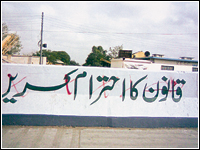
If one looks closely, one will notice all kinds of slogans — from advertising catchwords to political cries — sprayed or painted on the walls of public property. One such picturesque site is a short wall along Sharea Faisal near Karsaz, which carries a public message from the traffic police.
It was almost two weeks ago that some graffiti artists sneaked over to the place to draw their lines and successfully managed to give it an artistic touch. Interestingly, no one at the helm of affairs has taken notice. Or maybe there are some more important tasks ahead.—HA
Compiled by Syed Hassan Ali
Email: karachian@dawn.com
Anti-polio programme
Sir,
 The concept to eradicate polio by launching a door-to-door campaign was wrong and ineffective. It could have been more effective by improving the routine immunization programme (including MMR or MMRV).
Before launching the polio programme, neither any public counselling was done nor was awareness developed within the community.
Multiple loopholes were present while the programme was undertaken. Initially, the programme was launched at the DHO level (district), then on the town level.
According to multiple surveys and exchange of views among programme officers, workers and the public, the programme was manipulated, taken for granted and bad service was delivered to the public.
Manipulated tally sheet and final report was presented to the higher authorities by forcing the zonal supervisors and area in-charges, at the same time delivering a shameful amount of money to the zonal supervisor/area in-charge/workers for conducting the programme.
DR SOHAIL NOMAN
Urban Health Centre
Orangi Town 10
A message for Lyari SP
Sir,
We, the members of the Mohallah Committee and residents of D.D. Chaudhry Road, Baghdadi UC 5, Lyari, would like to inform you that street crimes have become the order of the day in this area and the situation is going from bad to worse day by day.
Cases of mobile snatching and looting have reached their peak. The law-abiding and innocent residents of the area are very much perturbed by the unlawful activities of the gangsters and terrorists.
We, therefore, request you to kindly deploy the police/Rangers or armoured vehicles near the telephone exchange building and its surrounding areas for the safety and security of the local people, as this area gives a deserted look and criminals become free to carry out their notorious activities after office hours.
Thanking you and awaiting a positive response.
MEMBERS OF MOHALLAH COMMITTEE
Baghdadi UC 5
Surjani defaulters
Sir,
I must commend Imran Ayub for his comprehensive report about 4,500 Surjani home-owners who, owing a total of Rs380 million to the House Building Finance Corporation (HBFC), are under threat either to pay anything up to Rs10,000 each within a month or else vacate the houses, which would be auctioned by the HBFC to recover the dues.
Presumably, the auction proceeds of each house would be in excess of the principal and interest, and after deducting the amount due, the HBFC would hand over the balance to the former owners. How long would it take to hand over the balance, what would the recipients be able to achieve with it and where will they live in the meantime is anybody’s guess. Perhaps we will see a spate of suicides. Do we really want that and is it really unavoidable?
We read in the papers that huge amounts of debt are written off each year and many of our state corporations incur astronomical losses, but all that is forgiven and forgotten.
Surely, the government cou-ld, and should, write off this relatively small amount of Rs380 million and earn the gratitude of 4,500 families.
Surely, such a large number of people cannot be thrown out of their homes just like that, especially at a time when the avowed aim of the government — among other things — is to provide shelter to the homeless.
S.R.H. HASHMI
Karachi
Exam woes
Sir,
O-level exams have started. DHA O-Level School, Phase VIII has been made a centre for many schools. It is a matter of grave concern that the roads around the school and leading to the school are in a total mess.
This is causing great difficulties for students and parents. The DHA authorities are requested to immediately get the roads repaired.
The fee paid to the DHA School as a centre for CIE exams goes into the coffers of the DHA. It should be used to allay the suffering of the students.
The British Council should also take cognizance of this matter and do the needful without delay as the students pay a hefty amount to the British Council for registration.
Also, keeping in view the exam situation, the KESC should ensure that minimum load-shedding takes place.
PARVEEN SHAH
Abdullah Haroon Rd
Seniority denied
Sir,
It is surprising that in the new democratic set-up in Sindh, in the KWSB, the seniority list of BPS was ignored and a junior-most person was promoted in grade while the senior-most persons were ignored and denied promotion in BPS
Five posts are still lying vacant in BPSand the high-ups are not considering the senior-most person for promotion in grade
ANONYMOUS
Karachi
city@dawn.com
Proposed package seems person-specific
 THE cat finally got out of the bag. Pakistan People’s Party has made public its much trumpeted 62-point constitutional amendment package, which apparently seems a move to mix-up other issues with that of the ongoing judicial crisis. Through the said package the Asif Ali Zardari-led PPP has proposed drastic changes in the constitution which has presently been in mutilated shape after amendments made by successive military and civilian governments.
The proposed amendments relating to judiciary appears to be person-specific and a move to get rid of deposed Chief Justice Iftikhar Chaudhry as soon as possible even if he is restored by the government. At the same time the ruling party seems happy with Chief Justice Abdul Hameed Dogar and wants to retain him.
Legal circles believe that the ruling party has presented an amalgamation of different proposed amendments so as to hoodwink the people and overshadow the issue of the restoration of pre-Nov 3 judiciary. Similarly, the government has tried to appease different parties and segments of the society by raising the issue of renaming of NWFP and reservation of seats for minorities in the Senate.
It appears that history is repeating itself. General Pervez Musharraf had amended the constitution in 2002 to enhance the retirement age of the judges of the superior courts so as to retain Justice Sheikh Riaz Ahmad as the Chief Justice of Pakistan. The ruling party has proposed the same kind of amendment. Question arises what is the difference between a military dictator and a popularly elected government when they act in same manner to place their favourites on key judicial posts.
On Aug 21, 2002, General Pervez Musharraf promulgated the controversial Legal Framework Order through which he changed the salient features of the constitution and enhanced the powers of the president. The controversial Article 58(2) (b), which the Parliament had done away with during Nawaz Sharif’s government in 1997, was restored along with the corresponding powers of the governors of dissolving the provincial legislature. On Oct 9, 2002, he amended the LFO and Articles 179 and 195 of the constitution were amended to the effect that the retirement age of a judge of the Supreme Court was increased from 65 to 68 years and that of the high court from 62 to 65 years.
The legal fraternity including the entire major bar associations had condemned the LFO and the extension in retirement age of judges terming it a person-specific amendment. Under normal circumstances Justice Sheikh Riaz had to attain superannuation in March 2003. After the controversial amendment he continued to serve as chief justice and had to serve till 2006. When General Musharraf and Muttahida Majlis-i-Amal reached an agreement the 17th constitutional amendment was subsequently passed by the Parliament in Dec 2003, the acts of General Musharraf including the LFO was given indemnity and the retirement age of judges was reverted back to the pre-LFO stage. Thus the Supreme Court judges -- Chief Justice Sheikh Riaz, Justice Munir A Sheikh and Justice Qazi Mohammad Farooq, the present chief election commissioner -- were unceremoniously removed along with seven judges of the high courts.
Now the PPP-led federal government has been repeating the same act. The retirement of Justice Abdul Hameed Dogar is due on March 21, 2009. By enhancing the retirement age of judges of the apex court to 68, Justice Dogar would continue to serve till March 2012. At the same time the government has proposed to fix tenure of the Chief Justice of Pakistan and that of the high courts to three years. Government circles claimed that they might show flexibility over it and increase the tenure to four or five years.
The proposed amendment is on the pattern of the Constitution (Fifth Amendment) Act, 1976, when the government of Late Zulfiqar Ali Bhutto fixed the tenure of Chief Justice of Pakistan to five years and that of the high court to four years. After that amendment the then Lahore High Court Chief Justice Sardar Mohammad Iqbal and Peshawar High Court Chief Justice Ghulam Safdar Shah had to relinquish their posts. The then government was feeling uneasy with the two judges and the amendment was specially tailored to get rid of them.
Interestingly, Justice Safdar Shah was made member of the bench which heard appeal of late Bhutto against his conviction by the Lahore High Court as General Ziaul Haq believed that he would be annoyed with Bhutto. However, he along with Justice Dorab Patel and Justice Mohammad Haleem dissented from the majority judgment of upholding the death sentence of Mr Bhutto and instead ordered his acquittal.
Later on, through the Constitution (Sixth Amendment) Act, 1976, the government of Mr Bhutto further amended the constitution so as to retain Justice Yaqub Ali as Chief Justice of Pakistan after his retirement age which was due in the middle of 1977. The said amendment provided that a chief justice would continue to complete his tenure even if he had attained the retirement age.
History proved that Mr Bhutto had erred when he had introduced amendments to the constitution specifically for weakening the judiciary and curtailing its powers. A weak judiciary failed to come to his rescue rather it played vital role in his “judicial killing”. If the present government continues to repeat those mistakes it might face the same fate.
The electricity quagmire
 IF there is one lesson many residents in Islamabad are gradually learning since the beginning of this year when rigorous load-shedding in the city began, it is not to take electricity for granted.
Even if the cooler temperatures in the city during the past couple of days might have temporarily reduced the sting of power outages somewhat, in the technology-driven, electricity-dependent modern life that many residents in the capital city, and elsewhere in the country, are too familiar with, load-shedding is an infuriating system.
Whether the alternatives to electrical power during the hour-long outages every three hours round the clock are candles and hand fans or UPS and generators, they are no comparison at all to the convenience and reliability of constant and ubiquitous electrical power that comes straight into our homes through the flick of a switch.
If load-shedding is messing up our lives at home, its effects on the economy is much worse. Denial of the comforts that electricity brings to our homes is nothing compared to the devastation that load-shedding is wrecking on industrial, manufacturing and commercial units whose business and production are being adversely affected.
Electricity development has come a long way since the 18th century when Benjamin Franklin first conducted an experiment with a kite one stormy night in Philadelphia, paving the way to the gradual understanding of the principles of electricity.
Then in the 19th century Thomas Edison invented the light bulb and Nikola Tesla pioneered the generation and transmission of electricity over long distances, thus enabling lighting in our homes and the powering of industrial machines.
Who would have thought that this development of electricity would come full circle in the 21st century, throwing us back to the pre-electricity days of candles, kerosene lamps and hand fans.
Electricity shortages have been knocking on Islamabad’s door for decades and even getting their foot in sometimes, prompting occasional load-shedding. But as far as most residents can remember, they have not seen the kind of extensive electricity shortages which have been experienced since the beginning of this year.
It first started with two or three hours of load-shedding per day which were initially haphazardly scheduled and irregularly timed, much to the chagrin of the city’s consumers. Soon after the timings were regularised and fixed daily so that consumers know when to expect the load-shedding, the total duration was increased to the current six hours, with the timings of the one-hour duration outages staggered in different localities.
We have been warned that things are going to get worse. Next month, shops will have to close at 9pm and air-conditioners in offices will not be switched on until 11am. Maybe even the total number of load-shedding hours might increase.
The fact that we are not alone in the electricity quagmire, and that many cities elsewhere in India, Bangladesh, Nepal, China, North Korea, Tajikistan, South Africa, Zimbabwe, Ghana, etc., are also in the same boat, is little consolation.
Why didn’t we shut electricity shortages out completely through timely implementation of power conservation measures and increasing power generation capacity? Easier said than done, perhaps.
What apparently paralysed us was a combination of policy uncertainty, planning confusion and delayed investment in new power generating capacity.
Apart from invoking partial de-regularistion and privatization of the power industry leading to the emergence of Independent Power Producers, the earlier power shortages failed to inject a greater government-led urgency into increasing power generation.
Meanwhile, the shortages were worsened by inadequate maintenance, line losses and high demand growth.
Even if we can avert the feared crisis this summer of a system-wide blackout in Islamabad that might take days if not weeks to restore, is power planning adequate and coherent enough to avoid electricity shortages in subsequent months and years?
What is urgently required is for the administration to show leadership and a clear sense of direction in steering a major power-saving campaign. Although domestic power saving will be valuable, the biggest contribution must come from the major electricity users.
With the electricity supply problem only expected to worsen in the capital, and elsewhere in the country, with a rise in demand driven by population, economic and city growth, the longer term solution, needless to say, is ensuring there is sufficient investment in new generation as well as improved transmission to meet the increased demand.
In this respect, the proposed plan revealed last week for Islamabad city to generate its own electricity through public- private collaboration and make it self-sufficient in electricity production is welcomed.
But as we de-regulate the electricity market further, we mustn’t forget that electricity is not a commodity that consumers can choose to take or leave depending on price and supply. It is an essential service central to the maintenance of today’s lifestyles.
Liberalisation of the electricity market is fine so long as there is no price manipulation by the private companies leading to high and volatile electricity prices, decline in service reliability with regular failure of fuses and transformers, and hesitancy in investing in new infrastructure because prices are higher if electricity is in short supply.
After all, it was the unwillingness of the private sector to take on the risks associated with building capital-intensive electricity infrastructure that led to government provision of electricity in many countries in the first place.



























