0
0

From Kabul with love
 THOUGH the Soviet invasion of Afghanistan in 1979 and the subsequent flood of refugees created a number of problems here in Pakistan, most notably an influx of narcotics, arms and the proliferation of an extremist ideology, perhaps the one positive aspect that came out of the whole sordid affair was the availability of Kabuli pulao in Pakistan.
This is not to say the dish was unavailable in Pakistan prior to the invasion; it probably was. But as the refugees fanned out across this nation, they brought their cuisine with them to more and more people and resultantly, one of the spots that has become famous for Kabuli pulao in Karachi is the dusty Al-Asif Square, located off the Super Highway in Sohrab Goth on the city’s outer rim.
The troubled land of Afghanistan is at the confluence of Central Asia, the Middle East and the great Indian subcontinent. Hence, its culture and its cuisine reflect the influences of all the civilizations of these mighty land-masses. And Kabuli pulao, named after the devastated Afghan capital, is perhaps the best representative of this ancient land’s cuisine. It bears close resemblance to the Arabian ruz laham or ruz Bukhari and the Central Asian plov.
This writer is not aware of the availability of Kabuli pulao in Karachi other than at Al-Asif Square. Friends tell me it is available at a high-end restaurant popular with barbeque buffs near the Bilawal House Chowrangi, but I have yet to taste their version of the pulao. I have tried the dish at an Iranian hotel in Karachi famous for its delicious chillou kebabs. Now considering the close cultural and linguistic ties between the Afghans and the Iranians, I thought the pulao might be a knockout. Sadly, I was quite disappointed when I was served beef biryani dressed up as the exotic pulao.
Hence, the quest for Kabuli pulao saw a friend and I head for the outskirts of Karachi to savour the delightful dish on a recent weeknight. Suffice to say, Al-Asif Square has a bit of a dodgy reputation and doesn’t exactly feature on the list of fine dining establishments. It’s a bit of a schlep, but if the pulao chef’s stars are in alignment, you’re in for a treat.
 The last time I had real Kabuli pulao was about four years ago and it was at a place nestled deep within the apartments that form the heart of Al-Asif Square. However, considering it was late, we settled for a place facing the roadside past the upcountry bus stands and fruit vendors. After all, neither of us wanted to get mugged, at least on that particular night.
Parking our bikes by the roadside, we alighted and asked a Pakhtun kid hovering around the place if the joint served pulao. He replied in the affirmative and we took our chances. Interestingly, both clocks in the eatery were firmly set to pre-daylight savings time and we had to do a double take by checking our own wristwatches.
We ordered the pulao along with a few skewers of kebabs. In a few minutes, starters in the shape of a plate of salad and green raita with small spoons arrived, followed shortly by a piping hot naan accompanied by two small portions of aloo keema (on the house, perhaps).
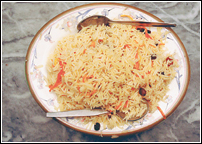
Finally, the moment of truth arrived as we greeted the plates of pulao piled high with fragrant rice with our mouths a-watering. We were told that we had just made it in time for the last helping of pulao as the place was all out of the stuff for the night. Indeed, it would have been a drag to come all the way to Sohrab Goth and not find our Holy Grail.
The stuff was incredibly oily. It seemed that Saudi Arabia’s entire crude oil reserves had been used to flavour our pulao and this writer had to make use of an ice-cold fizzy drink to wash the stuff down. However, it was a definite guilty pleasure, as we dispensed with the forks and dug in with our bare hands.
Buried under the rice was a small chunk of lamb, which was quite tender. Aside from the rice and meat, raisins and sliced carrots made the experience even more delightful, while the raita also helped matters.
Along with the pulao, the kebabs served up by the place were quite different from the stuff regularly available. Brought over with the seekhs still hot, the pieces of meat had bits of animal fat sandwiched in between, while the seekh kebab made from lamb’s meat had an overpowering smell and taste which was a bit testing for those not used to it.
I have had better Kabuli pulao in Karachi, inside the Al-Asif complex as previously stated. Still, it beats the beef biryani served elsewhere. On a visit abroad once, an Afghan friend cooked up a delightful version of the pulao complete with fresh baked salmon. The flavour has still not left my taste-buds.
However, perhaps this is as close as it gets in Karachi. With that thought in mind, we mounted our steel horses, revved up the engines and rode into the night.