



 0
0

Bridge inaugurated by president has not yet fallen — II
 Those who complain about the media always bringing bad news must dwell on the fact that news is what is out of the ordinary, what disturbs the standard pattern of events.
In much of the world, the assumption is that life, whether for a citizen or the state, functions smoothly. That which disrupts this process is news. Therefore, it is news that a murder or accident has taken place, since such incidents are not the norm. In terms of Pakistan, however, I can’t help but dwell on the fact that the standard pattern is one of disruptions, crises and latent chaos. Endemic shortages, inflation or rising unemployment are no longer ‘news’ since they’ve been the norm for so long that they have become characteristic. This implies, therefore, that real news in terms of Pakistan’s reality would concern the bridges that don’t fall three weeks after being inaugurated, the brief period when there is sufficient food to go around, the jirgas that come to an equitable decision, etc – the ‘good’ news, in fact.
News consumers with delicate sensibilities are increasingly criticising the media for not disseminating any good news. Were the organisations to change their approach in view of Pakistan’s reality, as the consumers demand, here’s an example of how a newspaper story of the future may read:
Power supply takes citizenry by surprise
KARACHI, June 7: In an unprecedented development, the metropolis failed to experience even a single hour of loadshedding or power failure on Saturday as the various supply stations continued to operate despite the fact that the mercury rose to 42 degrees.In numerous localities, shocked residents were forced to come out on the streets to pull aside the tyres they had kept ready to burn, in anticipation of the established pattern of electric supply in the country. The move allowed traffic flow to continue freely, upon which the Rangers and riot police that had earlier been put on standby by the city government in case of any untoward incident had to withdraw and concede ground to the traffic police. However, the officers found themselves with little to do in view of the fact that the traffic lights continued to work.
In a disturbing turn of events, meanwhile, many areas of the city experienced gridlock since angered citizens found themselves bereft of any excuse to either fail to arrive at their workplaces or to vent their resentment against the government. As a result, a large number of business, commercial and educational institutions, such as schools, colleges, factories, banks and multinationals, reported an unprecedented shortage of seating space since 100 per cent attendance has not been witnessed in living memory. “The KESC’s failure to abide by the norms of the country has come as a great disappointment,” said a disgruntled worker as he stood in queue for a workstation at an office in Clifton. “This is another indication of the rot that has set into our society, since we cannot even expect life to be the same from one day to the other.”
KESC under fire
Thousands of irate citizens called the KESC complaint lines in order to inquire when the next session of loadshedding or electric breakdown would be, since they did not want to take the risk of starting jobs that they would then have to abandon without warning when the power failed as is the general norm.
As a result of similar concerns, gangs of youths showed up outside the various offices and grid stations run by the power supply company, accusing it of failing to live up to their expectations and threatening to resort to violence in case they were refused the opportunity of burning the tyres they had spent so much time and money in stocking up on.
As a result, the electric supply company’s telephone operators are now considering billing the KESC for overtime, and have contacted a lawyer in this regard. “My clients feel that their employer made unwarranted changes to routine operations,” he stated upon being contacted by Dawn. “These professionals’ high work ethic prevented them from resorting to tactics such as keeping the phone off the hook or refusing to answer calls. Because of this, they had to field thousands of calls such as whether it was safe to set washing machines on an hour-long cycle or even to undertake a credit card transaction. In my opinion, the show cause notice stands a good chance.”
If submitted, the pertinent bill will amount to millions of rupees and will no doubt give rise to further resentment amongst citizens, who expect the burden to be passed on to them as has been the practice in recent decades.
‘Gangsters gathering energies’
In a separate but related development, the ordinarily crime-ridden locality of Lyari failed to experience even a single gunbattle on Saturday since the uninterrupted supply of power meant that all gangsters were able to remain in airconditioned environs. They did not therefore experience the surges in blood pressure or irritation that are generally the underlying cause of such displays of aggression.
However, terrified residents of the area refused to leave the safety of their homes since they fully expected the lull in violence to be the calm before the storm. “I have lived in this area for 30 years and have never seen a day as disturbing as this,” said one resident. “The criminal elements are gathering their energies for heightened assaults upon our lives and liberty. By failing to provide an interruption in the power supply, the KESC has allowed them the time and luxury to make nefarious plans instead of being out on the streets as they should be.”
As a result of the situation in the metropolis, the newly-elected government has come under severe criticism as citizens wait to see whether Sunday [today] will herald a return to normality. When contacted by Dawn, the minister for water and power promised a probe into the matter and said that strict action would be taken against those found responsible. “The government accepts that all citizens have right to expect tomorrow to be the same as yesterday,” he commented. “Through this irresponsible behaviour, the KESC has broken traditions that have existed uninterrupted in Pakistan for years.”
— hmumtaz@dawn.com
Dying for a smoke — in the land of smokescreens
 IN this country, there are smokescreens and then, there is real smoke. What this real smoke entails is often ignored at the altar of “good taste”.
About smokescreens, we worry endlessly; about real smoke, we puff it away. We huffed and puffed only last Saturday — to mark the World No-Tobacco Day.
But, true to form, there was flip-flop starting with how Islamabad made noises about the rising smoke (not the chimney or kiln kind) while cousin Rawalpindi slept over it.
The garrison city chose to ignore it much the same way smokers overlook statutory health warnings on the pack of a cigarette.
Meanwhile, a clutch of newspapers, including Dawn’s Islamabad Metro, published cheeky pictures of photojournalists/anti-smoke volunteers of a walk themselves puffing with no sign of discretion. Full marks for the exposure!
There was also the spectacle of a news anchor friend, who is a chain smoker, engagingly talk on the pitfalls of lighting that fire!
So who will walk the talk when charity does not quite begin at home?
In fact, one believes that media is particularly to blame for a large majority of journalists are culpable in underplaying messages aimed at highlighting the extremely harmful effects of smoking.
Is it any wonder therefore, that according to a study no more than five per cent of our population is aware that tobacco smoking damages the lining of blood vessels, deposits cholesterol and reduces the blood flow to the heart causing heart diseases?
But this is nothing compared to statistics that should have the smoke coming out of our ears. The situation begs urgent attention — before the current generation of smokers and those following it end up in a smoke themselves.
Early bird catches the worm, they say, and so should be the emphasis on getting a handle on youth in particular, which at 42 per cent of the country’s population, are the most vulnerable to the menace.
Consider these facts:
l According to Youth Affairs Secretary Ashfaq Mehmood every day, 1,200 young Pakistanis — aged between six and 15 — including girls begin smoking. An independent expert, Dr Shahzad Ali Khan, puts the daily figure at 1,600 between the ages of 15 and 19.
l There are about 30 million smokers in Pakistan, 28 per cent of these are students. Schools, colleges and universities serve as breeding grounds — away from any prying eye — for these students.
l According to a recent research by the National Health Services of Pakistan, 14.4 billion cigarettes are sold daily — a million every minute.
l Pakistan Medical Society (PMS) Chairman Dr Masood Akhtar Sheikh says 42.7 per cent of the country’s population indulge tobacco smoking on a daily basis.
l According to Pakistan Institute of Medical Sciences (PIMS) Executive Director Dr Abdul Majid Rajput, 40 per cent of the patients admitted in the Intensive Care Unit (ICU) of Islamabad’s top medical facility with lung disease are smokers.
l Seventy-five per cent of the patients visiting the cardiology outpatient department suffer from ischaemic heart disease (an inadequate blood supply to a part of the body, especially to the heart muscles) and 70 per cent of these are chronic smokers between the ages of 40 to 55. Not surprisingly, most of them began smoking when they were young.
l PIMS Assistant Director (OPD) Dr Waseem Khawaja reveals less than 20 per cent of smokers can limit themselves to occasional or intermittent smoking.
l According to Pakistan Anti-Smoking Society, tobacco sales per year in Pakistan amount to 108,000 tons. The government gets an annual revenue of $452 million out of these sales.
l About a 100,000 people die in Pakistan every year owing to diseases related to tobacco smoking.
Apart from a raft of immediate policy measures, Pakistan needs to implement a total ban on tobacco advertising if it is interested in protecting the youth from the hazards of smoking.
But what is really happening on the ground, say in Islamabad, which by virtue of being the seat of the federation, should have been leading the national campaign to arrest the negative fallout?
To begin with the Islamabad Capital Territory administration has failed to implement the Prohibition of Smoking and Protection of Non-smokers Ordinance passed three years ago, which envisaged the setting up of smoking zones.
According to the ordinance, no person could smoke in public places including auditoriums, health institutions, amusement centres, restaurants, public offices, court buildings, cinema halls, conference or seminar halls, eating houses, hotel lounges, other waiting lounges, libraries, bus stations, sport stadiums, educational institutions and other places.
Anyone who knows his or her way around the federal capital knows how the law is violated with impunity in most of these supposedly off-limit areas.
In a belated move, health warnings on tobacco products will be rotated on a half-yearly basis, effective January 1, 2009 — a necessary step considering that, over time, a smoker is lulled into seeing the statutory warning as part of the overall cigarette pack design.
But World Health Organization representative Dr Khalif Bile warns that half-hearted measures will not do. He says if the government is really serious, it should ban all forms of tobacco advertising and substantially raise the taxation system.
One wonders what hope there is for a country, which ranks with India, Japan, Thailand and Turkey as one of the world’s largest tobacco growers, its government benefits enormously from its sale and the young people are dying for a smoke — perhaps, literally.
The writer is News Editor at Dawn News
What makes Musharraf so confident?
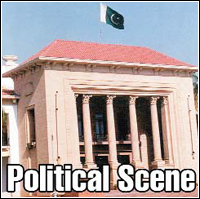 President Pervez Musharraf, under intense fire since the general elections brought his opponents to power, delivering a crushing blow to his supporters, met some journalists yesterday and explained his position on many issues. However, the explanations raise more questions than the ones he answered.
The president said very emphatically that he is not going to step down or move to some other country. The assertion contradicts many a press report that the president is holding consultations with his friends to leave the political scene. It also belied reports that a plane from a foreign country has reached Chaklala to take the president and his family out of Pakistan.
While ruling out the possibility of his stepping down, Musharraf said a procedure has been provided in the constitution to impeach him and that he won’t have any objection if the legislators invoke it.
The president said he doesn't expect any negative reaction from the army, the institution that he commanded for a long time.
The question is what is it that has given the "dormant" president so much confidence. And why is he not afraid of being removed through impeachment? How will his assertion affect the lawyers' ongoing movement? What will the ruling coalition do now?
Apparently, the president is capitalizing on the differences between the PML-N and the PPP, the two major coalition partners. While the PML-N wants to remove the president within no time, the PPP has not a very clear policy about him.
The PML-N leadership advised the PPP many a time to rid the country of the dictator in the presidency, but the PPP is yet not very clear as to what it should do. Some times the PPP leaders start attacking the president and call him a relic of the past and advise him to quit or face impeachment. But then the party changes its tone and says that Musharraf is an elected president. (Defence Minister Chaudhry Ahmed Mukhar held a news conference at his Gujrat residence a few days ago to say that Musharraf is an elected president. Before that, Information Minister Sherry Rehman distanced the PPP from Mian Nawaz Sharif's proposal to impeach the president, saying impeachment cannot be carried out at the whims of an individual).
It appears that the PPP has no intention to remove the president through parliamentary proceedings. Had the political will been there, the ruling coalition has the required two-thirds majority in the bicameral legislature to oust him. And had there been any possibility of the ruling coalition going for impeachment, the president would not have dared the legislators to go for it. He is relying on the PPP support.
Maybe, President Bush who had phoned Musharraf a few days ago and expressed his all-out support for him has told the PPP leadership to cooperate with the staunch US ally on war against terror.
The president also defended his action against the judges. He said he did not remove them, but they ceased to remain judges when they refused to take oath under the PCO. About the reinstatement of deposed judges, he said parliament could bring them back.In fact, this is what he has consistently been saying. He believes that neither the ruling coalition would have the two-thirds majority in parliament nor the judges would be able to return to their courtrooms.
The PPP also thinks that a constitutional amendment is needed to reinstate the judges, but the PML-N doesn’t agree with this opinion. And if the two parties don’t reconcile their differences on the subject, judges can't be restored. And if judges are not restored, the PML-N will be left with little justification to stay with the PPP in the coalition.
The president’s view will not be acceptable to the lawyers and they may have to step up their struggle in favour of deposed judges. The lawyers will now be free to show their muscle on June 10, the day their long march on Islamabad is due to start. —Ashraf Mumtaz


























