



 0
0

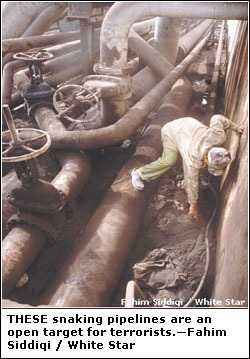 KARACHI, June 13: When the threat of terrorism looms large as a real and present danger across the country, the oil installation area in Keamari – one of the gateways of trade and business activities in the city – remains vulnerable as its four exit points are open and unguarded and allow for free movement.
The area is the main source for business activities of bulk liquid petroleum, edible oil, sensitive chemicals, exportable molasses and ethanol, catering to the whole country’s needs. If an accident were to occur here or if the facility was attacked, it would surely have a devastating effect on the whole nation’s economy.
The highly sensitive area is under the grip of lawlessness where thefts, hold-ups and even daylight robberies by armed gangs are common.
An official of the Terminals Association of Pakistan (TAP) told Dawn that all the three intelligence agencies have already sent reports to their respective heads citing the vulnerability of the oil installation area and have suggested that immediate corrective measures be taken.
TAP Secretary Akhtar Sultan, citing the sensitive nature of the installation, said the area has a storage facility for POL and hazardous products ranging from 1,500 to a maximum 15,000 tonnes.
“The Keamari oil installation area is practically the nerve centre for the supply of oil and other products. If any mishap occurs here, the entire country could come to a standstill as there is no alternative to this installation,” Mr Sultan observed.
Recalling an old but important incident, he said that coinciding with the plane crash of General Ziaul Haq in 1988, on that very day two persons on a motorcycle came to the area and fired a rocket aimed at one of the oil tanks. “Fortunately, the rocket hit a molasses tank, thus the damage was minimal. But if it had hit any POL tanks, the entire area could have been blown up,” Mr Sultan said.
Along with armed hold-ups, the area is frequented by different groups who puncture the oil pipelines running through the area and siphon off the oil, taking it away in donkey carts and pick-up trucks. “While carrying out these activities, these people are usually armed,” an office-bearer of the TAP told Dawn.
Safety and Security Manager of Al Rahim Trading Company Mohammad Azam told Dawn that on May 29 2008, armed suspects attacked their security guards deputed at the lines. “After opening fire on the guards, they punctured the oil pipelines and filled their drums with oil and escaped in a pick-up truck, threatening us with dire consequences if we resisted in future,” he said.
He pointed out that free movement of such elements in the area is indicative of the security lapse on part of the security agencies. There is a single Rangers picket in the area, which is merely symbolic.
He said that his association has held well over a dozen meetings with the law enforcement agencies; even former Sindh home secretary Brigadier Ghulam Mohammad Mohtaram visited the area and held a meeting with the stakeholders, but nothing came out of it. In fact, the situation is worsening by the day.
At one point it was suggested that gates be installed at the exit points and a wall be built around the oil installation area. But when the question of finances arose, the government backed out, suggesting that the stakeholders pay up.
The TAP secretary said that when it is government land and stakeholders are already paying revenue in the form of taxes, why should they pay up further for a security wall, which is primarily the responsibility of the government as the land is owned by the Karachi Port Trust.
General Manager of Azlak Enterprises, Moinuddin Khaild, told Dawn that every other unit of the oil installation area has been subjected to break-ins, while most sub-stations have been targeted by bandits.
“They break into the premises, tie up the employees after shutting down the power supply from the sub-station and take away expensive electrical equipment each time,” he said.
Recently, a group of bandits badly beat up employees of Habib Sugar Mills in the area, trussing them up and taking away electrical equipment.
“Even if a shoot-out takes place with the bandits or if they open fire hitting any of the POL or chemical tanks, it could spark a fire, which will be uncontrollable as the city doesn’t have the resources to fight such a fire,” said a stakeholder.
“Even with the collective strength of the city’s fire units, the fire of these tanks could not be controlled as they would run out of foam, which is a prerequisite for controlling such a fire,” he added.
Mr Sultan pointed out that even an empty tank could catch fire as leftover gases remain in the tank.
“We have even written to the IG Sindh drawing his attention towards the law and order problem of this sensitive area. But things have not changed,” the TAP secretary remarked.






























