



 0
0

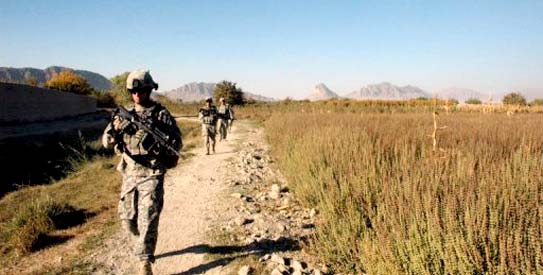
KANDAHAR: When insurgents lobbed six grenades into a US-Afghan base in Kandahar this week, some US soldiers who took shelter in a bunker muttered darkly that it looked like an inside job.
Tuesday was the first night for a week that soldiers in the heavily-fortified base were not told to don body armour as darkness fell and, the troops said, an Afghan police officer may have passed that information on to the enemy.
The accusation highlights the sometimes fraught relationship between US and NATO troops and the Afghan forces they live with and whom they are trying to train to take over security so that foreign soldiers can pull out
The incident came just three days after NATO and Afghan officials began probing reports that a rogue Afghan soldier shot dead foreign troops – said to be two US Marines – on a base in another part of the volatile south.
In July, a renegade Afghan soldier shot and killed three British Army Gurkhas and wounded several others on a base in Helmand, which borders Kandahar province.
A month later, an Afghan police officer killed two Spanish paramilitary police officers and a Spanish interpreter during a training session at a base in Badghis province in the northwest of the country.
Such incidents are rare but raise questions about the effectiveness of the multi-billion-dollar international effort to train and mentor Afghanistan's security forces.
In the cramped Kandahar base hit by the grenade attack, 200 US soldiers from 1-22 battalion of the 4th Infantry Division live and work alongside some 50 Afghan National Police (ANP) officers.
About 250 paramilitary Afghan National Civil Order Police (ANCOP) are also stationed there.
The US and Afghan soldiers appear to have good relations and every day conduct joint patrols through Kandahar city, which is the spiritual heartland of the Taliban. But they mix little socially, largely because of the language barrier.
Tuesday's attack left just one US soldier with minor injuries and came less than an hour after four men wearing ANP uniforms walked up to a nearby police checkpoint and shot dead two officers at point blank range.
The precise identity of the attackers was not immediately clear. Afghan police uniforms are on open sale in the markets of Kandahar city.
In July, a suicide bombing on the base left several American troops dead.
“That attack almost destroyed relations between our forces and ANCOP,” said the commander of the 1-22 battalion, Lieutenant Colonel Clay Padgett.
But he said relations were now good and that the Afghan forces his soldiers are mentoring are well on the way to being able to work unsupervised.
“It always defaults to being good. There are frictions because it's a different culture and I think that the majority of the friction occurs at the lower levels of the armed forces,” he added.
Tensions exist, too, among the Afghans.
The ANCOP recruits in Kandahar are mostly from other parts of the country and are better paid and seen as more professional, while many Afghans view the ANP as predatory and corrupt.
The United States and NATO have more than 150,000 troops in Afghanistan fighting the Taliban-led insurgency which is now in its 10th year.
These forces have trained more than 136,000 Afghan army soldiers and 119,600 police as part of the NATO training mission, with a goal of 171,600 soldiers and 134,000 by November next year.
Building Afghanistan's security forces is pivotal to US President Barack Obama's plan to start drawing down US troops from next July.
Publicly, US soldiers that AFP spoke to in and around Kandahar city were all “on message”, and trotted out the line being pushed by their military top brass that the Afghan forces were shaping up well.
But privately, some doubt the loyalty of the security forces they currently spend their days with.
“They're playing both sides,” said one soldier, who asked not to be named, during a joint US-Afghan foot patrol near Kandahar. – AFP




























