0
0

ISLAMABAD, Nov 11: Pakistan Development Forum (PDF) will take place here from Nov 14 to 15 for a comprehensive dialogue with development partners on government's strategic direction, priorities and policies enabling the government to chart out its future economic and social strategy.
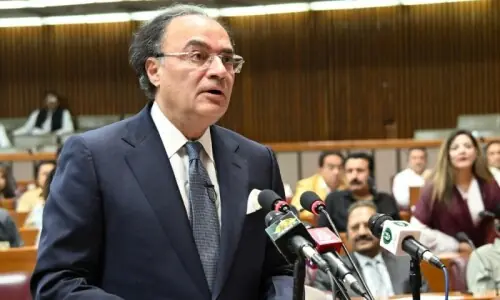
Federal Finance Minister Dr Abdul Hafeez Shaikh while explaining details of the PDF at a ceremony here on Thursday, said the forum would focus on how to deal with the current economic challenges, both fiscal and monetary and the long-term agenda, particularly in the aftermath of floods.
The fundamental objectives of the PDF are to give a comprehensive shape to government's economic reforms, and through the forum the government would present to the world its strategic plan in a sound and clear voice.
The review of country's economic development would encompass vision and strategies of the provinces about the post-flood economic and social development, flood damages, need assessment and reconstruction, protection of the poor and vulnerable, challenges of the economy and its response, growth and sectoral reforms and aid effectiveness.
Dr Hafeez Shaikh clarified that PDF is not a forum for pledging by donors rather a process of dialogue with partners.
While the forum would allow development partners to realign their strategy, the government would be able to assess its policies and take decisions to which extent changes could be made.
Under the theme “reform agenda-road to sustainable economic development,” the two-day forum, being held after a gap of two years, would be chaired by Finance Minister Dr Abdul Hafeez Shaikh and addressed by provincial chief ministers and Khyber-Pakhtunkhwa Governor in addition to federal ministers, the NDMA chairman, the BISP chairperson, Governor, State Bank of Pakistan.
Power sector reform plan would be presented by Raja Pervez Ashraf while Syed Naveed Qamar will present oil and gas reform plan.
Provincial economic managements and finances will also be debated at PDF.
Statements will be delivered by Andrew Mitchell, Secretary of State for International Development, UK, Richard C. Holbrooke, US Special Representative for Afghanistan and Pakistan, Xiaoyu Zhou, Vice President of Asian Development Bank, Isabel Guerrero, Vice President of World Bank and a representative of IMF.
The finance minister said that Pakistan was passing through a revolutionary period after the 18th amendment when administrative powers and financial resources were being transferred to provinces.
Dr Hafeez Shaikh said that Watan Card and Benazir Income Support Programme (BISP) have earned laurels internationally and donors have approved these schemes.
He told a questioner that the NDMA had estimated loss at $10 billion, out of which crops losses are valued at $5 billion, citizens' housing and property losses at $2 billion and the loss of infrastructure of the federal and provincial governments amounted to $3 billion.
Dr Shaikh stated that 1.6 million families have been affected by the devastating floods to whom the government would pay Rs160 billion.
The Citizen Damage Compensation Mechanism evolved by the government would initially need $1.8 billion. To fund this programme, the government was reprioritising its preferences, and the fiscal measures announced on Wednesday would generate Rs45 billion. At least three-fourth funds for the programme would come from different sources.
In reply to a question relating to the release of next tranche by the IMF under the Stand-by Arrangement (SBA) for Pakistan, the finance minister explained that talks with the fund were currently being held on the basis of macro-economic situation, mobilisation of domestic resources.
There is no deadlock, our talks are progressing steadily and we would approach the IMF for the review of economy leading to release of the tranche.