6
6

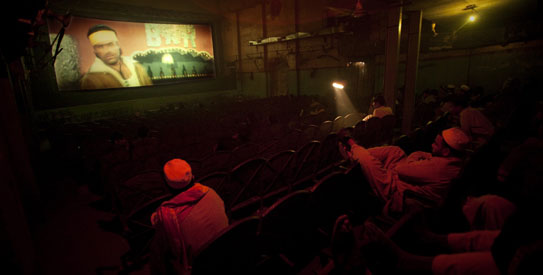
LAHORE: Spinning tales of love and revenge packed with testosterone, filmmakers from Pakistan's Taliban-hit northwest dream of stamping out militancy and restoring their culture to a bygone era.
Coming from an area known as a Taliban and Al-Qaeda stronghold infamous for religious seminaries that recuit young men into "holy war", Pashtun actors say they are promoting the benign side of their heritage.
Clad in traditional white shalwar kameez and topi prayer cap, director Ajab Gul says he uses cinema to promote pride in his warrior culture and provide an outlet for young men at risk of being lured by militant mullahs.
"The young generation is illiterate and unemployed and having a lot of problems. They need to be involved," says the 45-year-old former actor.
"If you do not entertain and pay attention to the youth they will end up into terrorism."
Filmmakers brush aside fears of Islamist attacks, but working with ageing equipment and desperate to keep their loss-hit industry alive, they admit the sector is in financial crisis. But it was not always that way.
The first Pashto film, made in India in the 1930s, was an adaptation of the Sufi love story, "Laila Majnu" and preceded the industry's 1970s heyday when a series of classical cultural tales were adapted for the big screen.
But in the 1980s a new type of Pashto film was born that Gul and his actors say damaged the industry with its sexed-up love scenes -- heavy on dancing and light on plot, in poor imitation of Bollywood cinema.
In one such trailer a woman in heavy make-up and a figure-hugging dress clutches the vest of her beefy beau and gazes beseechingly at the sky, while he, his hairy chest on display, stares moodily into the camera.
The scene switches to a fast action sequence in which men with fake beards and moustaches wage battle, throwing scarcely believable punches and firing pistols as their enemies are covered in splashes of red paint.
The new style offended cultural mores in an increasingly conservative Muslim society and their poor quality turned a generation of Pashtun moviegoers off films made in their own language.
"1980-1998 were very bad years for the Pashtun film industry, with very bad movies that weren't suitable to our culture," said Gul.
Pakistan has suffered increasing Islamisation, economic malaise and cultural marginalisation, but so great is suspicion of India it is perhaps unsurprising that filmmakers blame their rivals for conspiring in their decline.
"The main reason was RAW (Indian intelligence) trying to kill us off because they couldn't compete with Pashtun culture and language," says Gul.
His team, who work in Pakistan's cultural capital Lahore because of a lack of studios in the northwest, say they are trying to return Pashto film to its chaste roots while giving their own take on the community's social problems.
Actress Rahila Agha, 39, who has worked in the industry for 11 years, plays a mother in Gul's latest film, in which her two sons - one a police officer and another a traffic cop -- are fighting.
"It's about Pashtun traditions and rivalries," says Gul.
Agha, who is not Pashtun but comes from the traditionally more moderate province of Punjab, says film plays a vital role in the Pashtun community.
"I've worked with many heroes," says the buxom 39-year-old, fluttering her heavily made-up eyelashes. "People like me, that's the reason I'm here."
But the cinema refuses to tackle religious or cultural taboos head on.
"We cannot because of security," says Gul.
"That's our restriction, we can't touch taboos... because we represent almost two million people, we have to live in that culture."
Another convention unchallenged is male dominance in a society in which women often keep purdah, meaning that they are kept out of sight of men, and in which they are subject to arranged marriage, frequently as teenagers.
"In these movies women also have desires, but they accept the man's supremacy," says Gul. "This is the culture and this should be."
But the industry is in dire straits, with only a dozen movies now made each year, down from 40 in its heyday. Gul says he often expects a 50 percent loss on each film distributed.
A lead actor in one of Gul's movies now commands a fee of up to 200,000 Pakistani rupees (2,332 dollars).
Gul blames security fears among would-be moviegoers and poor equipment affecting production values, which contrast miserably with the big-budget and wildly popular Bollywood smash hits that play in cinemas across Pakistan.
Militants have launched attacks on music stores and other cultural institutions in the northwest, although cinemas have been largely untouched so far, residents say because of the films' waning popularity.
Gul Akbar Khan Afridi, 70, chairman of the Pashtun film association, says a safer environment could turn the industry's fortunes around.
"Because of the security situation people are not coming to the cinemas. If the situation improves, the film industry will be better," he says, hopefully. – AFP