0
0

GREYMOUTH: A bore hole drilled close to where 29 men remain trapped in a New Zealand mine revealed high levels of toxic gases Wednesday, in a further blow to families angry at stalled rescue efforts.
Police said extreme concentrations of some gases meant it was likely to be a long wait before rescuers could enter the Pike River colliery, where the missing men have not been heard from since Friday’s underground blast.
“The samples are off the limit,” said police superintendent Gary Knowles who delivered the grim news to the families before addressing a press conference.
The miners’ families had pinned their hopes on good news from the bore hole, drilled over the past two days through a hillside in a remote area of the South Island above where the men are believed to be.
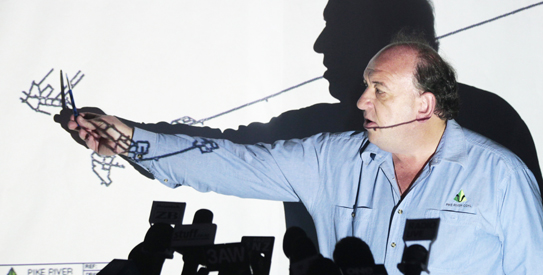
“As we expected, but not as families hoped, the air that came out from the hole was extremely high with carbon monoxide, very high in methane and fairly low in oxygen,” Pike River mine chief Peter Whittall said.
“It’s making their hopes diminish and making it more difficult for them to hold out that hope that all 29 of those guys are waiting for us as we hoped on day one.”
“I think we’re all coming to that realisation now,” he added, but he would not comment on whether the gas levels were survivable.
When asked when he thought rescuers might enter the mine, Knowles said:
“It’s a very unstable environment and currently it’s not safe to go underground. It may never reach that point, but if it does, rest assured we’re ready.”
He said this did not mean there would never be a rescue, but “it’s a long journey”.
As emergency crews awaited the all clear to go underground, relatives of the missing miners – 24 New Zealanders, two Britons, two Australians and a South African – criticised the delays.
Lawrie Drew, whose son Zen, 21, is one of those trapped, said the families wanted confirmation about the fate of the men, not the “PR spiel” authorities were delivering.
“We don’t want bullshit, we want answers, we’re sick of these meetings,” he told reporters after attending the families' latest twice-daily briefing with rescue coordinators. He added: “We want confirmation, that's about all we want.”
Geoff Valli, whose 62-year-old brother Keith is also among the missing, said local residents in the remote west coast community wanted rescuers to enter the mine.
“I know pretty well from the talk around town, the local guys that they’re prepared to go and do it... It’s time for men to do what men have got to do,” he told public radio.
Knowles said “a minority” of the rescuers on standby at the mine were prepared to go underground but most supported his decision to hold back.
The police chief said he understood why the families' frustration and anger was being directed his way.
“(But) I’m not making decisions alone, there’s a lot of people at my level and very senior experts who are giving me sound advice based on logic,” he told reporters.
In the hope of gaining a clearer picture of conditions underground, two remote-controlled robots have been sent part-way down the mine. Rescuers took delivery of a third from Australia Wednesday and a fourth is being flown in from the United States.
The first robot, restarted after breaking down on Tuesday, had reached a kilometre (about half a mile) into the tunnel and found the helmet of Russell Smith, one of two miners to make their way out after the explosion.
Whittall said the headlight on the helmet was “very encouragingly” still working, which was positive for the miners underground “if they're still there”.
Authorities on Tuesday released chilling video footage which showed a powerful and sustained explosion at the mine on Friday.
The security video released by the Pike River Coal company showed stone dust being blasted for 52 seconds out of the shaft's entrance – some 2.5 kilometres from the explosion and where the missing men were located. — AFP