0
0

PARIS: Mummies decaying in Siberia, pyramids vanishing under the sand in Sudan, Maya temples collapsing: climate change risks destroying countless treasures from our shared past, archaeologists warn.
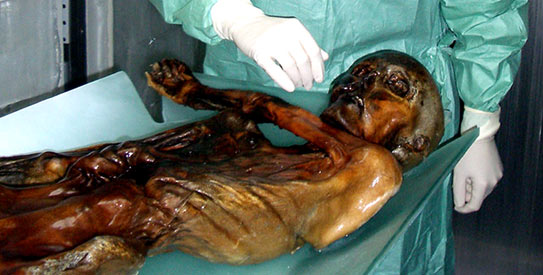
Melting ice can unlock ancient secrets from the ground, as with the discovery in 1991 of “Oetzi”, a 5,300-year-old warrior whose body had been preserved through the millennia inside an Alpine glacier.
But as ice caps melt, deserts spread, ocean levels rise and hurricanes intensify – all forecast effects of man-made global warming – Henri-Paul Francfort of the CNRS research institute fears a heavy toll on world heritage.
Francfort is head of a French archaeological team in Central Asia that played an important part in excavating the Kurgans, or frozen tombs, of nomadic Scythian tribes in Siberia's Altai mountains.
He fears they now risk being lost.
“The permafrost, the constantly frozen layer of earth that protected them up until now, is melting,” he said. “There are mummified, tattooed bodies, buried with sacrificed horses, furs, wooden objects and clothes. With my Russian colleagues, we are watching the part of the soil that melts each season, and which is getting deeper and deeper. Unless we take preventative action, it will soon be too late.” According to Francfort, Oetzi's remains were most certainly uncovered due to a receding high-altitude glacier in the Italian Tyrol region.
“Melting glaciers, especially in Norway, now regularly reveal other treasures,” he said.
Like a modern-day Atlantis, experts warn that rising ocean levels – which some forecast could jump a metre by 2100 – stand to wipe out dozens of coastal archaeological sites, with Pacific islands on the frontline.
In Tanzania, maritime erosion has already destroyed a wall of the Kilwa fort, built by Portuguese colonialists on an island just off the coast in 1505, Francfort said.
And in Bangladesh, the ruined city of Panam in Sonargaon, the heart of the kingdom of Bengal from the 15th to 19th centuries, is regularly hit by flooding.
Today, Panam is one of 100 sites listed by the UN culture agency UNESCO as threatened by climate change.
A forecast spike in unpredictable weather events – hurricanes chief among them – is another major source of concern, says Dominique Michelet, a specialist of American archaeology at the CNRS.
He cites the case of Chan Chan in Peru, former capital of the Chimu civilisation and the largest pre-Colombian city in Latin America, which is already severely exposed to flooding linked to the El Nino weather pattern.
Likewise, the Maya temple of Tabasqueno in Mexico had to be largely rebuilt after it was badly damaged by two tornadoes – Opalo and Roxana – in 1995.
“Archaeologists had managed to stabilise the main temple, but the buildings became saturated with water and collapsed inward,” Michelet said.
Sand is one of the worst enemies of archaeological sites, like in Sudan where dunes are encroaching on the burial pyramids of Meroe, the capital of a flourishing kingdom from the third century BC to the fourth AD.
“In Oman, two cyclones – Gonu un 2007 and Phet last year – totally buried in sand sites that date back to the fifth and sixth millennia BC,” said Vincent Charpentier, of the INRAP archaeological research centre.
Michelet warns that UNESCO's efforts so far to identify at-risk sites do not go far enough, calling for the world to “sound the alert” over the threat.
“Archaeology is part of human memory,” said Francfort, who suggests radical solutions may be needed to protect past treasures from climate change, citing the case of the Abu Simbel rock temples in Egypt.
Following a concerted international effort, the entire complex was relocated in the 1960s to prevent them being submerged by the building of a dam on the River Nile.