0
0

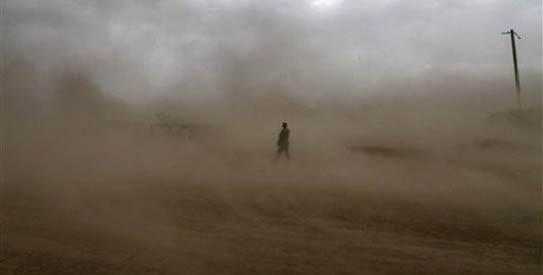
SINGAPORE: Studying the way glass or other brittle objects shatter can help scientists hone their weather forecasts and predictions of future climate, a study released on Tuesday says.
The study found that tiny particles of dust, released into the air when dirt is broken apart, follow similar fragmentation patterns as glass.
Dust plays a crucial climate role because it can affect the amount of the sun’s energy absorbed by the atmosphere.
Dust can also help with cloud formation and distribution of nutrients, such as iron that is vital for plants.
Some particles reflect solar energy, acting as cooling agents, while some trap extra heat.
For example, microscopic clay particles remain in the atmosphere for about a week, helping cool the atmosphere by reflecting heat from the sun back into space. Larger dust particles drop back to earth more quickly and tend to have a heating effect.
The trick is to figure out how much of each type is in the atmosphere and the better the estimate, the more accurate the forecast.
Jasper Kok of the US National Center for Atmospheric Research in Boulder, Colorado, said his work suggested there could be several times more dust particles in the atmosphere than previously estimated.
This is because shattered dirt appeared to produce a much larger number of dust fragments, a finding that challenges assumptions used in complex computer programmes to forecast the weather and future climate.
This is particularly the case for desert regions such as north Africa, parts of Australia and the southwestern United States, where winds can whip up large amounts of nutrient-rich dust into the air and across the sea.
“As small as they are, conglomerates of dust particles in soils behave the same way on impact as a glass dropped on a kitchen floor,” Kok said in a statement with the release of his study in the latest issue of the US journal Proceedings of the National Academy of Sciences.
“Knowing this pattern can help us put together a clearer picture of what our future climate will look like,” he added.
That is crucial for scientists using computer climate models to simulate the amount of dust particles in the atmosphere to figure out the heating or cooling effect.
Kok said his work suggested the amount of microscopic clay particles might be overestimated in many models and that there might be much greater amounts of larger dust particles swirling around, particularly near desert regions.
More study was needed to determine whether future temperatures in those regions would rise more or less than currently indicated by computer models, the statement said.
Mathematical formulae can be used to show how brittle objects crack and break in predictable ways. Using these formulae Kok estimated the size distribution of dust particles blown into the air, with the formulae matching the measurements of particle sizes almost exactly, he said in the study.
“The idea that all these objects shatter in the same way is a beautiful thing, actually,” Kok says in the statement.
“It’s nature’s way of creating order in chaos.” – Reuters