0
0

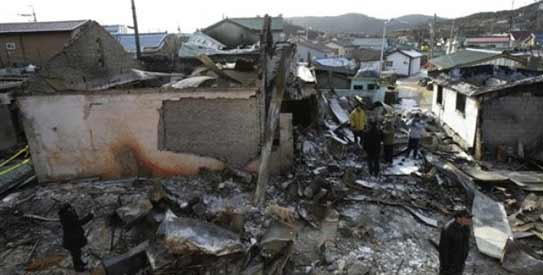
SEOUL: North Korea began 2011 with calls for improved relations with South Korea after a year of tensions marked by the first deadly attack on a civilian area since the war.
“Confrontation between North and South should be defused as early as possible,” a joint New Year editorial of three leading North Korean state newspapers said on Saturday.
“Dialogue and cooperation should be promoted proactively,” it said.
Relations plunged after the North shelled a border island in November, killing four people, including two civilians.
World leaders leapt to condemn the attack, with many calling on China to rein in its unpredictable ally, something Beijing so far appears unwilling to do.
The South has since staged a series of military exercises, including a live-fire drill on December 20 on the island but the North did not follow through with threats of a new and deadlier attack.
The editorial, which North Koreans are obliged to read, said: “This year we should launch a more determined campaign to improve inter-Korean relations.
“Active efforts should be made to create an atmosphere of dialogue and cooperation between North and South by placing the common interests of the nation above anything else.”
Professor Yang Moo-Jin of the University of North Korean Studies in Seoul said Pyongyang was apparently pursuing stability on the Korean peninsula to cement an eventual hereditary succession by heir apparent Kim Jong-Un.
The youngest son of leader Kim Jong-Il burst into the limelight in September. He was appointed a four-star general, given senior ruling party posts and appeared in photos and at a mass parade close to his father, whose health is widely thought to be failing.
The editorial, which was carried by the North’s official news agency, also reiterated that Pyongyang, whose nuclear drive is the subject of currently stalled six-party talks, is committed to denuclearisation.
But in a reference to South Korean military drills that have sometimes included the United States, the newspapers warned: “It is imperative to check the North-targeted war exercises and arms build-up of the bellicose forces at home and abroad that seriously threaten national security and peace.”
As well as the communist North’s deadly shelling of Yeonpyeong island, Seoul also accuses the North of sinking one of its warships in March near the disputed border in the Yellow Sea, a charge Pyongyang strongly denies.
The conciliatory tone of the editorial is in stark contrast to the bellicose language used by North Korea for much of the year as relations with Seoul dived.
However, it did warn: “The danger of war should be removed and peace safeguarded in the Korean peninsula.
“If a war breaks out on this land, it will bring nothing but a nuclear holocaust.”
In December, the impoverished North warned it was ready for a “sacred war” using its nuclear weapons as the South held a live-fire drill in a show of strength.
“The editorials hint the North will wait for the China-US summit this month and the US-South Korea annual joint military drill in March to decide its course of action between dialogue and confrontation,” Yang told AFP.
Pyongyang reportedly offered nuclear concessions to US politician Bill Richardson in a visit last month but Seoul and Washington have expressed scepticism about the North’s apparent overtures.
Pyongyang pulled out of nuclear talks involving the two Koreas, the United States, Russia, China, and Japan in April 2009 and ordered UN nuclear inspectors out of the country.
It staged a second nuclear test a month later.
Hong Hyun-Ik, senior researcher at the private Sejong Institute, wrote in the independent Hankyoreh daily that the North would conduct a third nuclear test unless the mood turns toward dialogue following the Sino-US summit.
Cheong Seong-Chang, another analyst at the Sejong Institute, said North Korea needs tension reduction to achieve the goal of improving living standards.
“This is why the North appears to be self-contradictory in denouncing the South’s policy toward the North while emphasizing the need for improving inter-Korean relations,” Cheong said.
Much of the annual editorial, which is regarded as setting the direction of policy in the secretive country for the coming year, focused on improving living standards in North Korea, which suffers chronic food shortages.
Leader Kim Jong-Il was quoted as saying: “We should bring earlier the bright future of a thriving nation by making continuous innovations and advance, full of confidence in victory.”