0
0

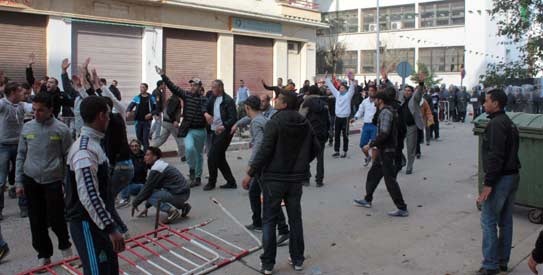
ALGIERS: Hundreds of stone-throwing demonstrators clashed with police in the eastern Algerian city of Annaba on Sunday, as the opposition announced another major anti-government rally next weekend.
Washington meanwhile called on Algeria's security forces to show restraint, a day after nationwide protests against President Abdelaziz Bouteflika that reportedly led to dozens of arrests and police attacks on journalists.
“We reaffirm our support for the universal rights of the Algerian people, including assembly and expression,” State Department spokesman Philip Crowley said in a statement.
The next anti-government rally will be held February 19, said Mustepha Bouchahi of National Coordination for Change and Democracy (CNCD), an umbrella group of opposition parties, civil society movements and unofficial unions.
On Saturday an estimated 2,000 protesters in Algiers braved 30,000 riot police, defying a ban against demonstrations in the capital.
Demonstrations also took place in cities across the country, galvanising hopes for the same mass uprisings that ousted the leaders of Egypt and neighbouring Tunisia.
“These people braved the ban to demonstrate peacefully,” Bouchahi said, following a meeting by the umbrella group which “denounced and condemned the brutal behaviour of the security forces.”
The crackdown did not stop another demonstration in Annaba Sunday, where four police officers were slightly injured during clashes with young protesters outside the local government headquarters.
The media offered a mixed review of Saturday's rallies, with the pro-reform daily Liberte topping its coverage with the headline: “Change is on its way”.
But the government daily El Moudjahid dismissed the Algiers rally as only a “weak echo” of events in Cairo and Tunis.
Public demonstrations have been banned in Algeria under a state of emergency put in place in 1992 but are allowed on a case-by-case basis outside the capital.
The national union of journalists condemned a crackdown on journalists covering Saturday's demonstrations and said several were “violently attacked by police.”
The head of the Algerian League for the Defence of Human Rights (LADDH), Mustapha Bouchachi, said 300 people were arrested Saturday in Algiers, the western city of Oran and the eastern city of Annaba, while the interior ministry said only 14 people were detained.
Both sources said however all were later freed. From Brussels, European Parliament head Jerzy Buzek demanded that Algerian authorities “shun violence and respect their citizens' right to peaceful demonstration.”
He also slammed Algeria's state of emergency as “unjustifiable”. The CNCD is demanding the immediate end of Bouteflika's regime, citing the same problems of high unemployment, housing and soaring costs that have sparked protests across the Arab world.
The grievances also triggered early January riots here that left five dead and more than 800 injured.
A protest called by the opposition Rally for Culture and Democracy (RCD) in Algiers on January 22 left many injured as police blocked a march on parliament.
Like their Tunisian and Egyptian counterparts, the protesters have used Facebook and text messages to spread their call for change.
Bouteflika, in power since 1999, has acted to curb price rises and promised political concessions, including pledging to lift the state of emergency, which the opposition says do not go far enough.
The 74-year-old leader was re-elected in 2004 and again in 2009 after revising the constitution to allow for an indefinite number of terms.