0
0

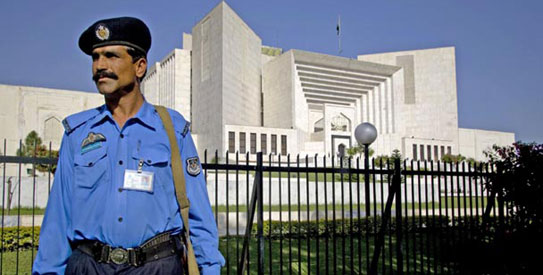
ISLAMABAD: Winding up over four weeks of talks on the economic reforms agenda, the government assured the PML-N parliamentary team on Tuesday that it would implement the Supreme Court’s judgment on reopening Swiss cases after three review petitions were settled by the apex court. Former finance minister Ishaq Dar told reporters in the presence of Finance Minister Abdul Hafeez Shaikh that they had been informed by the government team that three review petitions had been filed in the apex court by the government, former attorney general Malik Qayum and deputy prosecutor general Abdul Baseer Qureshi and when the court gave a judgment the government would start implementing it.
Senator Dar said the process of brainstorming, proposals and suggestions had been completed and since only nine days were left in the Feb 24 cut-off date announced by his party for implementing the 10-point economic reforms agenda, the two sides would meet again on Feb 22 for stocktaking. He said that although the issue of curtailing gas supply in Punjab was not part of the 10-point agenda, his team had impressed upon the government that thousands of people were losing jobs, hundreds of factories had been closed down and a lot of manufacturing sector output had been curtailed because of two judgments of Sindh and Peshawar High courts and, therefore, the federal government should play a role within the constitutional and legal parameters to reverse the trend.
“We have told them that a province should not be pushed to the wall by linking gas supply curtailments with high court judgements.”
The government has assured the PML-N team that the ministry of petroleum, in consultation with the ministry of law, would play a role in reversing the trend of poverty, unemployment and closure of factories.
“All pains and pleasures should be equally shared throughout Pakistan without any discrimination,” he said.
Dr Hafeez Shaikh did not answer when repeatedly asked if the government was in a position to implement the proposed revised budgetary measures for revenue mobilisation and expenditure cuts with effect from March 1 in the light of negotiations now completed with the PML-N and other political parties.
He said that State Bank of Pakistan had provided details of top 1300 written off loans of 16 financial institutions before privatisation, involving about Rs96 billion, including mark-up and penalties.
He said the two sides agreed to determine initially within three weeks the loans on the list which had been written off because of political or other influences after examining relevant records and laws so that immediate process for recovery could be commenced.
He said the meeting was also informed about decisions for restructuring Public Sector Enterprises which would be announced after their formal approval by the prime minister over the next two days. He said a procedure for a transparent induction of chief executives of PSEs and statutory bodies would be finalised in two to three days.
Under the process, inductions would be made by search committees through short-listing of candidates and applications would be invited through advertisements in the media.
He said the work for rightsizing of the federal cabinet had been completed while measures for revenue mobilisation and expenditure cuts would be taken up with the governments of Sindh, Khyber Pakhtunkhwa and Balochistan before the next meeting on Feb 22.
Mr Dar said a draft law for price control mechanism would be finalised in consultation with provincial governments and sent to the PML-N before Feb 22.
Asked if his side would support the government’s budgetary measures like introduction of reformed general sales tax, flood tax and increase in duties on imports, he said unless there was tangible progress on the PML-N’s 10-point economic reforms agenda, he would not be in a position to comment on the subject because the leadership of his party would take a decision on it. He, however, said the 10-point agenda was also aimed at overcoming long-term and medium-term fiscal difficulties because the government was looking at a target of Rs800-1000 billion fiscal space which could be generated by stopping losses of PSEs.
“Many things are now in an advanced stage and the only requirement is for fast track implementation.”
Dr Hafeez Shaikh said that of the 10 points, some issues had reached a final stage and some had witnessed significant progress while some had to be finalised over the next few days.
He said an informal contact would be maintained with PML-N to finalise remaining issues, but there was a need to recognise that a number of difficult decisions had already been taken by the government.
When asked why there had been no progress on the accountability law and the constitution of a parliamentary committee for finalisation of procedure for appointment of an independent election commission, he said the government was serious about tackling all such issues and the prime minister would talk to the Speaker on his return from Kuwait to notify the constitution of the parliamentary committee.
He said it should also be recognised that Pakistan was the only country where the Leader of Opposition was heading the most effective and highest accountability forum – the Public Accounts Committee.