0
0

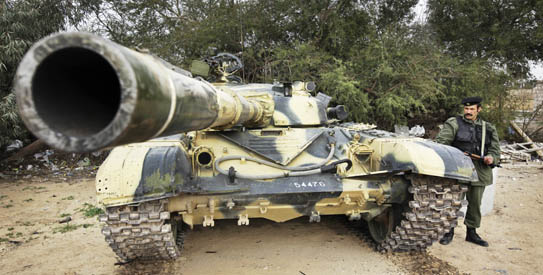
TRIPOLI: Forces loyal to Libyan leader Muammar Qadhafi were massed near the Tunisian border on Tuesday, residents said, and the United States said it was moving warships and air forces closer to Libya.
Residents feared pro-Qadhafi forces were preparing an attack to regain control of Nalut, about 60 km (38 miles) from the Tunisian border in western Libya, from protesters seeking an end to Gaddafi's rule.
The United States and other foreign governments discussed military options on Monday for dealing with Libya as Qadhafi scoffed at the threat to his government from a spreading popular uprising.
In the hardest-hitting US denunciation yet of Libya’s leader, US ambassador to the United Nations Susan Rice said Gaddafi was “disconnected from reality,” was “slaughtering his own people” and was unfit to lead.
She said Washington was in talks with its Nato partners and other allies about military options. The United States also said about $30 billion in assets in the United States had been blocked from access by Qadhafi and his family.
British Prime Minister David Cameron said his government would work to prepare for a “no-fly” zone in Libya to protect the people from attacks by Qadhafi’s forces.
Qadhafi rejected calls for him to step down and dismissed the strength of the uprising against his 41-year rule that has ended his control over eastern Libya and is closing in on the capital Tripoli.
“All my people love me. They would die to protect me,” he told the US ABC network and the BBC on Monday.
He denied using his air force to attack protesters but said planes had bombed military sites and ammunition depots. He also denied there had been demonstrations and said young people were given drugs by al Qaeda and therefore took to the streets. Libyan forces had orders not to fire back at them, he said.
LOOKING RELAXED AND LAUGHING
Qadhafi, 68, looked relaxed and laughed at times during the interview at a restaurant on Tripoli’s Mediterranean coast.
Ambassador Rice called him “delusional.”
As the uprising entered its third week, the situation on the ground was often hard for reporters to assess due to the difficulties of moving around some parts of the desert nation and the patchy communications.
A Nalut resident, Sami, told Reuters by telephone: “They have surrounded the area near the Tunisian border ... They came with heavy machineguns mounted on four-wheel drive vehicles and dozens of armed men equipped with light weaponry.
“They said they came to hunt down the thugs. But the people of Nalut are not buying this. Everybody is on alert for a possible attack by the same forces to retake the city.”
Another Nalut resident, who declined to be named, said he had heard Libyan soldiers had moved to the border with Tunisia.
“There was no fighting in Nalut. They passed it and went to the border, around the area of Wazin. People do not know what will happen here,” he said.
On Monday, witnesses in Misrata, a city of half a million people 200 km (125 miles) to the east of Tripoli, and Zawiyah, a strategic refinery town 50 km (30 miles) to the west, said government forces were mounting or preparing attacks.
“An aircraft was shot down this morning while it was firing on the local radio station. Protesters captured its crew,” a witness in Misrata, Mohamed, told Reuters by telephone.
A battle for the military air base was also under way, he said. A Libyan government source denied the report.
A resident of Zawiyah called Ibrahim told Reuters by telephone that brigades commanded by Qadhafi’s son Khamis were on the outskirts of the town and looked ready to attack.
In Tripoli, Gaddafi’s last stronghold, several people were killed and others wounded on Monday when forces loyal to him opened fire to disperse a protest in Tajoura neighborhood, Morocco’s Quryna newspaper reported. The protest gathered close to 10,000 protesters, the Libyan newspaper said.
A doctor in the neighborhood later told Reuters that protesters dispersed after seeing cars packed with armed militia.
Another Tripoli resident told Reuters by telephone there was a heavy security presence: “We are waiting for the chance to protest. We are more determined to go out and protest. We hope this will end soon but I think it will take much longer than anticipated,” he said.
NOT ENOUGH FOOD
In Tripoli, queues outside bakeries and soaring rice and flour prices fueled public anger. “There isn’t enough food,” said Basim, 25, a bank employee, adding many workers in the public sector had yet to receive salaries for February.
Crowds also massed outside state banks, which have started distributing handouts of about $400 per family in an effort by Qadhafi’s government to drum up support.
Foreign governments increased the pressure on Qadhafi to leave in the hope of ending fighting that has claimed at least 1,000 lives and restoring order to a country that accounts for 2 percent of the world’s oil production.
The UN Security Council on Saturday imposed sanctions on Qadhafi and other Libyan officials, imposed an arms embargo and froze Libyan assets. European Union governments approved their sanctions against Gaddafi in Brussels on Monday.
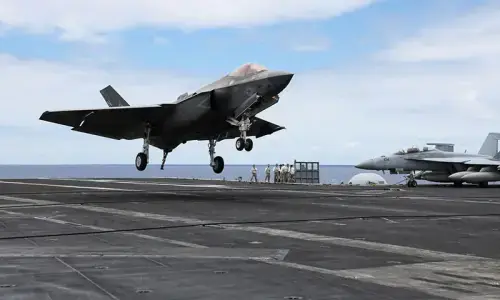
The United States, whose Sixth Fleet operates out of Italy, said it was moving US naval and air forces closer to Libya and working on various contingency plans.
But analysts said military action against Qadhafi was unlikely.
Foreign Minister Franco Frattini of Italy, formerly Libya’s closest ally in Europe, said a no-fly zone was a useful measure. Italy would consider allowing allies to use its bases but the UN Security Council must first approve the measure, he said. Revolutions in neighboring Tunisia and Egypt have helped to ignite resentment of four decades of often bloody political repression under Qadhafi as well as his failure to use Libya’s oil wealth to tackle widespread poverty and lack of opportunity.
Regional experts expect rebels eventually to take the capital and kill or capture Qadhafi but say he has the firepower to foment chaos or civil war.
Opposition forces are largely in control of Libya’s oil facilities, which are mostly located in the east.
Industry reports suggested Libya’s oil output had been halved as expatriate workers pulled out, Fatih Birol, chief economist of the International Energy Agency, said.