



 0
0

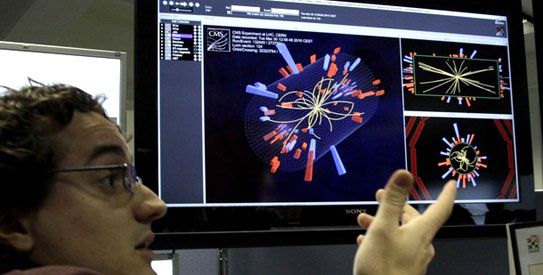
GENEVA: CERN scientists said on Monday they staged their first speed-of-light particle collisions of the year at the weekend, resuming their probes into the origins of the cosmos in the centre’s Large Hadron Collider (LHC).
“It started up well, with stable beams. We are even a little ahead of schedule after the winter break,” spokesman James Gillies told Reuters.
Oliver Buchmueller, a leading physicist on the $10 billion project, said top priority in 2011 and 2012 would be finding evidence of super-symmetry, extra dimensions, dark matter, black hole production and the elusive Higgs boson.
These concepts and ideas are at the new frontiers of science research as it pushes into the realms of what was once science fiction, giving a new impulse to cosmology and theorising on whether the known universe is alone, or one of many.
Cosmologists, like Briton Steven Hawking and US physicist and mathematician Brian Greene, are looking to the LHC to turn up at least strong signs that there was another universe before the Big Bang or that others exist in parallel to our own.
CERN – the 21-nation European Organisation for Nuclear Research near Geneva on the Swiss-French border – started what it calls “New Physics” in the giant underground LHC on March 31 last year, a project that could last into the next decade.
After 8 months of intensive operations, the LHC was halted on Dec. 6 for servicing of its complicated equipment.
In the 27 km subterranean near-circular tunnel, minute particles are smashed together creating billions of mini- explosions like the Big Bang of 13.7 billion years ago which led to the formation of the known universe and everything in it.
Information on creation period
These explosions are monitored and analysed by four research teams at CERN and by scientists around the world who are looking for new information about the primeval creation period.
With the scheduled closure later this year of the similar, but smaller, Tevatron collider at Fermilab near Chicago, CERN is the focus of global research in this area.
Initially interest in both centres centred on finding the Higgs boson, a particle whose existence was posited some 35 years ago as the agent that turned the matter created by the Big Bang into the mass that became stars and planets.
While the Higgs remains a key target in CERN, the centre’s scientists are now suggesting that by the middle of the decade -- despite a year’s shutdown of the LHC in 2013 -- more should be known on topics once left to science fiction writers.
Buchmueller is looking to see proof of super-symmetry – dubbed SUSY –which allows for the existence of unseen doubles of basic particles which could explain the existence of the dark matter believed to make up one quarter of the known universe.
But SUSY, if its existence is established, could also offer backup for the often-contested ideas of string theory which allows for at least six more dimensions than the known four -- length, breadth, depth and time.
Proponents of the theory like Greene, who has just published a book – The Hidden Reality – on the prospects it opens, argue that it allows for the existence of multiple, and perhaps ever- multiplying universes.

























