0
0

- Rebels ride toward the front line on the back of a vehicle outside Ajdabiyah in eastern Libya. -Reuters Photo
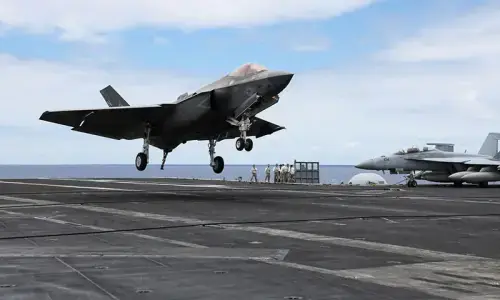
WASHINGTON: The US Defense Department is about to pull its attack planes out of the international air campaign in Libya, hoping Nato partners can take up the slack.
The announcement Thursday drew incredulous reactions from some in Congress who wondered aloud why the Obama administration would bow out of a key element of the strategy for protecting Libyan civilians and crippling Moammar Gadhafi's army.
''Odd,'' ''troubling'' and ''unnerving'' were among critical comments by senators pressing for an explanation of the announcement by Defense Secretary Robert Gates and Joint Chiefs chairman Adm. Mike Mullen that American combat missions will end Saturday.
''Your timing is exquisite,'' Sen. John McCain, a leading Republican, said sarcastically, alluding to Gadhafi's military advances this week and the planned halt to US airstrikes. ''I believe this would be a profound mistake with potentially disastrous consequences.''
Gates and Mullen, in back-to-back appearances before the House and Senate armed services committees, also forcefully argued against putting the US in the role of arming or training Libyan rebel forces, while suggesting it might be a job for Arab or other countries.
The White House has said repeatedly that it has not ruled out arming the rebels, who have retreated pell-mell this week under the pressure of a renewed eastern offensive by Gadhafi's better-armed and better-trained ground troops.
''My view would be, if there is going to be that kind of assistance to the opposition, there are plenty of sources for it other than the United States,'' Gates said.
The White House press secretary, Jay Carney, said he saw no contradiction between Gates' remarks and President Barack Obama's statement that ''he has not ruled it in or out.'' As yet, none of Obama's top advisers have publicly advocated a significant expansion of the U.S. role aiding the opposition.
Gates and Mullen were early skeptics of getting involved militarily in Libya, and Gates made clear Thursday that he still worries about the possibility of getting drawn into an open-ended and costly commitment.
Gates said no one should be surprised by the US combat air pullback, but he called the timing ''unfortunate'' in light of Gadhafi's battlefield gains.
He noted that the air attacks are a central feature of the overall military strategy; over time they could degrade Gadhafi's firepower to a point that he would be unable to put down a renewed uprising by opposition forces, he said.