0
0

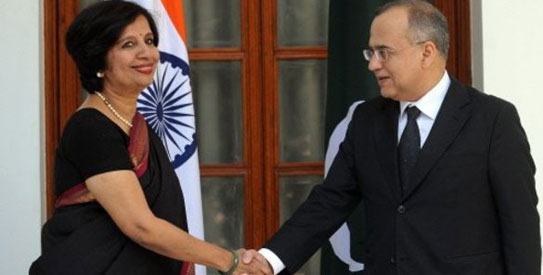
ISLAMABAD: Just two days after the prime ministers of Pakistan and India provided fresh momentum to the renewed peace process; top diplomats of both countries were at work on Friday to once again salvage the relationship following a clash of spies that saw the two holding each other’s high commission workers.
In a tit-for-tat move, Pakistani security agencies detained an Indian High Commission staffer after Indian agencies picked up a Pakistani mission employee from Chandigarh airport on the day of the semi-final at Mohali.
The detention drama, allegedly orchestrated by an Indian intelligence outfit, highlighted the fragility of the peace process and the underlying currents that could veto any initiative to overcome the acrimonious past.
The detained Indian, who has been identified as Ashok Kumar Sharma, was posted at the consular section of the high commission. Sources claimed that Sharma was an undercover intelligence agent who was here since May 2009.
While the Indians released the Pakistani worker late on Thursday night after torture, Mr Sharma, who was taken into custody while returning from work on Thursday evening, was set free on the intervention of Indian External Affairs Secretary Nirupuma Rao on Friday.
Ms Rao called up her Pakistani counterpart Salman Bashir in the afternoon to raise the issue of the missing Indian employee and called for his safe recovery.
Soon after the call, sources said, Mr Sharma was handed over to diplomats from the Indian High Commission in Islamabad.
Officially there was no word on the incident except for a late night release from Foreign Office spokesperson Tehmina Janjua’s office about the telephonic conversation between the foreign secretaries, but without any reference to what had prompted the discussion.
“The foreign secretaries of Pakistan and India had a brief telephone conversation today during which it was agreed that it was important to build on the momentum and goodwill generated by the meeting of the prime ministers of Pakistan and India at Mohali on March 30,” the statement said.
The conversation helped avert a diplomatic standoff that could have seriously damaged the positives generated by the renewal of peace talks and the meeting of the two prime ministers in Mohali.
Both countries in the past quite regularly mistreated and expelled each other’s diplomats and high commission staff in violation of the Vienna convention and the 1992 bilateral code of conduct for treatment of diplomatic and consular personnel and high commission officials. However, this practice appeared to have been discontinued after 2006.
The last reported incident was the expulsion of Deepak Kaul, visa counsellor at the Indian High Commission in Islamabad, in August 2006, which was the first time that Pakistanis had first expelled an Indian diplomat. Delhi retaliated for Kaul’s expulsion by sending back Sayed Mohammed Rafiq Ahmed, who held the rank of counsellor at the Pakistan High Commission in New Delhi.
The incident had taken place a week after the two countries had agreed on pushing forward the Composite Dialogue that had come under strain after bombing of trains in Mumbai on July 9.
Almost a year ago, a bizarre episode of India arresting its own diplomat posted in Islamabad on charges of espionage occurred.
ADVISORY: The Indian external affairs ministry had forwarded an advisory to the high commission in Islamabad after the detention of the Pakistani mission worker, asking its staff not to move out of their homes and to travel in groups.
However, this advisory was taken lightly by the Islamabad mission, considering it to be a caution against possible reaction to Pakistan losing the World Cup match to India. Little did they think that ignoring it could be nightmarish.
Mr Sharma’s detention for less than 24 hours would have been an unhappy experience for his family members who were here to spend a two-week vacation with him and were about to return.