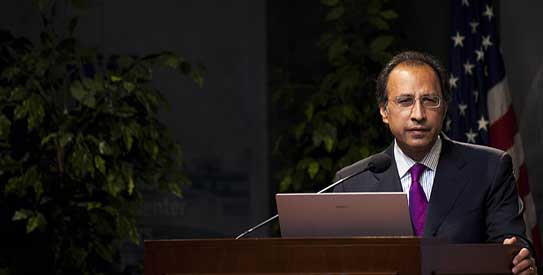
WASHINGTON: Pakistan's finance minister on Monday dismissed as “a myth” in the United States that his country is a major recipient of tens of billions of dollars in US aid.
Finance Minister Abdul Hafiz Shaikh told an audience in Washington that the United States had not delivered what it promised under the Kerry-Lugar-Berman Law aid package, which is meant to provide $7.5 billion in civilian aid over five years.
The law authorized $1.5 billion a year.
“There is a perception that there is a lot of money going to Pakistan,” Shaikh told the Woodrow Wilson Center policy think tank.
“It is largely a myth that Pakistan is a beneficiary of tens of billions of dollars. The truth is that in the Kerry-Lugar-Berman arrangement this year we have not even received $300 million,” he added.
Pakistan is dependent on foreign aid and plagued by political instability and violence. Massive floods last year, the worst natural disaster the country has ever seen, affected three million people, destroyed crops and swept away roads and bridges, causing over $10 billion in damage and wiping out about 2 percentage points of gross domestic product.
Washington has long pressed Pakistan to take on militants who have taken refuge in Pakistani border sanctuaries from where they attack Western forces in Afghanistan.
Shaikh, who attended weekend meetings of the World Bank and IMF, said Pakistan wanted trade, not aid.
“We're saying let's open our markets to each other,” he said, pointing to successful negotiations with the European Union that have expanded areas of trade.
He said the Kerry-Lugar-Berman Law was an important symbol of the US government and Congress's commitment for a new democratic government in Pakistan.
“If it is disbursed in a proper way and implemented in a proper way, then it can have far-reaching consequences for the people of Pakistan,” he said. “It would alter some misperceptions that are there.” Pakistan is a heavily indebted country, with its external debt amounting to about $58 billion and domestic debt at 6 trillion rupee ($70 billion).
The country turned to the International Monetary Fund for an $11 billion emergency loan in 2008 to avoid an economic meltdown. Shaikh said the economy had shown signs of improvement although the government was still trying to broaden its tax base to include untaxed sectors, such as agriculture. – Reuters