PESHAWAR, April 22: Literacy rate in the Federally Administered Tribal Areas (Fata) has dropped sharply from 29 per cent to 17.42 per cent because of the actions of the militants and inaction of the government, according a report prepared by the Society for the Protection of Rights of Child (Sparc).
Sparc’s regional manager Jahanzeb Khan told a press conference here on Friday that prompt steps were needed to reverse the trend and improve the education system in the tribal areas.
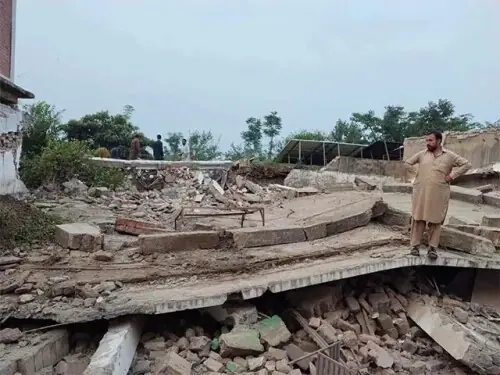
He said that the deteriorating education system in Fata due to the turbulent situation and regular destruction of schools by militants had kept the region with a literacy rate of as low as 17.42 per cent.
He said that the girl’s education in the tribal regions was just 3 per cent and called upon the government to launch emergency steps for improving facilities and quality of education.
He said that the Sparc had launched a campaign ‘global action week’ from April 19 with a theme ‘education for women and girls now’ for creating awareness of female education across the country.
While sharing the findings of Annual School Census Report 2009-10 by Fata Secretariat, Mr Khan said that the annual expenditure on education in tribal areas was Rs1.5 billion until 2001.
In 2004-05 the education budget was increased to Rs2.7 billion.He lamented that this increase is virtually meaningless as the estimates revealed that another Rs1.08 billion were needed for the provision of universal primary education alone.
The census report shows that there are 5,579 educational institutions, including 196 mosque schools and 3,640 primary schools, including 1,533 for girls.
There are 455 middle schools, including 156 for girls, and 275 high schools, 42 of them for girls. There are 13 higher secondary schools and 44 industrial homes in Fata. He said that of 1,800 community schools only 1,118 were presently functional.
The number of sanctioned teachers is 20,141, which includes 13,938 male and 6,203 female teachers. The number of students enrolled in all these institutions is 590,528 – 392,787 boys and 197,741 girls – which clearly shows gender disparity between male and female education. Sparc program manager Khalid Mehmood said that the number of non-functional primary schools in Fata was 542, including 261 for girls, and about 157 community schools, 108 of them for girls, were non-functional. Giving further details, he said that of 5,579 educational institutions in Fata, 844 boys’ schools and 629 girls’ schools had no boundary walls; 713 boys’ schools and 1751 girls’ schools lacked drinking water facility whereas 654 boys’ schools and 1,602 girls’ schools were without electricity.
Moreover, 1,070 boys and 1249 girls’ schools have no toilets. Besides these shortcomings lack of transportation for students to and from schools, teachers’ absenteeism, unaffordable tuition fee and the dreadful teaching standards are major obstacles hampering education in Fata.
Sharing statistics, he revealed that overall dropout rate from pre-school to 5th grade in primary schools over the last six years was 69 per cent, which included 63 per cent boys and 77 per cent girls. The overall dropout rate from class 6 to class10 over the last five years remained 54 per cent with boys counting for 53 per cent and girls 58 per cent.
Non-availability of separate schooling arrangements and hostel accommodation for girls is another major obstacle for promotion of education. Poverty, inconvenient locations of schools and lack of extra-curricular activities make schooling less attractive for children.
Mr Mehmood suggested that a change in attitudes in Fata, and in the country as a whole, could be ensured only through the provision of quality, free and compulsory education according to 18th amendment’s section 25-A. He said that increasing budgetary allocation and strong political will were essential to prioritising education in Fata.