



 0
0

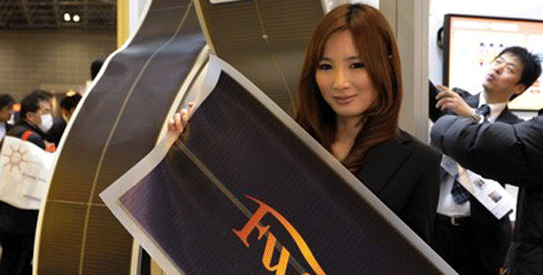
CURITIBA: Portable solar-powered lights that combine nanotechnology with local crafts could help bring electricity to some of the nearly two billion people without access to electricity.
The Portable Light Project, a non-profit initiative led by Kennedy & Violich Architecture and Global Solar Energy, in the United States, inserts tiny solar cells into shirts, woven items and bags produced by remote communities in developing countries.
The project aims to integrate clean energy and lighting with indigenous textile production. This helps local communities adopt the new technology and add value to it through their own work.
The project provides kits — containing a thin, two watt solar film, rechargeable battery, USB port, and an LED light — and training on how to weave them into garments.
Integration with the textiles allows the batteries and devices such as mobile phones to be charged on the move, as people go about their daily work, and LED lights enable communities to work and study after dark.
“You simply put it [the textile with solar cells] out in the sun for about three hours. It harvests the sunlight and turns it into electricity. Then you can use it for up to seven hours,” Sheila Kennedy, the Boston-based architect who leads the project, told SciDev.Net.
Pilot projects are underway in Brazil, Kenya, Haiti, Nicaragua, Madagascar, Mexico and South Africa, in collaboration with local non-governmental organisations (NGOs). For example, in the Sierra Madre mountains of Mexico the nomadic Huichol people charge solar lanterns during the day and use them to light their houses at night, which allows them to engage in artisanal cottage industries and later sell their products in towns.
The Nicaraguan NGO Paso Pacifico helps the project provide electricity to two villages. “Now children can study in the evening and women can carry out household work safely,” Sarah Otterstrom, Paso Pacifico’s director, told SciDev.Net.
Otterstrom said people in the village no longer need to buy diesel or batteries to light their houses. “Now they are asking for more lights,” she added.
Kennedy said they have half the carbon footprint of normal solar cells during production, and are smaller, lighter and more resilient.
Although there is still no economic model for mass production to meet global electricity needs for remote communities, the estimated price of US$16 per item can be paid off in a year via microloans, according to Kennedy.
Brazilian sociologist Paulo Martins, who studies the social impacts of nanotechnology, told SciDev.Net that integrating textiles with solar energy is a global trend. “We need to keep it available at affordable costs to the ones who really need it,” he said.
This is a good example of targeting science to local needs, he added. “[In Brazil] we invest huge amounts of money in technologies that can make our country a major player in global markets … But we constantly forget to develop science in a way that suits our true social needs.”
Frederik Krebs of the Risø National Laboratory for Sustainable Energy in Denmark, who designed a low-cost, plastic solar lamp for Africa, expressed caution. “All our studies indicate that a high degree of ruggedness is needed before it [portable solar lights] can help people in developing regions,” he said. In his opinion, such garments are “simply not wearable enough yet.”
However, Harish Hande, head of India’s SELCO Solar — a social enterprise taking sustainable power to households and businesses that tested Portable Lights garments — praised their portability, flexibility and light quality. But he said while it can help power off-grid communities it is not a complete solution in itself. -- www.scidev.net


























